On Nation Building: Alexandria, Egypt. (Mahmoud Khaled in conversation with Amro Ali)

Originally published in Ibraaz

II. On Nation Building: Alexandria, Egypt.

Mahmoud Khaled in conversation with Amro Ali




Mahmoud Khaled, A New Commission for an Old State, 2016. Installation view at Edith Russ Haus für Mediakunst, Oldenburg.
Mahmoud Khaled, A New Commission for an Old State, 2016. Installation view at Edith Russ Haus für Mediakunst, Oldenburg.


I have been familiar with Mahmoud Khaled’s artistic works for a number of years, and his creative output never fails to astound the observer. Alexandria, the city we both herald from, can often be a political tempest and urban dystopia that deepens a chronic melancholia within the public realm. This, in turn, foments nostalgia through the citizenry who long to live in a sepia-tinged so-called golden age. What romance is to Paris and ambition is to New York, nostalgia is to Alexandria. Yet perhaps because the city functions in a world of intangibles, one where the mythologized metropolis is drowned in a long glorious history that torments the human imagination; will as a result, ruthlessly press the artist, poet, writer, and thinker against established boundaries; at times breaking them.

Political theorist Fredric Jameson noted that nostalgia is an ‘alarming and pathological symptom’ of a modern world unable or unwilling to engage in any meaningful way with its own historicity.  This is where Khaled’s work comes in: he seeks to engage this symptom by confronting the Alexandrian spectre of memory. His latest work A New Commission for an Old State (2016) propels the progenitor of nostalgia, memory, into a new site-specific exhibition. A form of commemoration that embodies complex narratives in the young artist’s new body of work, through three iconic artefacts within the Egyptian context.

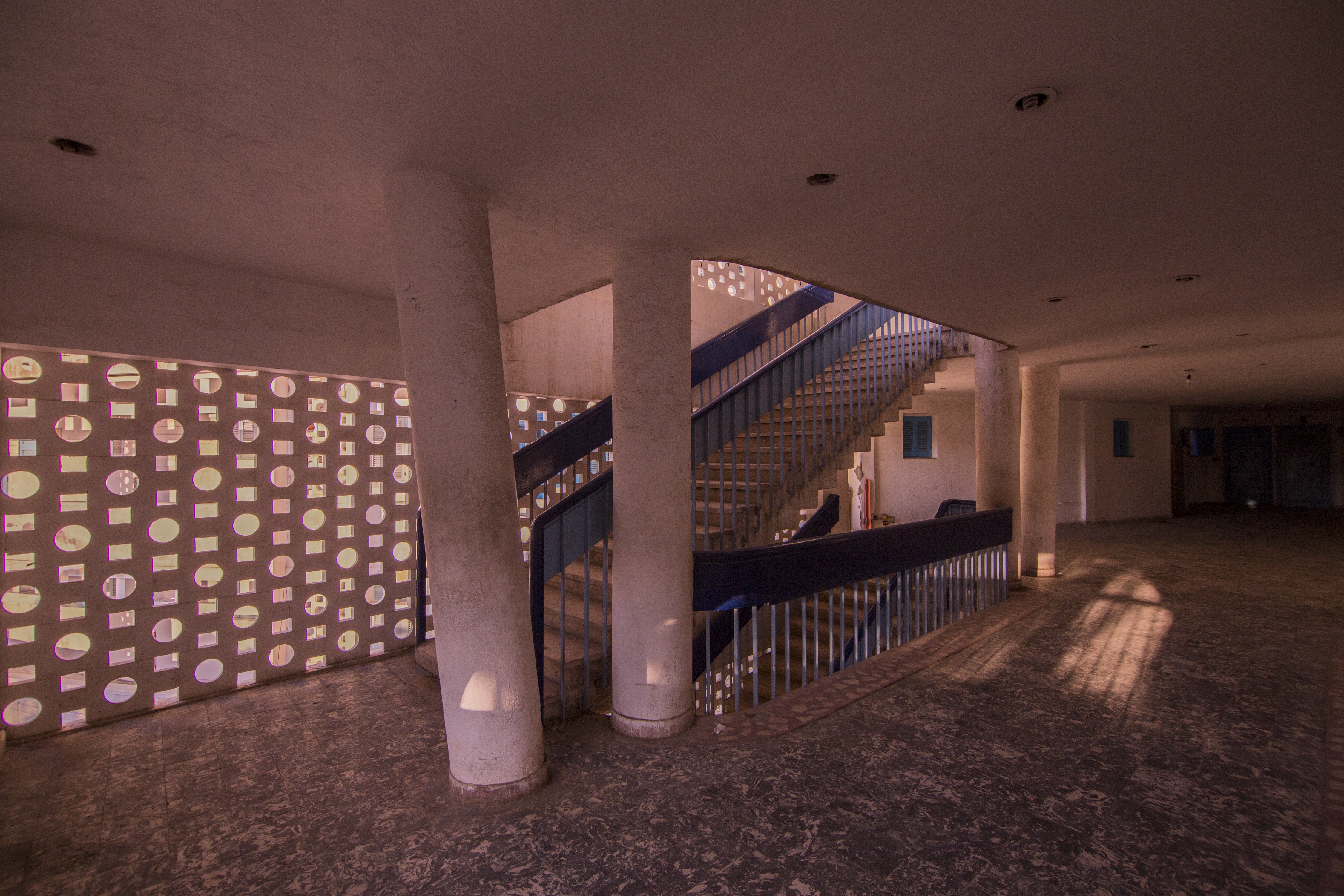
The first is a gated summer resort in Alexandria called Maamoura built by the state shortly after Gamal Abdel Nasser came to power to accommodate the new elite of the ‘rebranded’ (post-1952) Egypt. The second is a landmark text titled Maamoura’s Victims written by Judge Hassan Jalal who was a harsh critic of the Egyptian monarchy. The third artefact is a 1961 film by Youssef Chahine titled A Man in My Life, which started production in Maamoura a few months after it officially opened in 1959. The story revolves around the life of a fictitious architect who is known for his remarkable modernist style and who has built one of Maamoura’s most memorable buildings, which is used as a backdrop in the opening scene of the film.

Mahmoud Khaled, A New Commission for an Old State, 2016. Detail, C Photograph (15cm X 10cm).Mahmoud Khaled, A New Commission for an Old State, 2016. Detail, C Photograph (15cm X 10cm). Photo courtesy of the artist.

Amro Ali: Your recent solo exhibition in Germany last summer is highly fascinating and it certainly overlaps with my work in political sociology. The driving question that intrigues me is: Where does Alexandria, as an autonomous entity, fit in the artistic narrative that you have developed? My understanding of Nasser-era rebranding has more to do with how Alexandria was divorced from its Greco-Roman heritage, and pushed more towards its Arab heritage. I don’t see this as a phenomenon that happens immediately after 1952, but rather gains traction in the 1960s when, for example, Alexandria saw the rise of statues of Arab figures in the public space such as Ibn Khaldoun and Sayeed Darwish, among others. How does the rebranding in Mammoura fit in with this? When you speak of re-branding, is it a matter of the state homogenizing the entire landscape across the country, without any consideration for local factors and idiosyncrasies of a city? 

Mahmoud Khaled: I also don’t see this rebranding as happening immediately after 1952.  As you said it did take almost a decade for this process to physically and visually exist in the public sphere and Mammoura as a project is evidence of this, as it officially opened in 1959 and was promoted afterwards as one of the regime’s achievements towards the promised social democratic state and assuring the official support to the middle, working class and farmers.

We also know, this rebranding process was not only about erecting buildings with new architectural aesthetics and sculptures of significant Arab and national figures in public spaces, but included the establishment of agrarian reforms and ambitious industrialization programs that led to a period of infrastructure building and modern urbanization. There was a political need to have these social and architectural projects to form a new Egyptian identity that served the new elite of the republican era. Theses projects included housing complexes, theatres, cultural palaces, parks and summer resorts. Architecturally, aesthetically and functionally, then,  all these projects were designed in sharp contrast to the lavish lifestyle of the former royal aristocracy which added a strong political connotation to the style of these buildings and projects, and more generally to the introduction of ‘Modernism’ in Egyptian architecture. At least that’s how I understand it.

Maamoura is located strategically next to the former royal Montaza palace and gardens, which I read as an intentional political statement to show that the new state can also design and build a protected gated space for its won elite. This beach resort is considered to be the prototype for modern bourgeois summer destinations and is one of the first gated community projects in Egypt, functioning as a city within the city with its architecturally unique residential villas, houses, and cabins mostly owned by generals, businessmen, and celebrities that came to form the new upper class. At the same time, more modest buildings were targeted towards the middle-class with public sector companies having access to properties that they rented out to their staff for affordable prices.

Mammoura Beach, Alexandria, 1995. Black and white promotional video of Al Mammoura resort project, found on YouTube.

AA: The problem of political branding is that it tends to destroy pluralism, as the state imposes a narrative from above, rather than allowing an organic story to develop through civil society. How does your understanding of branding, in an architectural sense, equate with oppression and the destruction of civic meaning?

MK: Personally, I don’t see any contribution from the civil society in this whole process at all; everything was done by the state to the people, and mainly most of the projects were executed by the army itself which is something happening until now and my generation can definitely relate to it.

Mahmoud Khaled, A New Commission for an Old State, 2016. Installation view at Edith Russ Haus für Mediakunst, Oldenburg.Mahmoud Khaled, A New Commission for an Old State, 2016. Installation view at Edith Russ Haus für Mediakunst, Oldenburg. Photo courtesy of the artist.

AA: You touch upon an important aspect regarding Youssef Chahine’s films. From my readings, the struggle between Alexandria and the state extended to films: for example,  Nasser-era cinema tended to reflect narratives that domesticated Alexandria. This in turn subverted the city into the national narrative. Chahine’s films were not an exception, although it as only with his 1978 film Alexandria, Why? that he was able to challenge this trend, by breaking with the conventional narrative and realigning it with an emerging novel tradition that represented Alexandria as a place of “utopian desire.” The renowned director started to see a relative change in the political culture of 1970s Egypt – if not the Arab world – that enabled his cinema to “recognize and redress marginalized social elements within Arab national identity…[by revisiting and engaging] the cultural and historical elements of distinct groups he thought integral to the appreciation of a collective Arab identity.”[3]

In light of this, how much innovation and independence was Chahine allowed in the making of the 1961 film A Man in my Life? Was the film geared towards supporting Nasser’s project? Or did Chahine situate the idea of justice in a national (or perhaps nationalist) narrative at the expense of local civic factors?

MK: I think in this film Chahine tried to abstract the ideologies and the principles behind the “free soldiers” movement by staging a melodramatic love story that contains a lot of guilt, pain, and heroism to highlight the struggle for social justice amongst the working class (here, a group of fishermen in Alexandria) in the year of 1938, when the country was still a royal monarchy. It is very obvious to me how he was very influenced by these ideas, principles, and hopes for the establishment of a modern and socially equal state, like many other artists and intellectuals in Egypt at the time. For example, I still remember many of my painting professors in Alexandria who are associated with or known as the sixties generation of artists, were preoccupied with producing art that was heavily engaged with the ideas of social justice, class struggle and full independence from colonialism.  I honestly don’t think these artists, including Chahine, were doing this work to compliment the political power, or as a sort of a contribution to the propaganda of the new regime. Rather,  I think they – or let’s say most of them – believed in these ideas and wanted to dedicate their production to contribute to the cause.  

This is, in fact, the most interesting point for me: how can we now look back at the art production of this period, especially given the radical shifts since 2011, to how we understand the regime today? How does viewing the situation as a continuation of the 1952 state, reshape our relationship with our home country?

In terms of innovation, I am not sure to what extent the film was an original, given it was an adaptation of the 1954 American film  Magnificent Obsession by Douglas Sirk,  But I am personally not so crazy about this idea of originality; I find it clever how Chahine kept the structure of the story from Sirk’s film but  adapted the sociopolitical content  in order to respond and engage with the political and ideological moment in Egypt at the time.

Video collage by Mahmoud Khaled of two films, both of which were important source material for him during the formulation of this comission: A Man in My Life, dir. Youssef Chahine, 1962, Egypt, and Magnificent Obsessions, dir. Douglas Sirk, 1954, USA.

AA: Fascinatingly, this recent body of work metaphorically touches upon building materials such as glass and marble, which you argue have been widely utilized in state-sanctioned architectural projects in Egypt over the past thirty years. Here, I specifically want to point to the piece A Rare Glimpse into the Recent Moments When People Lived in a World Turned Upside Down (2016) in which you used eight computer-generated images of carrara marble printed on wallpaper and sixteen double glass panels, accompanied by images and texts that occupied almost half of the space of the exhibition.

Is there a particular state logic behind utilizing building materials such as glass and marble? Does this have any relationship to Mubarak’s political projects and neoliberal policies?

MK: Yes it does. I wanted to do something physical, imaginative and semi-fictional, using material that would speak directly to the content of the installation.  I decided to use the format of the memorial as a site from which to stage the content of the project; of course here, marble makes perfect sense, as a permanent noble and monumental material that has been used excessively in most of the governmental projects in Egypt during the past thirty or so years, which is of course, the era of Mubarak.

When I looked back at the use of the material and its existence in state-owned or run buildings, I started to see the sharp contrast between marble and the kind of modest, humble and relatively cheap building materials that was used in the late 50s and 60s by the regime. For me, this shows how the state wanted to manifest itself and assert it’s power architecturally and in public spaces, whilst pointing to the shift in aesthetics and values from the 60s to the 90s, and so I was keen for the installation to reflect this.


AA: The ‘Maamoura’s Victims’ text by Judge Hassan Jalal, published in Al Hilal Magazine in February 1955 just few years after the ’52 state’ started, presented a report on the atrocities, horrendous conditions and systematic tortures in a prisoner camp on the King’s properties, which later became the land on which Maamoura was built. It is an insightful artifact from a very romanticized period in the Egyptian and Alexandrian popular imagination. Would you say that your work in this regard is a strong statement against nostalgia?

MK: William E. Jones, who is one of my favorite artists said recently in an interview that ‘Nostalgia is a sympathetic feelin’[4] – and I completely agree with him.

Unfortunately, Alexandria has been always romanticized in the popular imagination. I can even sense this when I talk about the city with my friends and colleagues from Cairo. It’s something I used to be very sensitive about it.  Nostalgia became the scary ghost that I tried to kill while I was developing and working on the exhibition, and I hope I did that  –  though I don’t know.  I think the problem for us Alexandrians is that we have been over saturated with nostalgic narratives and representations of the city in books, films, and photographs (and now even on social media) but it’s still the city we live and work in. And so, it is hard to ignore the overarching sentimentality. 

That is why I tried for a long time to avoid working on anything related to Alexandria and its history – near or far – because you can never escape the language and aesthetics of nostalgia when talking about the city in the field of artistic and cultural production. This idea shifted for me in 2011, when I saw everything in the city becoming highly politicized and very active, instead of being forever decaying and romantic; it was then that I realized that I can talk abut the city in a way I was unable to before, mainly because of my own self-censorship towards this fear of being nostalgic. 

Jalal’s text was also a huge discovery for me –  it made everything feel similar and yet different all at once, and that’s why I wanted to use it in full length in the installation.  First of all, it gives us a glimpse of Maamoura when it was just an empty, neglected wasteland, and how even during this time (late 1940s/early 1950s) it was a stage for human rights violations, torture and the exertion of power by the state. Secondly, the fact that it was written by a judge, whose profession is to protect the values of social justice and dignity in society, he is also fully supporting the 1952 state (which I believe we are still living an extension and the continuation of this era).

I also think my fascination with the text has a lot to do with the fact that I was born around a bunch of structures, monuments, and buildings which are gradually vanishing from the cityscape, yet I still don’t know much about the socio-political history of Maamoura or how things were before these structures were built.  At the same time access to information as an artist or a researcher is restricted by state authorities; you will find a lot of intentional obstacles in your way, so as not to ask or uncover anything that may conflict with the state-sanctioned narrative.  Here, the act of knowing becomes a highly politicized endeavour and pushes this persistent nostalgia out of the frame.

AA:  The use of the Maamoura’s Victims as a textual document/ testimony is described in the exhibition text as an element that is highlighting and activating the “haunting similarities” between the methods of the monarchy and republic, which you argue, puts the document in a completely different light, making it even more relevant when read in the present.  Based on this reading, I would like to ask: could not the observer of your work suggest that in attempting to condemn the monarchical period as being just as bad as the republican era, you have indirectly vindicated the latter? Historians would probably not disagree with your account, but they could argue that oppression and torture increased exponentially and systematically under the Nasser regime, making the King Farouk era pale in comparison.

MK: Well, I don’t think the work is trying to vindicate or blame one era or another as both eras are very difficult to understand or judge in their entirety.  I also hope the artwork works to complicate and problematize moments in our history, instead of just giving a statement about who was more oppressive than the other, because things are far more complicated than this.  This is especially the case for artists; perhaps it is easier for researchers, academics, and historians because they have a clearer methodology for how to draw their conclusions. Yet for most of us – and by us, here I mean the artists whom I am close to and am in dialogue with – we are all producing and speaking from a position in a world that does not make any sense at all, and art seems for some of us, still the only possible long-term attempt to deal with this mess that we are collectively sharing.

The work is imagining a memorial, a space for remembrance, which as an act includes thinking and reflecting with a strong sense of monumentality and spectacle. Memorials are traditionally built after long civil and grassroots discussions, and to remember key social and political events.  Yet my generation only inherited memorials; we never experienced or witnessed the building of those we inherited, and so the aim of my work is to both consider and commiserate the absences in constructing our own history, emotionally and meaningfully.

Mahmoud Khaled (b. 1982, Alexandria, Egypt), lives and works between Egypt and Norway.   He studied fine art at Alexandria University in Egypt and in Norwegian University of Science and Technology, Norway. His work traces the boundaries between what is real and what is hidden, disguised or staged. His artistic practice is both process oriented and multidisciplinary. Mixing photography, video and wall painting with sculptural forms, sound, and text, his works can be regarded as formal and philosophical ruminations on art as a form of political activism, as an object of desire and as a space for critical reflection. His artistic vocabulary is composed of appropriated forms that have been displaced from their original context thereby proposing alternative meanings.  

Khaled’s work has been presented in solo and group exhibitions in different art spaces and centers in Europe and the Middle East, including Whitechapel, London (UK); Edith-Ruth-Haus, Oldenburg, Germany; BALTIC Center for Contemporary Art, Gateshead, UK; Galpão- Videobrasil, São Paulo, (Brazil); Gypsum Gallery, Cairo, (Egypt); Centre Pompidou, Malaga, Spain; Stedelijk Museum Bureau Amsterdam (SMBA), (Netherlands); Bonner Kunstverein, (Germany); UKS, Oslo, (Norway); Salzburger Kunstverein, (Austria); Contemporary Image Collective/CiC, Cairo, (Egypt); Sultan Gallery, (Kuwait). His projects have been featured in several international biennales such as LIAF Biennale, Lofoten, (Norway). BManifesta 8: European Biennale for Contemporary Art; Biacs 3, Seville Biennale, and 1st Canary Islands Biennale, Spain. In 2012 Khaled was awarded the Videobrasil In Context prize and he was shortlisted for the 2016 Abraaj Art Prize.


[1] Alexander Reid Ross, ‘A New Chapter in the Fascist Internationale’ in CounterPunch, 15 September 2015: http://www.counterpunch.org/2015/09/16/a-new-chapter-in-the-fascist-internationale/

[2] ‘Hegel remarks somewhere that all great world-historic facts and personages appear, so to speak, twice. He forgot to add: the first time as tragedy, the second time as farce.’ The eighteenth Brumaire of Louis Bonaparte, Karl Marx 1852. 

[3] Malek Khouri, The Arab National Project in Youssef Chahine’s Cinema (Cairo: American University in Cairo Press, 2010). 117.

[4] Quoted in Mousse Magazine. Issue 56. December 2016–January 2017


Alexandria’s church bombing and the deepening of melancholia

An extended piece of my former blog post for Mada Masr on the ways in which pain, anger and grief are being internalized vis-à-vis the state and the city after the tragic church bombing in Alexandria.

Image by Sara Younes


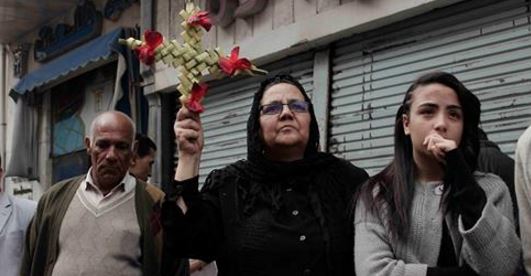
It was not supposed to be like this. The week leading up to the annual Sham el-Nassim holiday is usually filled with joy and elation as we welcome the spring. And it certainly was not supposed to be like this for Christians on their holy Palm Sunday. Twenty-eight victims lost to the bombing at St. George Coptic Orthodox Church in Tanta, and 17 lost to the bombing at St. Mark Coptic Orthodox Church in Alexandria.

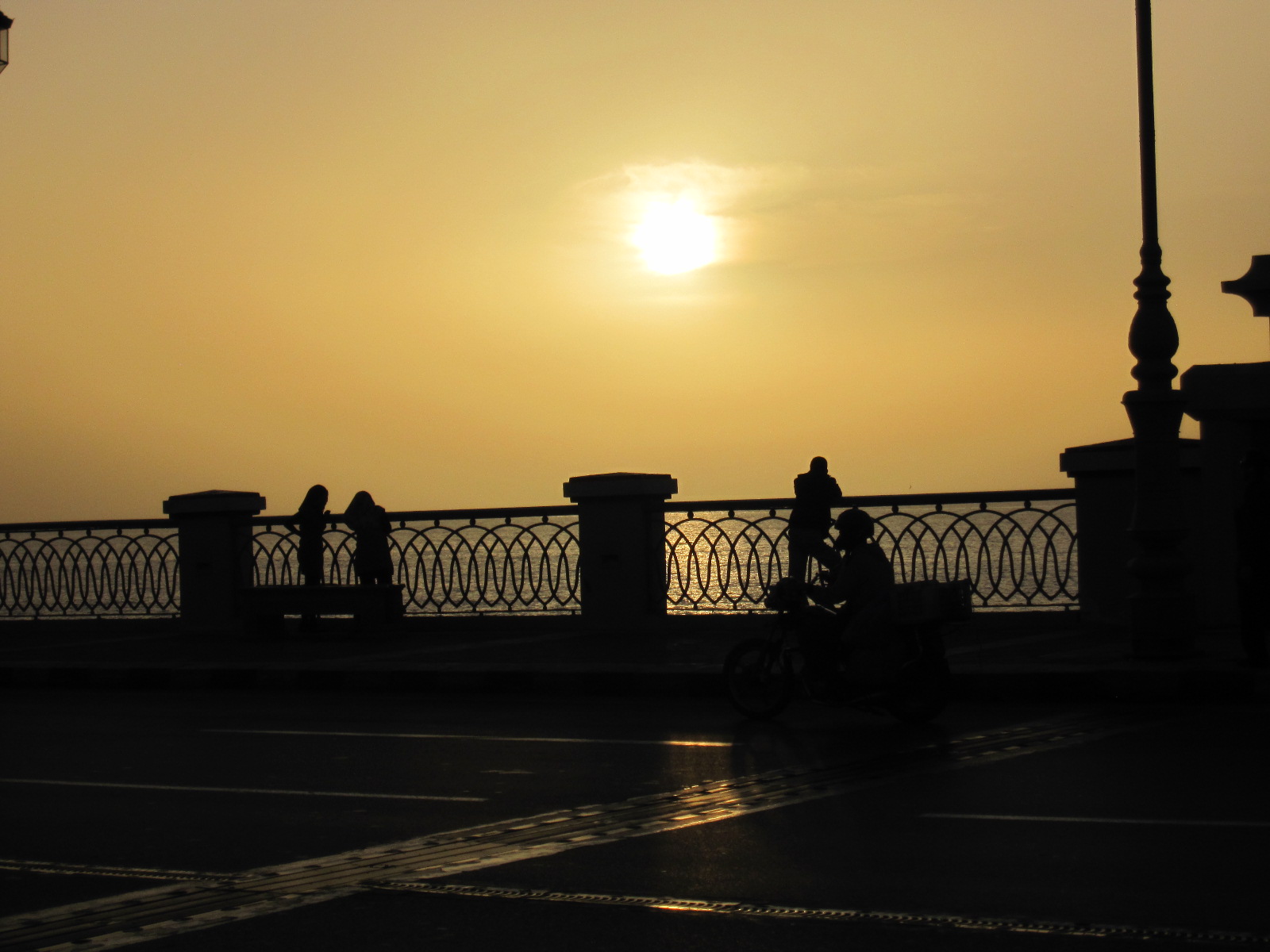
Dark clouds had spread on Sunday morning, and I had remarked to a friend that this was quite unusually gloomy for April weather in Alexandria. It turned out to be fitting for the events that were to come in a few hours. Alexandria, historically, seems to understand itself as a city when it is confronted with tragedy.

In the wake of the bombing, the downtown streets were on lockdown and traffic appeared frozen in time. This was not the average traffic standstill, as rarely was a car horn sounded. It was as if everyone had sensed, or was in the process of being informed through their mobile phones, what had just happened. Now, the trademark noise-sutured impatience of traffic dissipated as drivers perhaps realized that arriving late to your destination may not be the worst that can happen in your day. The scene along the Mansheya corniche could have been ripped out of a Hollywood blockbuster in which immobilized commuters had transfixed their gaze at some impending meteorite about to strike their city. A bombing in Tanta, a bombing in Alexandria, a reported (but later dismissed) second bombing in Alexandria. Where next?

The subtext was the reemergence of the eve of 2011, when a devastating terrorist explosion targeted the Two Saints Church in the eastern district of Sidi Bishr, leaving 25 dead and over 200 injured. This was supposed to be the last tragedy of its kind, giving birth to a new civic spirit to counter the infamy and set the tone for the 2011 revolution a few weeks later. In a stage by stage process, it went roughly something like this: shock; melancholia; outrage; refusal of the status quo (which was illustrated, for example, through the adoption of the cross and crescent logo as a social media avatar or draped over one’s balcony); joining up with the growing street vigils; publicly denouncing the Mubarak regime as many mourners shouted at the funeral of the victims, “We want to fire the president and interior minister!;” as well as, significantly, the re-appropriation of the idea of Alexandria from the state by the public.

A new civic-driven discourse placed the city at the heart of political problems. This can be understood when, following the brutal security crackdown after the Sidi Bishr tragedy, the Muslim Brotherhood’s Sobhy Saleh cried, “It’s like we’ve been occupied by a foreign power. Alexandria has become an occupied country.” Or at times the tone was subtler, as AUC’s linguistic professor Reem Bassiouney pointed out in her recent work of an Alexandrian journalist who broke linguistic conventions and used the Alexandrian dialect in her reports, to imply “a shared identity that surpasses religious differences.” Therefore, a robust civic identity based on the popular trope agda nas (Bravest people) that the reporter is “authentic, tough, and, first and, foremost, a typical ‘Alexandrian’.” In other words, if the Egyptian identity could no longer furnish inter-religious cohesion and agency, the Alexandrian identity would have to step in.

But the mood was different this time. People’s reactions and emotions seem to be trapped in the intermission between shock and melancholia. In the days leading to the Palm Sunday tragedy, the biggest complaint dominating Alexandria’s conversations was the military’s economic project in Sidi Gaber, which has severely disrupted traffic flow. (This project has been perceived as negative enough to even sway pro-military supporters I know from their traditional positions.)

Yet there was an exposed fracture that could not be easily hidden. To the average resident, the military appears focused on its exclusive economic ventures, often to the detriment of the economy and the public good, while the police have developed a rapid method of cracking down on political protests and imprisoning countless activists, or in the case of bread-driven protests, swiftly negotiating them away. All the while, 17 dead bodies were strewn at the gates of a church of historical magnitude. These are questions the authorities will need to deal with — when they promise security in return for the citizen’s forfeiting of progressive governance, but are now unable to deliver that security.

However, the high talk on regimes, Sisi, the Islamic State, terrorism and geo-strategy, can be lost on the day-to-day life of an individual who struggles to survive and make meaning of forces beyond his or her control. The day following the bombing, life attempted to go on as normal but with a broken spirit and tinge of despair under the, still, grey skies. The men at the coffeehouse in front of my place smoked shisha without conversation, at times looking down to the ground; customers calmly bought their ful and falafel breakfast without the usual jostling; the fruit sellers did not yell to market their produce, and the signature smiles across the bakers’ faces were all but gone. No visible public argument or fight broke out on the streets in a very long time. There was a shared language of mourning that consisted of frequent silences, occasionally punctured by the innocence of cheerful children running around. Yet, melancholia deepened its claws to stunt the growth of any budding civic flower.

Even in these dark times you need to seek out a spirited hope and consolation. In the context of this discussion, it’s never far. I’m blessed to live between a Coptic Orthodox Church and a Catholic Church, both stand strong and resilient, and as a powerful reminder that this is, and will always be, one of the things that is beautiful about Alexandria and Egypt. The sound of church bells is a message to the forces of fanaticism and sectarianism (and even to the smug individual who deems Christians as second-class citizens) that churches, as well as the Christian life and evocative prayer chants within its heart, will not be silenced.

As a Muslim, these churches are my churches, they complete my identity, colorize my worldview, and deepen any understanding of my faith. Any harm that comes to them, its worshippers, and those who protect them, is a savage assault on my very being.

I wish I had clear answers to give. I don’t, and I hate to admit a sense of helplessness in all of this. I can only, along with others, ask questions, and keep asking questions, in the hope that the sinister matrix that oppresses and exterminates human lives in different manifestations — in Alexandra, in Egypt, in the Middle East and elsewhere — is eventually and somehow unravelled.

Alexandria’s Church Bombing and the Mourning After

Following yesterday’s horrific bombing in Alexandria, life is attempting to go on
as normal in the coastal city but with a (more than usual) broken spirit and tinge of despair. The men at the coffeehouse in front of my place are smoking their shesha without conversation, at times looking at the ground; customers are calmly buying their ful and falafel breakfast without the usual jostling; the fruit sellers are not yelling to market their produce; the signature smiles across the bakers’ faces have been temporarily erased. No visible public argument or fight (so far) has taken place on the street in a very long time. Melancholia is deepening its claws.

However, a spirited hope and gratification is never far. I’m blessed to live between a Coptic Orthodox Church and a Catholic Church, both stand strong and resilient, and as a powerful reminder that this is, and what will always be, beautiful about Egypt. The sound of church bells is a message to the forces of fanaticism and sectarianism (and even to the smug non-Christian who deems Christians as second-class citizens) that churches, as well as the human Christian life and evocative prayer chants within its heart, will not be silenced.

As a Muslim, these churches are my churches, they complete my identity, worldview, and an understanding of my faith. Any harm that comes to them, its worshippers, and those who protect them, is a savage assault on my very being.

I wish I had clear answers to give. I don’t, and I feel terribly helpless. I can only, along with others, ask questions, and keep asking questions, in the hope that the sinister matrix that oppresses human lives in different manifestations – in Alexandra, in Egypt, in the Middle East – is eventually and somehow unravelled.

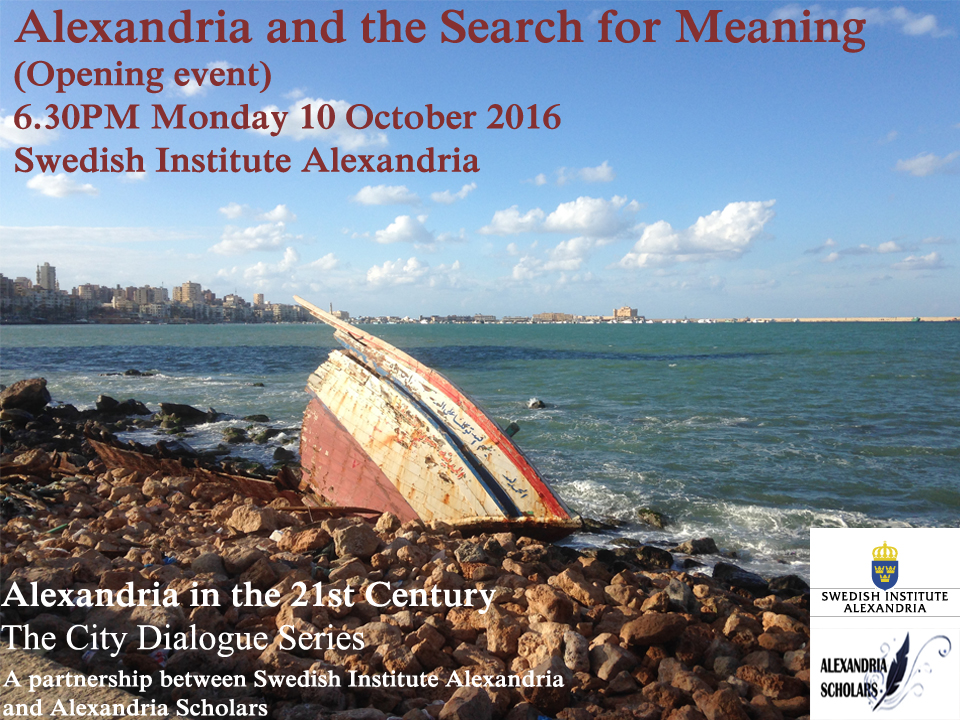
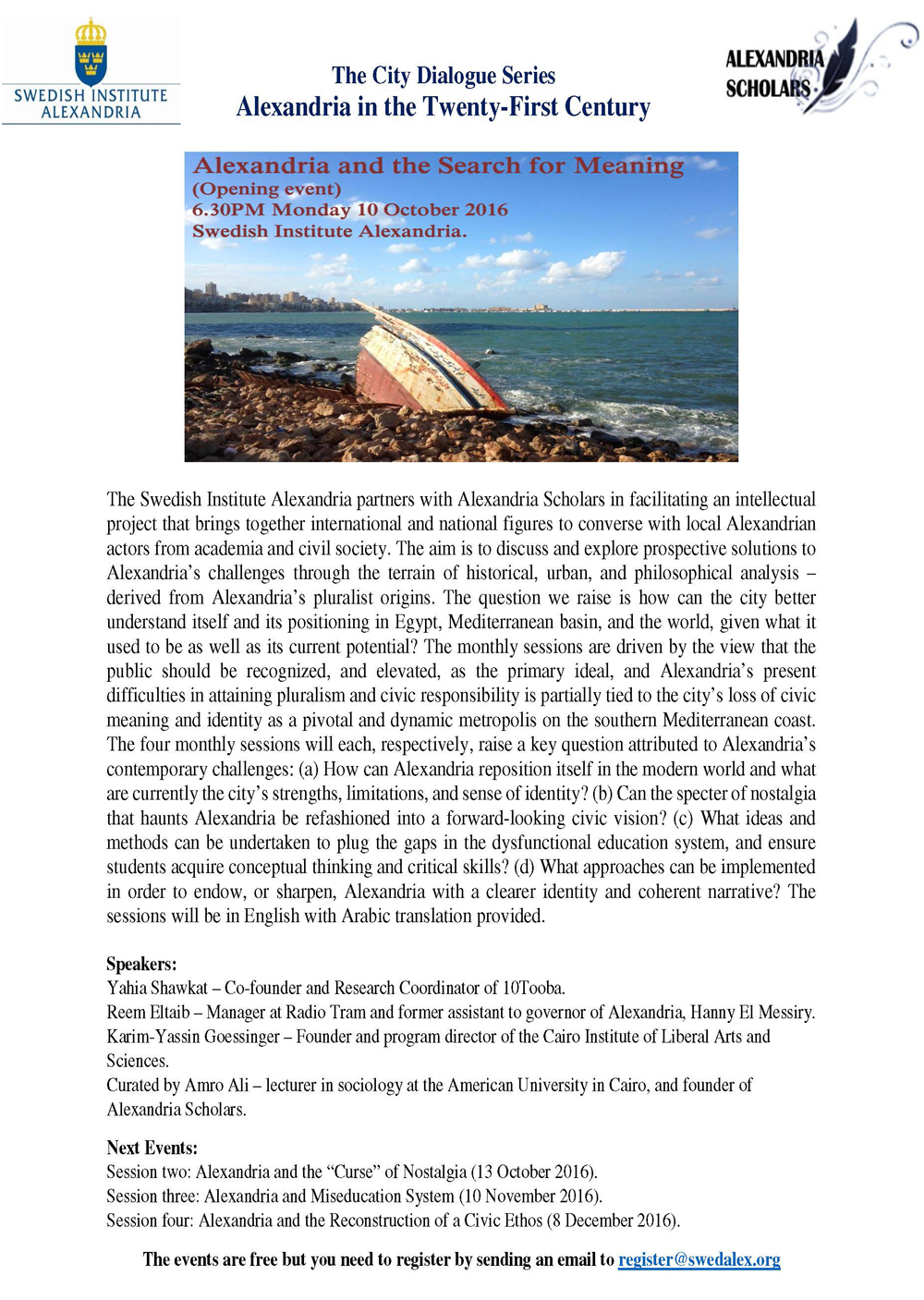
Alexandria and the Search for Meaning (The City Dialogue Series)

coverimagealexin21stc

(Click here for flyer link)
The Swedish Institute Alexandria partners with Alexandria Scholars in facilitating an intellectual project that brings together international and national figures to converse with local Alexandrian actors from academia and civil society.

The aim is to discuss and explore prospective solutions to Alexandria’s challenges through the terrain of historical, urban, and philosophical analysis – derived from Alexandria`s pluralist origins. The question we raise is how can the city better understand itself and its positioning in Egypt, Mediterranean basin, and the world given what it used to be as well as its current potential?

The monthly sessions are driven by the view that the public should be recognized, and elevated, as the primary ideal, and Alexandria’s present difficulties in attaining pluralism and civic responsibility is partially tied to the city’s loss of civic meaning and identity as a pivotal and dynamic metropolis on the southern Mediterranean coast.

The first of these monthly sessions will be held at SwedAlex premises on Monday 10h of October at 6:30 pm. It will raise a key question attributed to Alexandria`s contemporary challenges: How can Alexandria reposition itself in the modern world and what are currently the city’s strengths, limitations, and sense of identity?

The four monthly sessions will each, respectively, raise a key question attributed to Alexandria’s contemporary challenges: (a) How can Alexandria reposition itself in the modern world and what are currently the city’s strengths, limitations, and sense of identity? (b) Can the specter of nostalgia that haunts Alexandria be refashioned into a forward-looking civic vision? (c) What ideas and methods can be undertaken to plug the gaps in the dysfunctional education system, and ensure students acquire conceptual thinking and critical skills? (d) What approaches can be implemented in order to endow, or sharpen, Alexandria with a clearer identity and coherent narrative? The sessions will be in English with Arabic translation provided.
Speakers:

Speakers:
Yahia Shawkat – Co-founder & Research Coordinator of 10Tooba).

Reem Eltaib – Manager at Radio Tram and former assistant to governor of Alexandria, Hany el Messiry.

Karim-Yassin Goessinger – Founder and program director of the Cairo Institute of Liberal Arts and Sciences.

Curated by Amro Ali (lecturer in sociology at the American University in Cairo, and founder of Alexandria Scholars).

Please register your attendance by sending an email to

* This lecture is in English language.

* Limited seats available. Priority for early registration.

Facebook event: https://www.facebook.com/events/955615517882221/

Next Events:
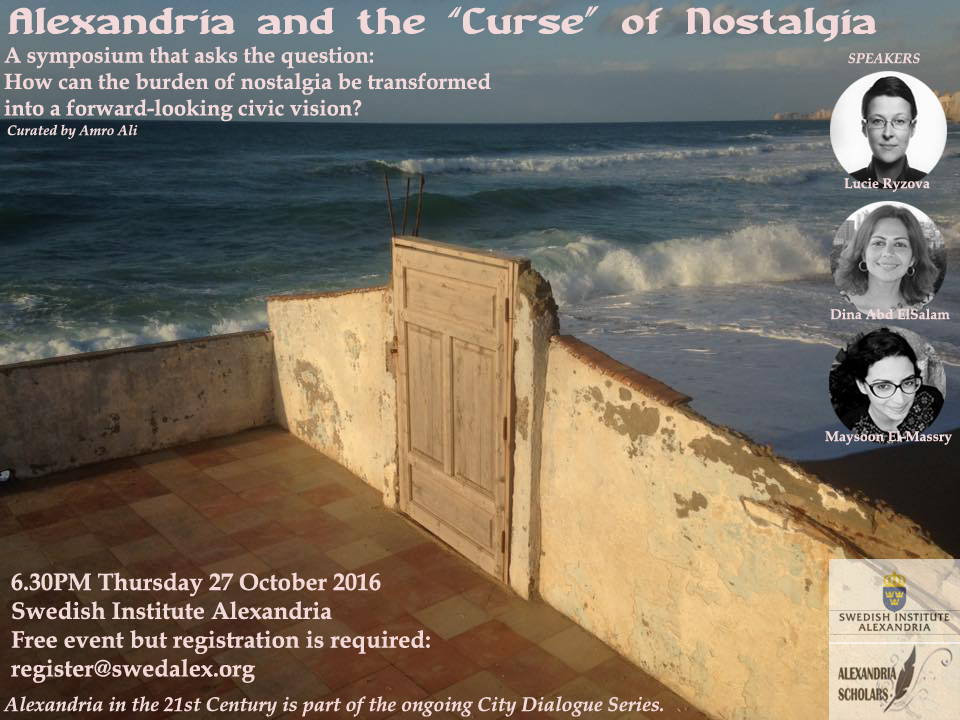
Session two: Alexandria and the “Curse” of Nostalgia (13 October 2016).
Session three: Alexandria and Miseducation System (10 November 2016).
Session four: Alexandria and the Reconstruction of a Civic Ethos (8 December 2016).

Giulio Regeni e gli italiani in Egitto che denunciano il regime (Italian translation)

Published in Italy’s Internazionale magazine. Originally published in Mada Masr (in English).


Tra il deserto immobile che “incessantemente si consuma” e il mare perpetuo che “manifesta furiosamente il rinnovamento” si è formata la “mia prima visione della realtà”.

Sono le parole di Giuseppe Ungaretti, poeta italiano nato ad Alessandria. Le scrisse nell’Egitto degli anni trenta. Oggi nel paese è presente una comunità transnazionale sempre più numerosa, emersa all’ombra delle rivolte arabe, soprattutto dopo la rivoluzione egiziana. Questa comunità si colloca tra un’Europa vuota di ideologie e in preda all’austerità e un Medio Oriente politicamente spietato e radicale. Ma chi sono, e qual è la loro “visione della realtà”?

Gli italiani transitati in Egitto negli ultimi anni illustrano bene le caratteristiche di questa comunità che con le sue idee supera le nazionalità e i rapporti geopolitici.

L’orribile morte di Giulio Regeni, il dottorando italiano torturato e assassinato mentre si trovava in Egitto per fare ricerca sul sindacato, ci impone di osservare più da vicino i saperi prodotti da queste persone sullo sfondo di rapporti storici, politici e sociali spesso tesi da un capo all’altro del Mediterraneo.

“La ribellione era necessaria nell’Europa delle politiche di austerità, e l’atto di ribellione stava accadendo in Egitto. L’Egitto ci stava ispirando a sfidare la nostra realtà”, mi ha detto Lucia Sorbera, una storica e femminista italiana di Pisa che per molti anni ha fatto ricerca in Egitto.

Prima delle rivolte arabe nel 2011, l’interesse degli attivisti italiani in Medio Oriente si è concentrato soprattutto sulla lotta palestinese. Dopo le rivolte però, dopo che piazza Tahrir ha esportato una forma di protesta spettacolare, tanti intellettuali italiani hanno cominciato a preoccuparsi dei paesi a sud del Mediterraneo, soprattutto l’Egitto. Nel giro di poco tempo i nomi di rivoluzionari egiziani come Alaa Abd El Fattah e Mina Daniel hanno cominciato a circolare nelle università italiane e tra le comunità di attivisti.

Click here to keep on reading

Giulio and the Italians of Egypt

Published in Mada Masr
Italian translation in Internazionale 

Between the static desert that “ceaselessly wears away” and the
perpetual sea that “furiously manifests renewal” is constituted
“my first vision of reality.”GiulioRegeni

These are the words of Alexandrian-born Italian poet Giuseppe Ungaretti. He wrote them in the Egypt of the 1930s. Today, a growing transnational community of thinkers has emerged in the shadow of the Arab uprisings, particularly the Egyptian revolution. This community exists between an ideologically devoid and austere Europe, and a politically merciless and radical Middle East. But who are they, and what is their “vision of reality”?

The Italians who traversed Egypt in recent years stand out, and are illustrative of this transnational community that exists today and whose ideas trump nationality and geopolitical relations.

The horrific death of Giulio Regeni, the Italian PhD student who was tortured and murdered while in Egypt doing academic research on trade unions, has perhaps mandated us to take a closer look at this intellectual community that produces knowledge against the backdrop of often tense historical, political and social relations across the Mediterranean.

“Rebellion was much needed in the Europe of austerity policies, and it [the act of rebellion] was happening in Egypt. Egypt was inspiring us to challenge [our reality],” Lucia Sorbera, an Italian feminist historian from Pisa who has researched Egypt for many years, told me.

Prior to the Arab uprisings in 2011, Italian activists’ interest in the Middle East was primarily focused on the Palestinian struggle. But after the uprisings, after Tahrir Square exported an invigorating theatrical protest that made many on the Italian peninsula turn their faces to the south, many Italian intellectuals became preoccupied with south Mediterranean countries, especially Egypt. Soon enough, the names of Egyptian revolutionaries, such as Alaa Abd El Fattah and Mina Daniel, were becoming known throughout Italian university campuses and activist communities.

This was quite a change from a year earlier. In 2010, the Egyptian state made a strange appearance in Italian affairs after former Prime Minister Silvio Berlusconi secured the release of his underage Moroccan mistress, “Ruby the Heart-stealer” (Karima al-Mahroug), by telling police she was then-President Hosni Mubarak’s niece.

After Regeni disappeared for seven days, only to be found tortured to death, the pro-state media struggled to justify the murder. There were half-hearted accusations of espionage, but they did not sell well — relatively harsher statements only came in response to the European Parliament resolutioncondemning Egypt. This might have been due to the fact that Regeni was Italian, and there was no handy history of interventionism that the state and its cronies could bank on to promote an espionage charge or propagandize their usual conspiracy theories. It is safe to say if Regeni were American or British, it would have been far easier to dig up that country’s history of interventionism in Egypt as implicit justification for his death. But for Italy, there was no strong case in this regard.

In terms of public perceptions, Italy does not invoke any immediate threat in the public imaginary. Pro-Italian sentiments are not uncommon — from elite writers who praise historic relations with Rome that date back to classic antiquity, to the street vendor who tries to sell you a dubious “da Itali!” (It’s Italian!) leather belt, to my plumber who markets me a clearly marked “Made in China” water pump as being originally from Italy. Italy is more often than not perceived as a trademark of class, elegance and relatable credibility. To many Egyptians, for one reason or another, Italians are familiar Europeans.

Italians fit well into Egypt’s current crippling nostalgia of our bygone neighbors — a cosmopolitan narrative of a “once-had-and-lost-modernity,” as social historian of modern Egypt Lucie Ryzova puts it. It is a narrative that the current pro-government elites use when they say that the president “will make Egypt great again.” It is also a narrative that is equally promoted by the nostalgic public (especially manifested in social media through sharing of black-and-white images of a “cosmopolitan” Egyptian imaginary) as condemnation of the regime for having failed to care for heritage and culture.

The narrative is reinforced daily by the faded grandeur of buildings that remind you of their Italian architects. Or the conversations of older-generation Egyptians from an urban center who would have at least warmly recollected one Italian friend growing up, before they disappeared in the trenches of Nasser’s nationalization policies. In short, there is a lurking pro-Italian sentiment that is invoked by their presence in a past imagined to be more glorious.

“I always felt that being Italian in Egypt gave me a huge advantage,” says Alessandro Accorsi, an Italian journalist from the Marche region. “It helped me deal with policemen, government, people in the street. Egyptians love Italians — there’s a sense of brotherhood between the two countries, and I think we are also perceived as ‘less threatening’ than other countries from a world politics/power perspective.”

While this is a sentiment expressed by Italians in Egypt, it was also subjected to manipulation by the state, which used statements like “but we love Italians” in a frail attempt to evade responsibility. Regeni’s murder undermined the relative safety Italians have long enjoyed in Egypt. No one is off-limits in an insecure security state.

Sorbera acknowledges that the distinct relationship is quite a popular notion. “We share many experiences in terms of popular culture, a patriarchal structure of society and the history of cultural production — let’s think about cinema, for example.” However, she cautions, especially in light of Regeni’s death, this is partly a mystification, as “Italy and Egypt occupy two different positions in the geopolitical Mediterranean and global system, and Italy is certainly not a police state in which hundreds of people are disappearing.”

Other Italians do not necessarily view the situation through this lens, and echo statements one also hears from some French and Greeks. One tells me, “While authoritarian neoliberal control through violence and torture takes place in Egypt, in Italy it happens through deprivation of basic rights.” Egypt’s unabashed violence and lax rule of law cannot be compared to Italy’s, but there is a unique experience Italians seem to undergo that can act as a powerful catalyst for them to move to and emotionally invest in Egypt.

The issue has, in part, to do with a number of faceless and predatory Italian corporations that have a stake in North Africa, especially Egypt. When the chief of Confindustria (Italy’s national chamber of commerce) stated a few years ago that the southern Mediterranean is our China and should be considered as our main market and commercial partners, his statements raised concerns and masked a darker narrative. As Omar Robert Hamilton has argued, Italy is implicated in Egypt’s violence: from Italian company Iveco, which exports police trucks that ran over Egyptian protestors, to weapons company Fiocchi, which contributed the bullets that ended the lives of countless peaceful protestors. This is just a small part of the story of Italian companies invested in Egypt’s economy of violence — the very system that enabled Regeni’s death.

However, Italian activists, journalists and academics are, in fact, extremely critical of this neoliberal global order. Their support for Egyptian struggles for justice is an extension of a deeply anti-Italian establishment position.

“In some ways, [Egyptian president] Sisi and [Italian Prime Minister] Matteo Renzi are not any different,” says Azzurra Sarnataro, a researcher from Naples who works on community development in Cairo’s informal areas. “I stand against Sisi in the same way I stand against Renzi and his political and economic policies.”

By understanding this line of thinking — commonly expressed in different words — it becomes clear that Italians in Egypt are partly projecting their anti-neoliberal grievances onto Egypt.

“Egypt has always been (and still is) an excellent laboratory where it was possible to observe the interplay of endogenous and exogenous factors, and their impact on politics and society … the setup of power games on an ideological and religious basis, and the exposure of conflict of interests and the corruption machine,” says Chiara Diana, a researcher from the Campania region who writes on the post-revolution’s political socialization of Egyptian children.

Accorsi notes that he felt the Egyptian struggle was his struggle: “Egypt gave me an ideological space that I couldn’t find in Italy, exactly because the [Egyptian] revolution happened at a time when Italian social movements were living a general crisis and political apathy was reigning sovereign.”

Sorbera offers a more tempered view, saying, “Being away from home always provides a different — and I would say productive — space to articulate a more nuanced awareness of oneself and others.”

On the other hand, expanding on Accorsi’s view, Diana argues, “I think there is currently an ideological and political flattening in Italy that monopolizes citizens’ attention on issues such as security, terrorism, protection of national territory and culture. This prevents them from addressing problems related to their daily struggles, like the economic crisis or budget cuts in social welfare and education. In this way, there is the potential risk that those fundamental struggles take a back seat, while discrimination, fear, self-sufficiency and nationalisms lead the field.”

This, she states, is where Egypt breaks the morbid status quo. “In Egypt, the subalterns’ demands for human rights, social justice and freedom allow people like me to continue to believe in the dignity of human beings and in the struggle for their rights.”

While it might not be unusual to find such views in other Western nationals, the Italians stand out due to the more historically, socially and geographically intimate approaches they take toward the Mediterranean and Egypt, which can be summed up by what an Italian professor at the University of Bologna told his class: “The issue is not whether Turkey or Israel should join the European Union, but whether Italy should join the Arab League.”

Italy is also witnessing growing anti-Arab and anti-Muslim xenophobia, tied especially to the refugee crisis. But it’s not the bigots who are choosing to head south — those who follow an idealized line of thought from the peninsula’s base are crossing the sea because of such a perceived affinity.

“Many of us believe in the Mediterranean Sea, both as a space of historical and cultural bonds and a privileged space to express dissent,” says Enrico De Angelis, a scholar on media studies from Naples. “Italians complete their collective identity with the southern coast of the Mediterranean, and look to the south as they look to the north.”

“I feel a human proximity with Egyptians concerning some fundamental struggles, such as dignity of life, social justice and guaranteeing of basic human rights. Why this proximity? I don’t know, maybe because I come from the south of Italy, where social conditions are sometimes hard, like in Egypt,” Diana says. Sarnataro is more adamant, saying, “We as southern Italian, even those among us who are not politicized, share with Egypt an understanding of economic difficulties.”

Yet De Angelis takes exception toward such a widely held view, and states, “This can be a distortion due to the fact that we have regular access to some parts of Egyptian society and not all of it. There is a big difference between Italy and Egypt economically. Maybe you can say that the struggles against neoliberal policies can be the same, but from different positions.”

Nonetheless, what emerges across the board is a distinct southern Italian identity harnessed to building a bridge to North Africa. This is further legitimized by the fusion of the North’s anti-southern discrimination and anti-Arab racism, which was conveyed to me by an Italian professor from the University of Cà Foscari Venice, through the use of a 1960s Italian joke: Sicily is the only peaceful Arab country, as it has not yet declared war on Israel.

This is not to suggest that Regeni is a product of all the aforementioned factors. In fact, he left Italy at the age of 17 — a decade before he was murdered. Nevertheless, he was plugged into the Egyptian public sphere as an “Italian,” which came with the semiotics and social signifiers understood by the political, cultural, social and historical Egyptian matrix. Regeni’s gregarious personality, dynamic work and humane ideals — all within a “pro-Italian” environment — may have helped him until the illusion of immunity was shattered. It has “made us all equal in fear,” says Francesca Biancani from Bologna, a scholar on Middle East history with a focus on colonial Egypt.

Given their long and intimate experience with Italian activists and socialists over the years, it was not surprising that Egyptian revolutionaries circulated the hashtag, “Giulio is one of us and died like one of us.” Just as Rachel Corrie was adopted by the Palestinian cause, Regeni is possibly the first non-Egyptian to be inducted into the Egyptian revolution’s narrative of martyrdom. This was the first attempt to challenge the equation of citizenship and loyalty. That a member of a transnational community can also exhibit an equal, if not stronger, loyalty to Egypt’s public welfare is telling.

Regeni’s death, as Biancani notes, “could also be a promising new start for a wider struggle, really linking young generations with the same sensibility on both shores, as it seems to me that the way those in power are going back to utilizing very coercive forms of domination — almost anachronistically — is happening everywhere with varying degrees.”

The autobiographical novel by Italian writer Fausta Cialente, Le quattro ragazze Wieselberger (The Four Wieselberger Girls), is perhaps telling of the vision of Italians preoccupied by Egypt today. In 1922, Cialente witnessed a fascist parade underway from Milan to Rome. She responded by wanting to go back home to Alexandria in a “Middle East, all open, where freedom for us Europeans was full and pleasant.” She would later move to Cairo to air anti-Mussolini and anti-fascist propaganda over the radio.

The Italians who are preoccupied with Egypt today possibly see elements of Italy’s fascist past in the present world of Cairo and Alexandria — the cities that once offered them political safety and tolerance are now increasingly exhibiting the fascist tendencies ominously narrated by their grandparents. The road linking the two cities became the transitional cemetery to Regeni’s body when it was found dumped on the Cairo-Alexandria highway.

For Regeni, it seems to me that it was never just about writing a dissertation — tumultuous Egypt was the place where, as a student, his political identity could flourish through imaginative ways it could not back in Italy. It is where his “vision of reality” could be enriched and fulfilled. Like many of Italy’s youth who see their upward mobility hampered by nepotism, Regeni could, at the very least, “develop his sense of being a global citizen,” as Italian journalist Paola Caridi writes on her Invisible Arabs blog.

Maybe no one could better express Regeni’s vision more profoundly than his mother, Paola Regeni: Giulio was “an Italian citizen, a citizen of the world who could have helped many people in Egypt and the Middle East. He had foresight, that’s why he learned Arabic and was so interested in economics … [and] marginalization … He did not go to war. He was not a journalist. He was not a spy. He was a contemporary young man of the future who was studying. He went for research, and he died under torture.”

What response can be given when Regeni came to Egypt full of idealism and selflessness to understand the poor and downtrodden, only to tragically meet a fate not unknown to them?

I cannot think of a sentence that captures the monumental moral crisis that Egypt is faced with like this one by Regeni’s mother: “On his face, I saw all the world’s evil poured on him.”

Paola Regeni spoke from the other side of the sea. She held up a mirror toward Egypt and said, “What is happening now should make us all think about it. We lost Giulio, but many others ended up the same way as Giulio. So he might be an ‘isolated case’ for Italian history, but not if we look at Egypt and other countries.”

The mother of Khaled Saeed — the 28-year-old Alexandrian whose death under police custody in 2010 helped incite the Egyptian revolution — responded in kind. “I want to thank you for standing with us, and that you care about torture cases in Egypt,” she said.

In a coffee shop across the Alexandrian Corniche, a man asked why Italy is still making a fuss about Regeni. A patron stood up in the corner and yelled, “Because that’s what it looks like when a country actually cares for its own citizens.” An eerie silence followed. An evocative reminder why, some 50 meters away from the same coffee shop, Khaled Saeed was killed by two police officers almost six years ago, and his death mattered then — surely mattered enough for a revolution to be sparked. The same revolution’s fifth anniversary that saw Regeni go missing.

In the same anti-fascist spirit that Cialente wrote about in the 1920s, Regeni was, in a sense, a witness and warning siren, a harbinger of the rise of unaccountable rulers and the erosion of freedom, rights and human dignity. For that reason, among many, Regeni’s coming to Egypt was never in vain, and neither was his final departure.
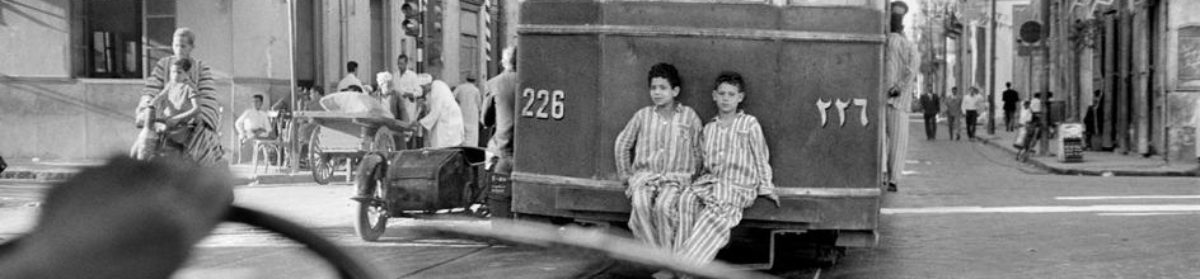
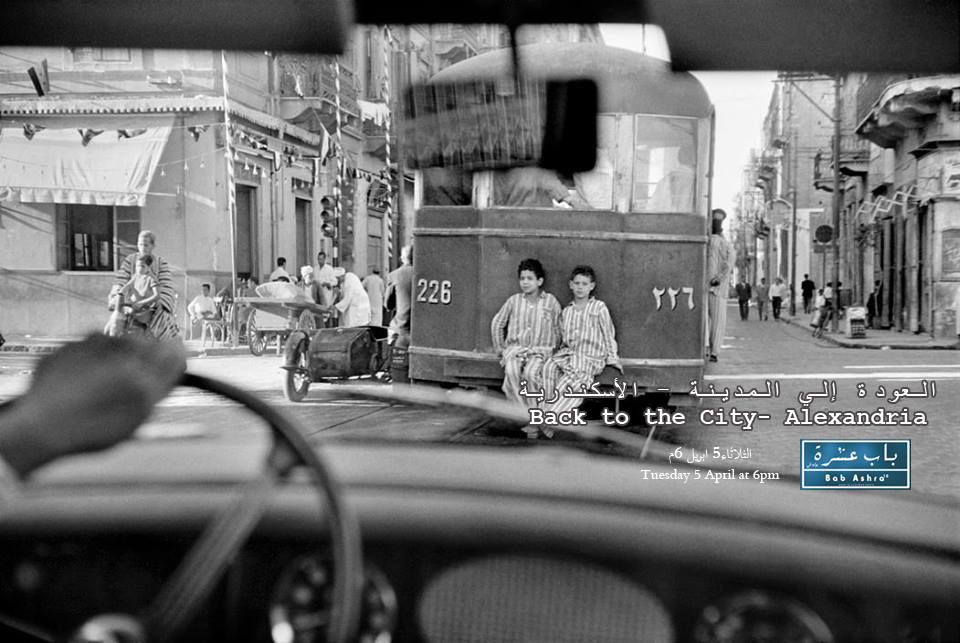
Back to the City: Understanding Alexandria’s Historical Awareness of Civic Responsibility

back to the city alexandria

I will be giving a talk and holding a discussion that seeks to understand how historical and philosophical processes shape the Alexandrian citizen’s relationship to identity, spaces and history. The session will raise questions of how does one improve their relationship to the city in a climate of indifference and apathy? How is greater meaning attained, beyond food and work, when mediocrity is on the rise? How does one set a counter-example when things around – from architecture to basic aesthetics – appear to be getting worse and ugly. The talk is to initiate a conversation on what challenges prevent such questions being raised and enacted, and what dimensions of Alexandrian society hampers social and civic progress.
This talk will be in Arabic

Date: 5 April 2016
Time: 6pm
Venue: Bab Ashra, Alexandria
Facebook event page

Free admission and open to the public. As seating is limited, please register by sending a message with your name and mobile phone number to Bab Ashra Facebook Page

more info :
03/5754917 – 01220841384 – 01223541065 – 01211624006
www.facebook.com/bab.ashra

Address : Janaklis ,abuoker .. mortada st. Elkhalig tower entrance G ..first floor

العودة إلى المدينة
عن فهم تاريخ الوعي بالمسئولية المدنية في الإسكندرية في إطار تاريخي

هذه المناقشة تسعى إلى فهم كيف شكلت العوامل التاريخية والفلسفية علاقة المواطن السكندري بالهوية والمساحات والتاريخ . كما انها تثير عدة أسئلة منها: كيف يمكن للمرء تحسين العلاقة بينه وبين المدينة في جو من اللامبالاة و الفتور ؟ كيف يمكن التوصل الى معان أسمى للحياة تتخطى الأكل والعمل في حين أن الاعتيادية في ازدياد ؟ كيف يصبح الانسان نموذجا للمقاومة عندما تكون الأمور في جميع النواح – من العمارة إلى الجماليات الأساسية – تزداد سوءا و قبحا .
المناقشة تأتي لبدء حديث عن التحديات التي تحول دون اثارة مثل هذه الأسئلة، كما انها تضم الأبعاد المختلفة في المجتمع السكندري التي تعوق التقدم الاجتماعي و المدني .

نأسف لمحدودية العدد نظراً لسعة المكان , لراغبي الحضور ارسال الأسم ورقم الموبايل علي :
https://www.facebook.com/bab.ashra

لمعلومات أكثر:
03/5754917 – 01220841384 – 01223541065 – 01211624006
www.facebook.com/bab.ashra

أو التوجه مباشرة الي مقر الأتيليه :
637 جناكليس شارع أبو قير ,شارع مرتضي , برج الخليج مدخل “ج” الدور الأرضي .

The Hidden Triumph of the Egyptian Revolution

Republished in openDemocracy

To those who cast doubt on the success of the Egyptian revolution. Step back, look around you, and reflect for a moment.

[From Alexandria’s Stanley neighborhood: “The People,” the eternal cry of the revolutionary voice that would follow it up with “Demand the fall of [insert your current oppressor here].”
[From Alexandria’s Stanley neighborhood: “The People,” the eternal cry of the revolutionary
voice that would follow it up with “Demand the fall of [insert your current oppressor here].”
As a result of the revolution, your social relations have been dramatically reconfigured. You have made new friends of strangers. You speak a new political language never known before. Your relationship to the state and public has been redefined. You have been involved in an unprecedented archival culture that narrates everything that has been happening. For every document, photograph and video will aid the next generation in resuming where you have finished off. For you cannot move forward without defining your relationship to the past.

Your understanding of history has been permanently altered. The 2011 revolution ruptured the political and social timeline giving you a new source of historical legitimacy. It gave you a critical juncture that emits a wave of vivid memories of sacrifices, victories, and betrayals of your hopes.

The 2011 revolution gave you a new validity to hold onto, and to rival any previous validity. No longer do you live in vain waiting for a future democratic “paradise”, you now realise that such a paradise needs to be shifted from the future to the present, from a goal to a process, to be instigated in small doses to the best of your human capacity.

The revolution in effect destroyed the previous dominant situation and cannot consolidate the new dominant situation, which can easily be clouded by the smokescreen of arrests and crackdowns.

That is what the revolution achieved. It did not arrive to give you a choice of regimes. It arrived to initiate a new beginning, one that is already on its course. You, among many, have been given a shared fundamental worldview that you unconsciously implement every day, and will determine the course of events in the present and, more theatrically, when the climate is ripe in your favour.

In a marvellous transformation, you can no longer recognise your pre-2011 self.

Alexandria’s walls can still speak: Shaimaa el-Sabbagh in street art

The late poet, writer and activist Shaimaa el-Sabbagh who was killed by security forces on 24 January 2015, as she was walking to lay flowers for those who have fallen in Tahrir, has, this month, been painted on the walls of her home and the surrounding vicinity in Moharem Bey, Alexandria. The moving words that accompany the images says it all:

“The one who fears the sun will have to imprison the day.”

“is there anyone guaranteed to walk in safety or not in safety – where can they walk?”
– Sheikh Imam

(This is a follow-up to my previous post on the drawings of Shaimaa)

In taking her life away, they inadvertently made her into a powerful living symbol. Rest in peace.

Left: "The one who fears the sun will have to imprison the day."  Right: "Freedom"
Left: “The one who fears the sun will have to imprison the day.”
Right: “Freedom”
left: "Is there anyone guaranteed to walk in safey or not in safety - where can they walk?" - Sheikh Imam
left: “Is there anyone guaranteed to walk in safety or not in safety – where can they walk?”
– Sheikh Imam

Shaimaa el-Sabbagh 3

"Shaimaa in paradise"
“Shaimaa in paradise”

"The flower of Shaimaa" [in the form of a clinched fist]
“The flower of Shaimaa” [in the form of a clinched fist]
Source: Shaimaa el-Sabbagh Facebook page.

The full story of her tragedy can be read here.