Ambushes, kidnappings, torture and murder have come to characterize Egypt’s security sector’s engagement with the Egyptian public in both pre- and post-revolution Egypt. This has left many asking: How did the interior ministry survive its pre-Mubarak incarnation given that one of the revolution’s key demands was police reform?
The issue is more complex than simply looking at how former autocracies were able to reform their police forces during their transition to democracy. The problem arguably starts with how Egypt’s elite – the military, the Muslim Brotherhood, and former regime loyalists – relate to the 18 day uprising.
Nabil Abdel-Fattah in his book “Elite and Revolution: State, Political Islam, Nationalism and Liberalism” argues that the elite are still unable to comprehend the gravity of the 2011 events. This view sheds light on why they are unable to generate a national post-revolutionary project, post-democratic movement or an overhaul of the security establishment, simply because a number of them conceive of the 2011 events as a “mere democratic protest movement.”
As Abdel-Fattah notes “The majority have not absorbed the nature of the event and the end of the legitimacy of 23 July 1952 with its generations, ideas and legacy…The conflict is still at its peak , and reveals two speeds running together in Egypt: one attached to the legitimacy of 1952 and another that claims a still unclear revolutionary legitimacy.” In other words Egypt is experiencing an ideational and generational war that has pitted two appeals to historical legitimacy against one another.
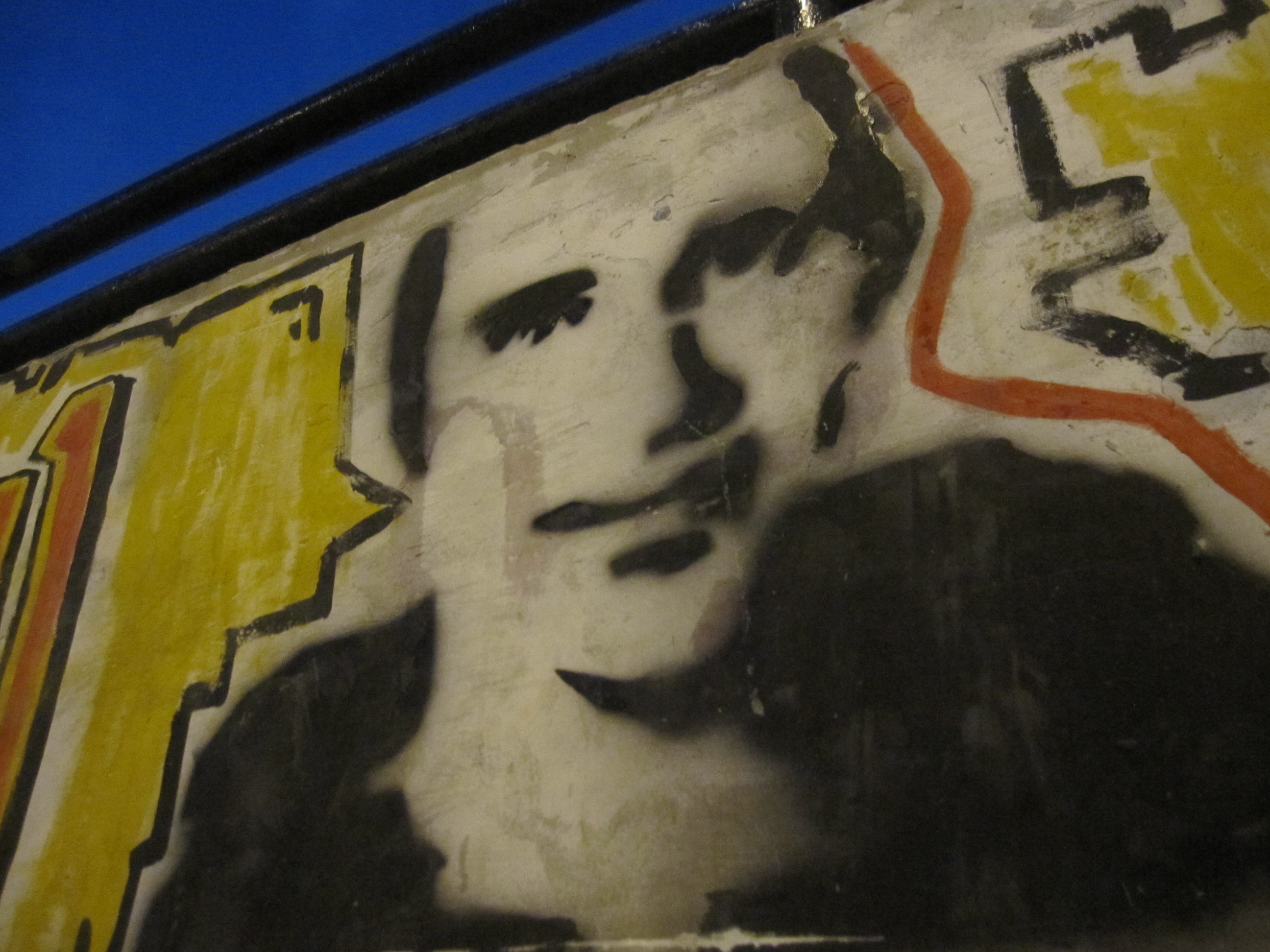
My article (June 2012) and collection of art on Khaled Saeed has been used as the basis of a feature piece in the UK Art Monthly magazine, titled “Viral Images: On the case of Khaled Saeed.” Beautifully written by London curator Sophie J Williamson, she expands on the threat posed by viral imagery to Morsi’s regime. With the author’s permission, I have uploaded a copy of the article to my site.
Below are some quotes from the article:
“The photo [of the brutalised khaled Saeed] itself was taken after an autopsy, which sparked disputes about whether some of the injuries seen in the image were delivered before his death or were the outcome of postmortem examinations. Saeed’s neighbour, Amro Ali, has since published an in-depth critique of the events, “Saeeds of Revolution: De-Mythologizing Khaled Saeed”, which gives an insight into Saeed’s somewhat dubious past. However, the discrepancies in these details were not important to the thousands of Egyptians who redistributed the image through their Facebook and Twitter accounts. The image quickly became independent of any objective retelling of its story; it stood for itself as telling of a seemingly objective reality of police brutality and the loss of individual dignity prevalent across the country”
“In Hito Steyerl’s insightful essay ‘In Defense of the Poor Image’, she describes the life of the online image as one of acceleration and deterioration; ‘a copy in motion’. The ‘poor image’ is one which has been ‘thrust into digital uncertainty’ – somersaulted through successions of uploading, downloading, reformatting, re-editing and
redistribution; quality is transformed into accessibility. In turn, image-value is defi ned not by resolution and content but by velocity, intensity and spread. This is not only true of the physical quality of the image, as Steyerl speaks about it, but also of the depth of meaning, understanding and context of the image.”
“The economy of poor images, with its immediate possibility of
worldwide distribution within a structure that facilitates almost
instantaneous appropriation, enables the participation of a
much larger group of producers than ever before. Users become
the editors, critics, translators and (co-)authors within a constant
frenzy of imagery production and re-production.”
“The vague language of President Mohamed Morsi’s
new constitution, especially with regard to freedom of
expression, inevitably reinforces concerns over the growing
tyranny of the permanent state of emergency declared
since the revolution. Using Giorgio Agamben’s definition
of sovereign power as the ability to decide on the state of
exception, to defined what is permitted – who is included
and who is not – Morsi effectively places himself outside
the law. Agamben argues that sovereignty is therefore
based on the ability to impose exclusion and is ‘the hidden
foundation on which the entire political system rested’.
While for Morsi, and Hosni Mubarak before him, this is
possible with established figures and organisations, it is
much harder, arguably impossible, to censor in its entirety
online activity which is spearheaded not by an individual but
by the masses”
“The image of Saeed proves that the digital image is not
as ephemeral as we might commonly think; as Steyerl argues: ‘just as a photograph is lodged in paper, the digital image is lodged in a circulatory system of desire and exchange.’”
With contributions from myself, Linda Herrera, Adel Iskandar, Sultan Sooud Al-Qassemi, VJ Um Amel, Vivian Salama, Nir Rosen, Anthony Alessandrini, Maya Mikdashi, Shiva Balaghi, Amal Hanano, and others…
Description:
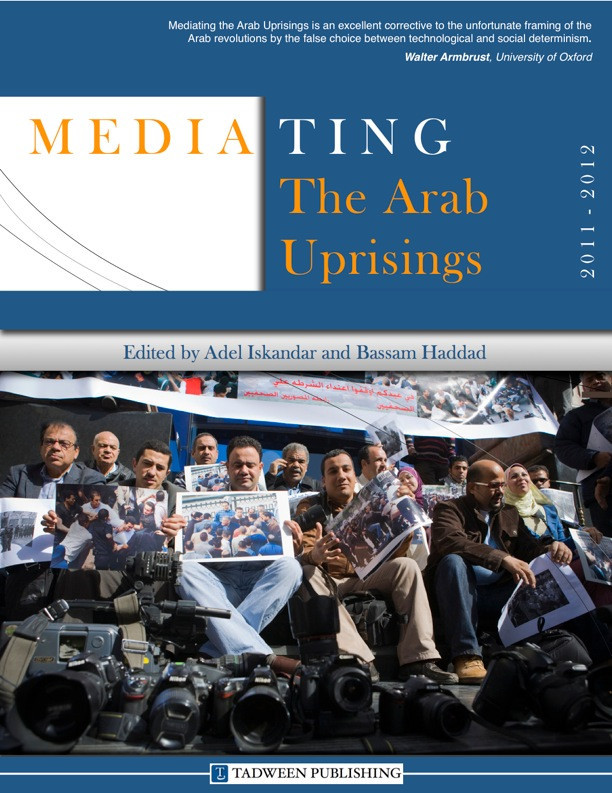
“From “Facebook revolutions” to “Al-Jazeera uprisings,” the outburst of popular activism across the Arab world has either been attributed to the media, drawn up by the media, observed through the media, or decontextualized by the media. Bloggers become icons, self-proclaimed experts becoming interpreters of unfolding events, stereotypes are cultivated, and autocratic regimes continue to subdue freedom of the press. The uprisings have become the most compelling media stories in recent memory. With so much at stake, the burden of relaying human narratives accurately and responsibly is a burden on all journalistic establishments worldwide.
In a unique collection of essays that covers the expanse of the Arab popular protest movements, Mediating the Arab Uprisings leaves no stone unturned by offering spirited contributions that elucidate the remarkable variation and context behind the fourth estate’s engagement with these mass protests.
So while the public debate about the coverage of the Arab uprisings remain effervescent and polarizing, the essays in this volume go beyond the cursory discussion to historicize media practice, unsettle pre-existing suppositions about the uprisings, puncture the pomposity of self-righteous expertise on the region, and shatter the naiveté that underlies the reporting of the uprisings. The volume includes essays on the tribulations of covering Syria, the contextualization and demythologizing of Facebook activism, the New York Times’ reporting rituals on Palestine, the tumult of Egypt’s media post-Mubarak, the ominous omnipresence of perennial media darling Fouad Ajami, the faltering of Al-Jazeera Arabic in the wake of the uprisings, the gendered sexuality of reporting Egypt, and journalism’s damning failure on Iraq. The first volume of its kind on this pressing topic, Mediating the Arab Uprisings is a primer for the curious reader, a pedagogical tool for media studies and communication, and a provocative collection for the seasoned scholar.
This initiative was supported by the Middle East Studies Program at George Mason University.”
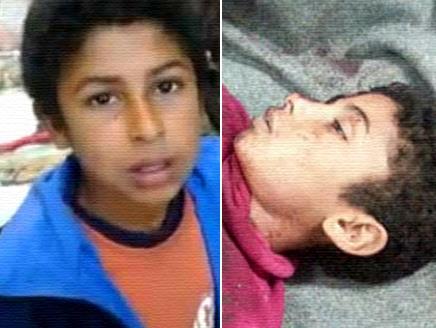
An Egyptian army conscript walks up to 12 year old Omar Salah Omran, a sweet potato seller – outside the front gates of Cairo’s US Embassy close to Tahrir Square – and requests two potatoes from the young street vendor. Omar answers, “I’ll do so after I go to the bathroom”. The allegedly untrained soldier retorts with a mix of cockiness and jest that he will shoot Omar if he doesn’t comply immediately. On Omar’s reply, “you can’t shoot me” – the conscript, on the alleged presumption that his weapon was not loaded, aimed two bullets piercing through Omar’s heart. He died instantly. (Based on Omar’s father’s television interview with host Mahmoud Saad)
The entire incident was over in ten seconds. The fallout continues.
Many Egyptians were humbled and awoken to another Egypt with the release of a gripping video of Omar speaking to a Life Makers charity member in which he says “I am tired of this job”: he says he wants to learn to read and write. There is an inherently troubling dimension in Omar’s demise that goes beyond the “accidental” nature of it. It is the callous disregard by the state that instigated and attempted to cover up the crime, and a society that no longer gives a second look to the plight of child labour. Continue reading “The Maddening Betrayal of Potato-Seller, Omar Salah”
Upon his arrival at the Al-Jazeera studio in Doha, Egypt’s former president Hosni Mubarak quipped his shock at the small office space of the news giant: “All that noise from this little matchbox?”
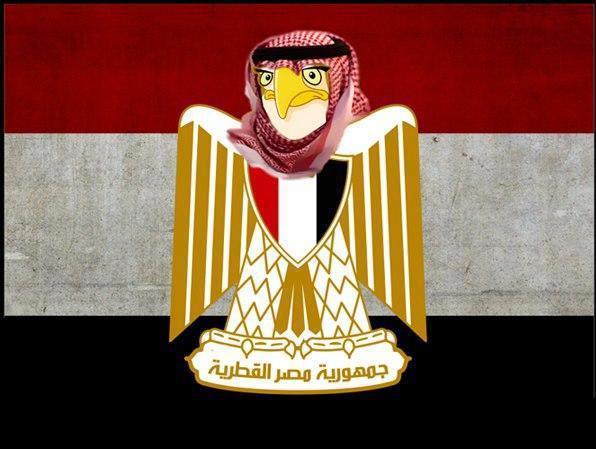
That “noise” widened beyond the Doha studios to take in the peninsula’s foreign ministry and royal palaces, eventually drawing the ire of Egypt’s revolutionary forces as Qatar cozied up with their country’s Muslim Brotherhood.
“The Qatari republic of Egypt” by an Egyptian cartoonist
The patronage role that Qatar plays to the region’s Islamists has been well covered by Arab affairs commentator Sultan Sooud Al Qassemi. Also As’ad AbuKhalil and others have given a deal of attention to the issue, which therefore will not be discussed here.
Qatar’s frequency on Egypt’s news and commentary radar has been reflected in everything from unconfirmed stories of Qatar buying the Suez Canal to frequent yarns about how much influence the tiny state is gaining in Egypt. A focus on Qatar and other Brotherhood patrons should continue to be scrutinized, but it risks enveloping the dynamics that started the revolutions.
As a student of international relations I would hesitate to downplay the role of state actors, but if the Arab uprisings have taught us anything, it is that the Arab public represents a formidable challenge to power elites. Grievances should not limit Egypt’s revolutionary camp towards a reactionary anger at Arab governments at the expense of a proactive outreach to Arab societies – the very element that two years ago fuelled a trans-national Arab uprising or at the very least, demands for reform. One party in particular that requires examination is the large number of the Arab world’s passive supporters of Egypt’s Brotherhood which is a byproduct, if not of a pro-Brotherhood slanted Al-Jazeera (Arabic) and other media outlets, at least partly to the incoherent noise Egypt’s revolutionaries have unintentionally exported. Continue reading “I Can’t Believe It’s Not Qatar!: Addressing the Brotherhood’s Other Patron”
On 24 January 2011 – a day before the arc of Egyptian history would be altered – the film Microphone was screened. Microphone documents Alexandria’s pre-revolution underground scene of artists and musicians fighting a passive oppression that suffocates their ability to nurture their creativity. Khaled (played byKhaled Abol Naga), who has returned to Egypt from the US, wishes to aid the youth by providing them with a venue and funding for nurturing their talents. In one scene, Khaled is conversing with an official at the state’s cultural office to request support for his project. The dialogue proceeds as follows:
Official: What is this graffiti? Is our role to pollute the walls or to clean them?
Khaled: “Graffiti is an art, the whole world acknowledges it. We have to encourage the youth in their pursuits”
Official: “Is this not transgression against people and properties, and visual pollution?
Khaled: “What about the campaign posters littered around the country’s walls, isn’t that visual pollution as well?”
Official: “No, that is something and this is something else. Election campaigning is part of our democratic process”
To the dumbfound look of Khaled who – frustrated enough by red tape – now is expected to digest a bureaucrat’s talk of “democracy” in Hosni Mubarak’s Egypt
Prior to the revolution, Alexandria’s walls were largely Soviet-esqe and barren. Artists who did attempt to paint the walls, like Aya Tarek (featured in the film) and Amr Ali (not the author of this piece), were often stopped by the police or reported by onlookers suspicious of their novel activity. Fatma Hendawy, a curator who started on the street scene before the revolution, notes that one way to circumvent these obstacles was to go through the Goethe Institute to use its diplomatic muscle to define joint German-Egyptian art projects. Yet as Fatma laments, such institutes inadvertently stump your creativity in order to cater to their bilateral agendas.
In the months following the 2011 Revolution, I took to cataloguing the artwork that blossomed and inspired me to believe that the public space was gradually being reclaimed by society. I am no artist; however, I take the position of the “public” and write on the art in the context of the socio-political dynamics and nuances that influence societal perceptions of street art. Specifically, this essay attempts to tell the story of the past two years purely through artwork from the streets of Alexandria. For Cairo, I highly recommend the large collection of Suzee Morayef who, on her blog, offers great analyses on street art that is prolific through the capital’s streets. Also Mona Abaza, professor of sociology at the American University in Cairo, has penned brilliant pieces on the artistic narration of the revolution.
The 25 January 2011 revolution is nearly two years old, and with every anniversary reflection sets in, and so do the cynical questions thrown at me: “What has the revolution achieved?” and “It brought extremists to power”. It’s as compelling as the French asking themselves the same question in 1791, two years after the start of their bloody revolution. Yet I would be wary to compare Egypt to the bloody track record of the historical titan of revolutions or even to the current mess in Syria. Egypt, for all its faults, is not a country with a history of mass graves.
An insight dawned on me on a train journey from Alexandria to Cairo on the eve of the first anniversary of the revolution, heading to join my friends at Tahrir Square. In my carriage, were about a dozen and a half soldiers who had been recalled from the coastal city to secure parts of Cairo in anticipation of anniversary violence. Sitting next to me was the most senior army officer in that carriage and it had to be one of the most uncomfortable trips in the heated anti-SCAF (Supreme Council of the Armed Forces) days – my head sporting a beret next to his military cap could not have struck a more vivid contrast. You can imagine I felt awkward, surrounded by soldiers uttering statements like “If it wasn’t for us, the revolution would be dead.” Those ungrateful Egyptians.
In the final fifteen minutes of the journey, I decided to strike up a conversation with the officer. It was a cordial discussion until I asked, “That Tahrir girl who was beaten up by the army last month and her blue bra exposed..” before I could finish, he raised his voice, “That was a lie, do you ever see us wearing running shoes?” and he threw in the stock-in-trade conspiracies surrounding that incident. It was then that many officers came in to listen to the conversation of their commander but did not utter a word in deference to the chain of command. At that moment, I realised something: could I have even dreamed before the revolution of openly posing such a question to an official who, in a different era, might have had me arrested? It all comes down to what defines the post-revolutionary Egyptian public psyche – the vanquishing of fearthat remains the strongest bulwark against the counter-revolution. It is the absence of fear that translates into the protests, sit-ins, strikes, street art and the list goes on.
Cynics interpret every “successful” move by counter-revolutionary generals or the opportunistic Islamists as fait accompli – checkmate rather than check – all without considering the dynamic that such political actors just do not know how to coerce a public that no longer fears authority. I often say a revolution is not an event but a process – there is the 18 days that have come to be the 25 January 2011 Revolution. But then there is the extended revolution that has produced intense protest dynamics surrounding the cabinet killings, Maspero massacre, Mohammed Mahmoud clashes, Port Said soccer massacre, Presidential palace protests and so forth. Enough drama to produce hundreds of Ramadan TV shows.
With this loss of public fear in mind, there is an ominous sign for the Brotherhood and any political actor who wishes to turn back the hands of time. Otto Von Bismarck defined political genius as consisting of “hearing the distant hoofbeat of the horse of history and then leaping to catch the passing horseman by the coattails.” The implication is that Egypt’s aspiring or established political actors who miscalculate or mistime their leap will end up on the wrong side of history while the horse gallops into the sunset leaving them behind. The strength of the Brotherhood and counter-revolutionary actors is illusionary, in that clinging desperately to the practices and models of the former regime only increases their chances of failure – not only missing the ability to shape Egypt’s future, but increasing the structural tensions and further rupturing the sync between ruler and ruled, policymaker and public.
With the economy in a downward spiral, increasing media censorship, growing repression, the Brotherhood’s legitimacy rapidly eroding, the undermining of institutions, and with little being done to address the very factors that sparked the revolution two years ago: 2013 has many surprises in store for Egypt.
One of the most oft-quoted lines two years ago by commentators was the story of when Henry Kissinger once queried the Chinese Premier Zhou En Lai in 1971 for his views on the consequences of the French Revolution. Zhou famously responded, “It is too early to tell”. Some 180 years on (an overstatement but a poignant one) notwithstanding, Zhou’s point was that consequences of revolutions do not unfold until much later. We just might need to give Egypt a little longer than two years.
‘In the Eruptive Mode’ is an intense and complex set of six monologues of ‘ordinary’ individuals who have been caught up in the Arab Spring. [Image: Laurie Bost]Amro Ali from the Department of Government and International Relations responds to the Sydney Festival production In the Eruptive Mode, on now at the Seymour Centre until 27 January 2013.
When I was asked last month on ABC News 24 if I had ever imagined the Arab Spring to descend into the mess that it is two years later, I could have pointed out that In The Eruptive Mode would have been the last scenario(s) on my mind.
Kuwaiti-born Sulayman al-Bassam has directed an intense and complex set of six monologues of “ordinary” individuals who have been caught up in the historical tidal wave of the Arab Spring only to be left in its debris. The darkness and horrific tone of the play strikes a far cry from the nascent days of the Arab Spring when the narrative and roles were relatively defined and clear-cut: urban-based Tunisians and Egyptians rising up against authoritarianism to demand “freedom, bread, and dignity.”
Eight tumultuous seasons later and the Arab Spring is aptly expressed “No spring breezes in this neck of the woods” by Kim Vercoe who plays an opportunistic Australian public relations official for an investment firm, and makes a case to support a questionable “153rd-in-line for succession” figure from a morally bankrupt clan in which their power moves are cloaked in a religious guise.
The other outsider kicks off the hour-long play as an idealistic journalist in her death throes yet still eager to report to the world the events unfolding. The scene is poignant for two reasons, it was inspired by Marie Colvin, who was killed on a reporting assignment during the Homs siege in Syria almost a year ago. The other is that 2012 saw a dramatic increase in the number of journalists being killed and serves as a reminder to the danger the profession faces when placed on the front battle-lines. The journalist is epitomised as the window to the Arab Spring (sadly no mention of activists and bloggers here), which illustrates even an outsider is sucked into the downward spiral of the Arab Spring nightmare.