[album id=1 template=extend]
Author: Amro Ali
Why a Democratic Egypt Should Trump all Fears
By Amro Ali:
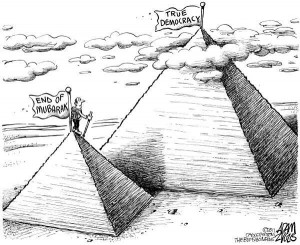 It was Lenin who once said, “There are decades where nothing happens; and there are weeks where decades happen”. After decades of stagnation under Mubarak, there could not have been a more fitting description for the events in Egypt of early 2011.
In 18 days, the Middle East experienced a geo-political earthquake. President Hosni Mubarak was successfully overthrown after 30 years in power. Yet what made the events spell-binding was the relative non-violent nature of the protestors, the all-inclusiveness, Muslim-Christian unity, and the communal spirit – an inspiration to the world. After the Pyramids, Tahrir Square became one of the most famous Cairo landmarks and was elevated to the hall of famous squares alongside Tiananmen Square.
After the January overthrow of Tunisia’s leader Zine El Abidine Ben Ali, Middle East experts were appearing and proclaiming that the Mubarak regime would not follow the Tunisian path. Yet what so-called experts and intelligence services could not measure or foresee was the indomitable spirit of a downtrodden people. Once unleashed, people power kept gathering momentum at a formidable pace.
So, where to from here? Can Egypt handle its own version of democracy and put to rest the fears that have done the rounds on the news circuit? While the road ahead will be difficult, it is an absolute essential that a transition to democracy takes place and is supported by the international community. Continue reading “Why a Democratic Egypt Should Trump all Fears”
Defriending Mubarak – Egypt’s social media revolution
By Amro Ali:
In early 2007, while still a student at the ANU, I received a call from my younger relative in Alexandria, Egypt. Her words: “Are you on Facebook?”
Little did I know, some four years later, social media tools like Facebook would help drive passionate anti-government protests in a country that had been struggling to suppress politicised social media and its outcome on the streets of Cairo’s Tahrir (Liberation) Square and other cities in Egypt.
On 6 June 2010, my neighbour in Egypt Khalid Saeed was brutally killed at the hands of police, a tragedy about which I had written last year entitled “Egypt’s Collusion course with History”. In the wake of his death, his symbolism as martyr for anti-government sentiment flourished with the creation of the “We are all Khalid Saeed” Facebook group page whose members grew into the hundreds of thousands. Saeed’s symbolism was powerful; like the Iranian shot dead, Saeed was Egypt’s Neda Agha Soltan. Continue reading “Defriending Mubarak – Egypt’s social media revolution”
Egypt’s Collision Course With History
By Amro Ali:
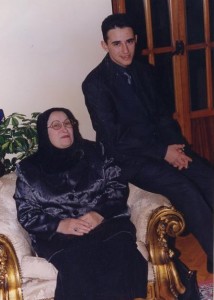 In a bustling area of the 2,300 year-old Alexandria, Egypt, lies the middle class suburb of Cleopatra
Hammamat, meaning Cleopatra’s Baths, named after the legendary Cleopatra VII and where she once ruled. She was the last Queen Pharaoh who came to understand, albeit belatedly, that power can be vanquished at a heavy price; the rest is history. Today, overlooking the Mediterranean Sea, Cleopatra Hammamat is a beautiful, harmonious, and vibrant area – Muslim and Christian traders work side by side, men play their checkers in the coffee houses, soccer matches bring the streets to a standstill. And, despite the extremely difficult economic situation, Egyptians are still willing to express their renowned warm sense of humour at life’s challenges.
Cleopatra Hammamat (or Cleopatra for short) rarely made the headlines – until Sunday, June 6, when fate propelled it back onto the world map. Two plain-clothed policemen entered an internet cafe near the beach, seizing 28-year-old Khalid Saeed and smashing his head against a marble shelf, dragging him outside, and brutally beating and kicking him to the ground. Saeed pleaded for them to stop, but the police shoved him into a car in which he died en route to the Sidi Gaber police station. Afterwards, his lifeless body was brought back to the café and dumped. With Saeed’s death, a Pandora’s Box had been opened. Continue reading “Egypt’s Collision Course With History”