If you are in Sydney, then please feel free to come to a talk this Frid
ay 27 Sept 2013 that me and Macquarie University lecturer Noah Bassil will be presenting on the topic: “Whither Democracy in Egypt?” Noah will be discussing the role and relationships between the Brotherhood, the Egyptian state and the US. My talk will discuss the political trajectory of Egypt’s hindered democratic development and the challenges of reforming the brutal security forces.
Time: 6pm to 7.45pm
Date: 27th September 2013
Location: The Gaelic Club, 64 Devonshire Street, Surry Hills
Author: Amro Ali
Sidi Gaber, Ovvero Fare Rivoluzione Ad Alessandria (Journal article in Italian)
La città mediterranea è il termometro della crisi egiziana.
La grande diversità sociopolitica e alcuni fattori geografici
e urbani la rendono perfetta per la ‘politica della strada’.
I crocevia delle proteste.
http://temi.repubblica.it/
Redefining Alexandria: The Liberal, Salafi, and Muslim Brotherhood Struggle Over the Public Space (conference abstract)
Conference title: Competing Visions in the Muslim World: Rebuilding States and Reinvigorating Civil Societies
Venue: University of Sydney
Date: 14-16 August 2013
My presentation is at 10.30am, 15/Aug/2013, at the Professorial Board Room, The Quadrangle.
Redefining Alexandria: The Liberal, Salafi, and Muslim Brotherhood Struggle Over the Public Space (conference abstract)
This study seeks to understand the primacy of politics in the public space and the rise of a revolutionary space in Egypt’s second largest city of Alexandria. The city has experienced a long history of political struggles to brand the city in which the state led the destruction of the political by manipulating people and places and injecting external meaning rather than allowing a self-creation by Alexandrian society. The 2011 Revolution was in part an unintended consequence of that
branding. The dramatic birth of public space and politics in Alexandria was crystallised during the tumultuous but electrifying 18 days of the 2011 uprising – the net result was the birth of an invigorated political public. Individuals of differing ideological persuasions in the coastal city mustered the courage to interrupt their routine activities and break out of their private lives to assemble and produce a public space where freedom and plurality could materialise. However, this human togetherness would be temporal and would make way for Alexandria’s liberals, Salafists and Brotherhood supporters to battle for “control” of the public space and attempt to marginalise the other.
Alexandria is a paradox given that it has swung from a cosmopolitan city in the first half of the twentieth century to the so-called Islamist bastion in the last few decades, to the extent of acting as the base for a resurgence of modern Salafist movements. The past two years have shown each political actor struggling to define the narratives, myths, and vision of the city. Moreover, the past two months in Egypt’s political trajectory have illustrated the unpredictability factor – the decisive character of human affairs – in polarising society and now further entrenching Islamist actors as they perceive an existential threat in the public space as well as further emboldening liberal actors due to the military coming down on their side.
Alexandria is chosen in large part because it is a political laboratory in how a city deals with a fraught process in which a series of contradictory events have happened, far from over, that have only served to illustrate the fragile space of appearance that is dependent and recreated when citizens are together. Yet just as disappointment, sense of injustice, nostalgia, disenchantment, power struggles, are the poisonous fruits of the birth of public space; there comes with it also disintegrative tendencies that can set in with the birth of public space and the events of June and July, Egypt’s people-driven coup, can also have a renewal of another possible beginning.
Marching to Sidi Gaber: Alexandria’s Epicenter of Upheaval

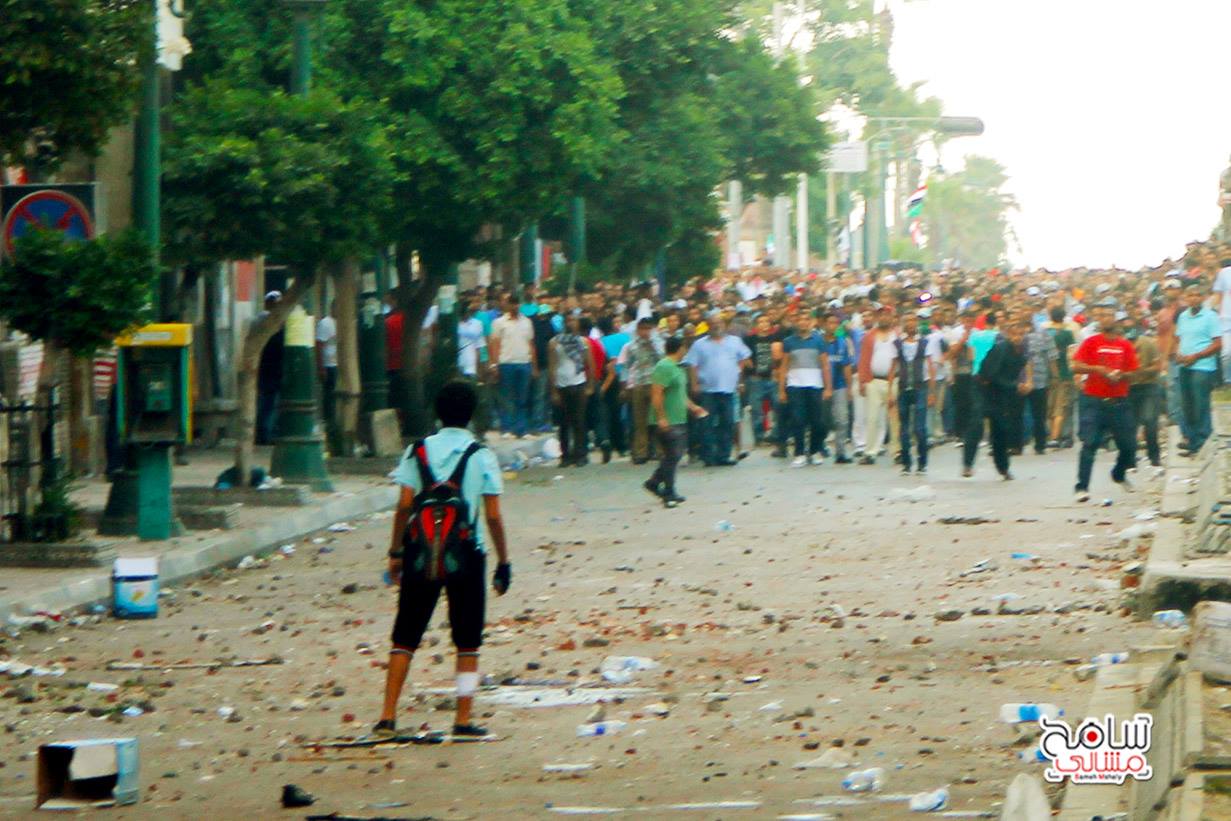
Pro-Morsi supporters clash at Sidi Gaber, 28 June 2013. Photo by Sameh Meshally
A brief but long-lasting moment occurred on 19 May 2012, one that would awaken me to the changing realities in our neighborhood since the January 25 Revolution. It was late at night, while standing on my balcony overlooking Cleopatra Square, Alexandria, at the height of the first leg of the 2012 presidential campaign. A scuffle broke out between a group of political campaigners tearing up posters of candidate Amr Mousa, and shop owners and residents who supported Mousa. I ran down to film the incident, only to be tackled by undercover “security” who mistook me as part of the group. One yelled: “We are taking you to army headquarters.” Then a voice was heard: “Leave him, he is one of us” (as in to say, a resident of the area). It turned out to be my barber. In exchange for letting me go, I had to delete the video footage—which I pretended to do but did not.
I took a few steps back in disbelief. Someone I had trusted turned out to apparently be a part of an informal former regime loyalist network. This same group has attacked revolutionary protest marches that pass frequently through this area with bottles and knives. This same Port Said Street was the site of several human chains formed by former regime loyalists in order to prevent revolutionary protests from moving on, often unsuccessfully.
The motives behind their actions soon become apparent.
Stroll some one hundred meters or so, and you end up in Sidi Gaber–Alexandria’s budding Tahrir Square, second only to, or possibly eclipsing, the Qa’id Ibrahim Mosque courtyard–where the military’s fiercely guarded northern command headquarters is based. The barber and his friends see themselves as the first line of defense against encroachment on the “guardians of the nation.” Whether they were paid or not, I could not verify.
Sidi Gaber recently featured fierce protest violence during the pro-Morsi demonstrations on 5 July. Out of the thirty deaths across Egypt, a staggering seventeen occurred in Sidi Gaber alone. This includes the heart-wrenching video of what appeared to be pro-Morsi supporters throwing two teenagers over a ledge, resulting in the death of one of them. A week earlier, American student Andrew Pochter was stabbed to death in the same area.
Interview (Tripple J, The Hack)
A podcast of my interview, at 12:07, right after the segment “How young is too young to have Botox?” (the stuff that major international news has to now compete with)
http://mpegmedia.abc.net.au/triplej/hack/daily/hack_thurs_2013_7_4.mp3
How International Events Played into Egypt’s Crisis
First published in the Atlantic Council
Egypt’s road to the current crisis has been, in part, shaped by an understated yet unhealthy obsession on the part of Egyptian political groups in scanning the international terrain for allies to bolster domestic positions and fuel their narratives.
While many Egyptians are proud to have exported Tahrir Square-styled civil disobedience to rest of the world, it is not always a one way street.
Egypt’s political groups and movements pick up certain international signals and cues allowing them to frame their activities to their supporters as part of a universal necessity and embed themselves in a grandiose narrative to which they are, somehow, central.
The 2012 Gaza-Israel conflict was a key moment in this process in which President Mohamed Morsi’s brokering of a ceasefire between Hamas and Israel resulted in praise lavished on him by President Barack Obama and the Western press. Morsi interpreted this as a green light for a significant power grab, issuing the November 2011 constitutional declaration, which in turn ensured that a highly flawed constitution was rammed through. Seen as having satisfied the international norms of acceptance, the Brotherhood agenda came out in full force, albeit recklessly.
Continue reading “How International Events Played into Egypt’s Crisis”
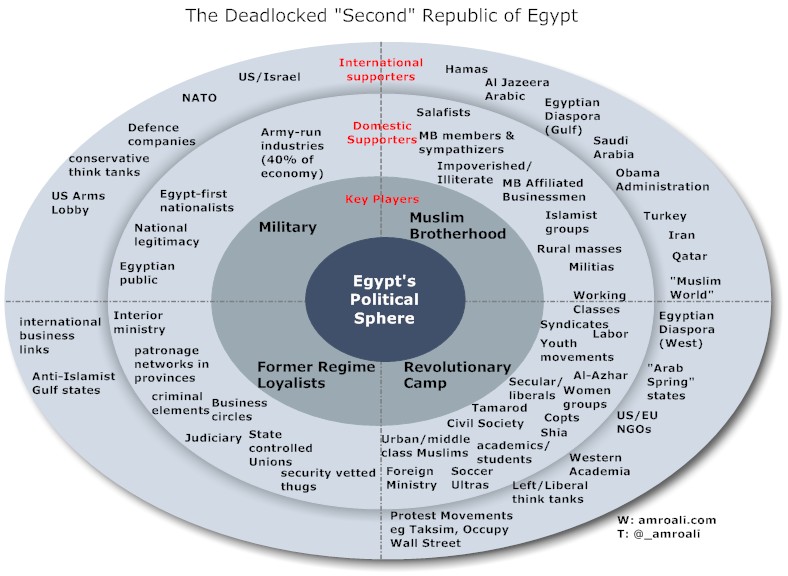
A Visual Breakdown of Egypt’s Political Deadlock
We have come to the current crisis that sees an Egypt that is politically stillborn and has been unable to resurrect the old regime nor can it establish a new one. What I have attempted to do is illustrate this by examining the constellation of actors that are contributing to this deadlock. The plotting of different groups on the map is based on news data, policy statements, interviews, and my experience with Egypt’s urban politics. At this stage it is not intended to be a scientific diagram nor is it an exhaustive list of all players. It is only to illustrate the gravity of the deadlock that has brought us to 30 June.

The former regime, according to Hazem Kandil, rested on a power triangle that consisted of an uneasy partnership between the military, security sector (interior ministry) and the political establishment. The 2011 events disrupted this balance resulting in the enhancement of the military’s role and saw former regime remnants, Islamists and revolutionaries seeking to fill the political vacuum.
1. Military
The military is the dominant actor and backbone of the transition, much of the current political rival suspicions and deadlock can be traced back to the military’s opaque decision making and centralisation of power when it was governing the country in the interim period. While the military is relatively de-politicised, it is nonetheless desperate to preserve its economic privileges and ensure the country does not enter a “dark tunnel” as General Abdel-Fattah el-Sissi puts it. This partly explains why it looked more favourably upon the Brotherhood who were less likely to dismantle the political economy than the revolutionaries were.
el-Sissi may have inadvertently emboldened the revolutionary camp by implicitly warning Morsi’s supporters that the military will step in if people are attacked during the planned protests.
Yet the military is still reeling from having its prestige damaged during its 2011 and 2012 rule, and it is unlikely to see a role for itself in the political scene even after today’s expected coup d’état. The military has never viewed its purpose as a force for change.
Continue reading “A Visual Breakdown of Egypt’s Political Deadlock”
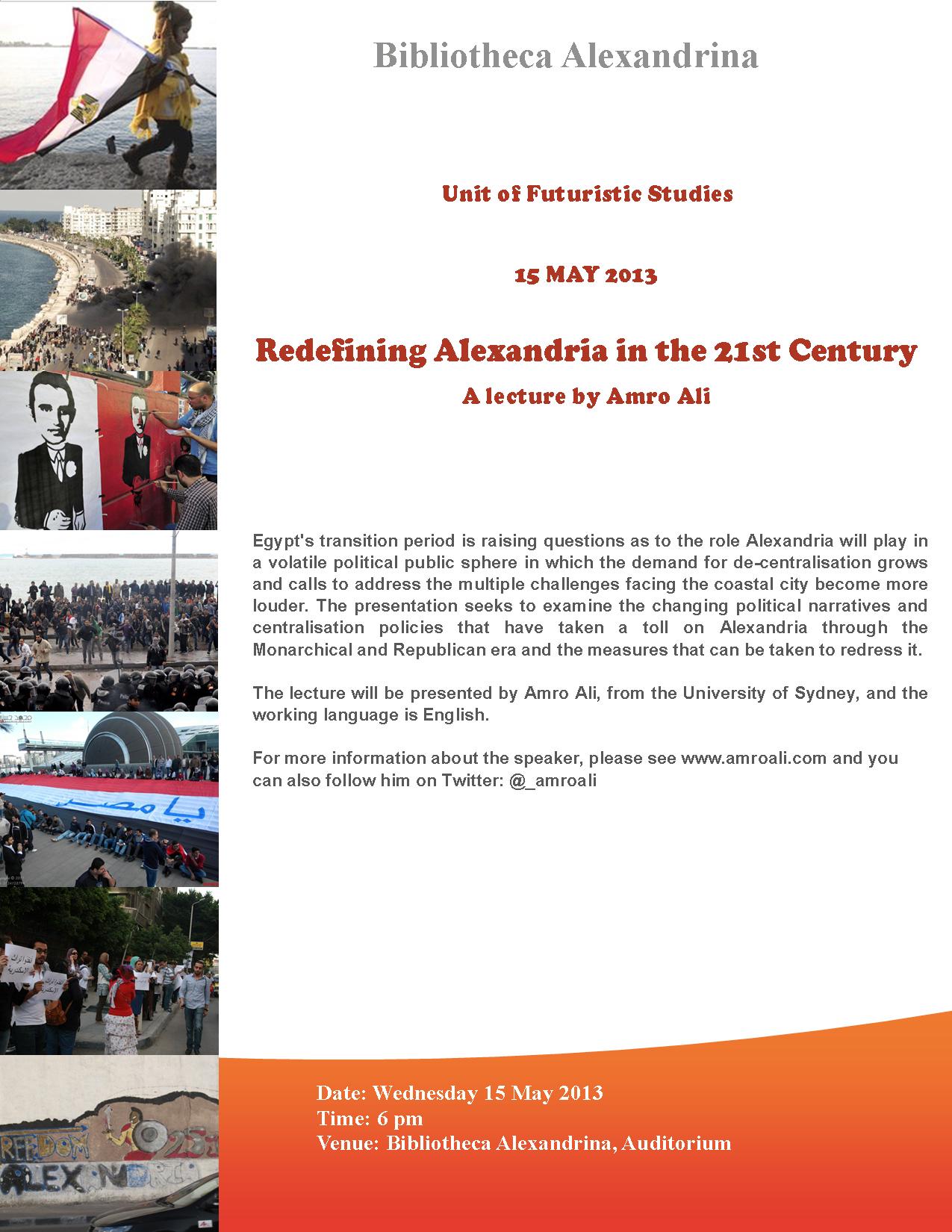
Redefining Alexandria in the 21st Century
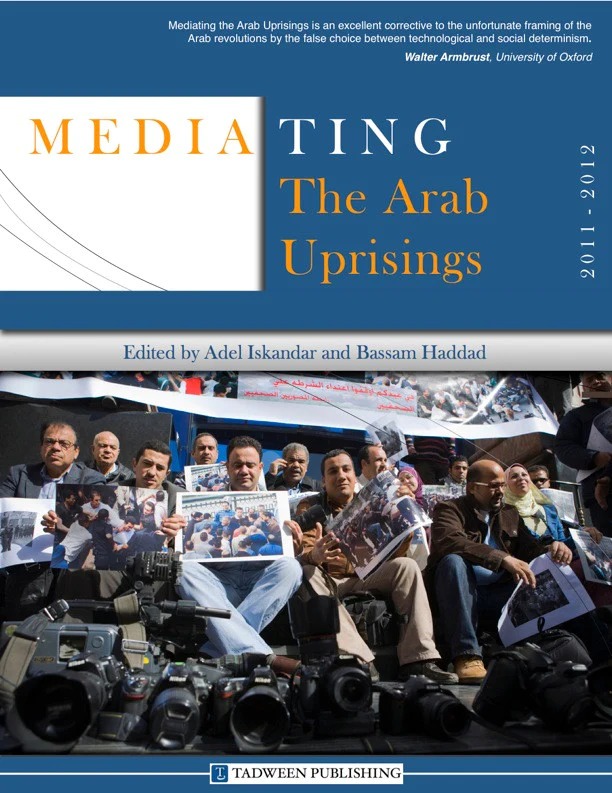
Mediating the Arab Uprisings
Amro Ali, “Saeeds of Revolution: De-mythologizing Khaled Said” in Mediating the Arab Uprisings. Eds. Bassam Haddad, Adel Iskander (Washington DC: Tadween Publishing, 2013).
Abstract:
From “Facebook revolutions” to “Al Jazeera uprisings,” the outburst of popular activism across the Arab world has either been attributed to the media, drawn up by the media, observed through the media, or decontextualized by the media. Bloggers become icons, self-proclaimed experts becoming interpreters of unfolding events, stereotypes are cultivated, and autocratic regimes continue to subdue freedom of the press. The uprisings have become the most compelling media stories in recent memory. With much at stake, the burden of relaying human narratives accurately and responsibly is a burden on all journalistic establishments worldwide.
In a unique collection of essays that covers the expanse of the Arab popular protest movements, Mediating the Arab Uprisings leaves no stone unturned by offering spirited contributions that elucidate the remarkable variation and context behind the fourth estate’s engagement with these mass protests.
So while the public debate about the coverage of the Arab uprisings remain effervescent and polarizing, the essays in this volume go beyond the cursory discussion to historicize media practice, unsettle pre-existing suppositions about the uprisings, puncture the pomposity of self-righteous expertise on the region, and shatter the naiveté that underlies the reporting of the uprisings. The volume includes essays on the tribulations of covering Syria, the contextualization and demythologizing of Facebook activism, the New York Times’ reporting rituals on Palestine, the tumult of Egypt’s media post-Mubarak, the ominous omnipresence of perennial media darling Fouad Ajami, the faltering of Al Jazeera Arabic in the wake of the uprisings, the gendered sexuality of reporting Egypt, and journalism’s damning failure on Iraq. The first volume of its kind on this pressing topic, Mediating the Arab Uprisings is a primer for the curious reader, a pedagogical tool for media studies and communication, and a provocative collection for the seasoned scholar.
This initiative was supported by the Middle East Studies Program at George Mason University.
The Buck Dies Here: Why Egypt’s Interior Ministry Refuses to be Tamed
Article originally published in The Atlantic Council’s ‘Egypt Source’ (4 April 2013)
Ambushes, kidnappings, torture and murder have come to characterize Egypt’s security sector’s engagement with the Egyptian public in both pre- and post-revolution Egypt. This has left many asking: How did the interior ministry survive its pre-Mubarak incarnation given that one of the revolution’s key demands was police reform?
The issue is more complex than simply looking at how former autocracies were able to reform their police forces during their transition to democracy. The problem arguably starts with how Egypt’s elite – the military, the Muslim Brotherhood, and former regime loyalists – relate to the 18 day uprising.
Nabil Abdel-Fattah in his book “Elite and Revolution: State, Political Islam, Nationalism and Liberalism” argues that the elite are still unable to comprehend the gravity of the 2011 events. This view sheds light on why they are unable to generate a national post-revolutionary project, post-democratic movement or an overhaul of the security establishment, simply because a number of them conceive of the 2011 events as a “mere democratic protest movement.”
As Abdel-Fattah notes “The majority have not absorbed the nature of the event and the end of the legitimacy of 23 July 1952 with its generations, ideas and legacy…The conflict is still at its peak , and reveals two speeds running together in Egypt: one attached to the legitimacy of 1952 and another that claims a still unclear revolutionary legitimacy.” In other words Egypt is experiencing an ideational and generational war that has pitted two appeals to historical legitimacy against one another.
Continue reading “The Buck Dies Here: Why Egypt’s Interior Ministry Refuses to be Tamed”