Published at Jadalliya
![[Revolutionary protestors clashing with security forces on the coast of Alexandria on 21 December 2012; Islamist activists protesting, with youth graffiti in the forefront. Design by Amro Ali]](https://www.jadaliyya.com/content_images/3/clashes2.jpg "[Revolutionary protestors clashing with security forces on the coast of Alexandria on 21 December 2012; Islamist activists protesting, with youth graffiti in the forefront. Design by Amro Ali]")
A Salafist Muslim intellectual, overlooking an Alexandrian beach last summer, tells me over coffee: “The cosmopolitanism of our city [Alexandria] may look like it has died, but the skeletal structure of cosmopolitanism is still there. It is this structure that underpins the spread and acceptance of ideas, including Salafist ones, that makes this city a formidable force.”
This “force” also makes Alexandria the vanguard city of Egypt’s socio-political developments. A glimpse of it was caught in the fogginess of the sheer ferocity that unfolded in the in the two Fridays’ immediately preceding the December constitutional referendum that has set off alarm bells as to where it is steering the direction of Egypt. The murky “battle-lines” appear to be drawn in what Lina Attalah, editor of Egypt Independent, describes as “a polarization between Islamist forces who are after a highly defined identity-based project to see a more Islamized Egypt…The other camp is a revolutionary camp that wants to see a democratic Egypt that allows multiple identities to exist.”
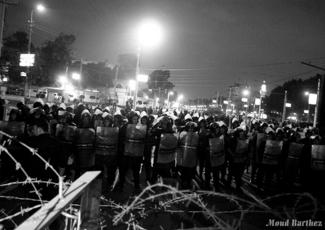
On 14 December, following a sermon by ultra-conservative Sheikh Ahmed Mehalawy who accused opponents of the divisive draft constitution as being “followers of heretics” and told worshippers to vote “Yes” in the referendum, violent confrontations ensued outside the courtyard of the Qaed Ibrahim mosque (or as many call it, “Alexandria’s Tahrir Square”) between Islamists and opponents of the Muslim Brotherhood-sponsored constitution. Violence also broke out the following Friday, despite the deployment of Central Security Forces, resulting in the burning of buses and cars, and leaving almost sixty injured. Clearly, they do not call it “Revolutionary Alexandria” for nothing.

[Anti-constitutional protestors burn vehicles that reportedly belong to Islamists. Photo from Alex Eyes Facebook Group]
The reinvigoration of the revolutionary camp and the rise of new Islamist currents have left the subtext of the chaos unanswered: How exactly does the city, defined as “Egypt’s subconscious” in Sarah El Deeb’s recent piece, influence the country’s developments? There are several factors that shed light on why and how Alexandria commands the trajectory of Egyptian politics.
The Bastion of Refuge
Alexandria fashioned itself over the decades as the only viable and structural oppositional city to Cairo. It could do this not only because it was relatively out of the central government’s sights, but it also did not have to suffer from the same constraints that Cairo-centered opposition initiatives constantly confronted. The closer a political group moved toward the centers of power in Egypt’s capital, the more likely they were to be compromised and co-opted by the vested interests inherent in a proximity to political power. Alexandria provided an ideal locality for Islamists to establish new movements, build social capital with the poor, and fill in the gaps where the state failed. Whereas Cairo represented the state, Alexandria represented the mantle of opposition, dominated by Islamists for years.
The deepening of the Egyptian state’s centralization over the past sixty years also meant the heavy concentration of the security and intelligence sector in Cairo. Consequently, Alexandria was not subject to the same degree of hawkish surveillance and brutal crackdowns as was the case in the capital, and therefore was given some leeway to maneuver.
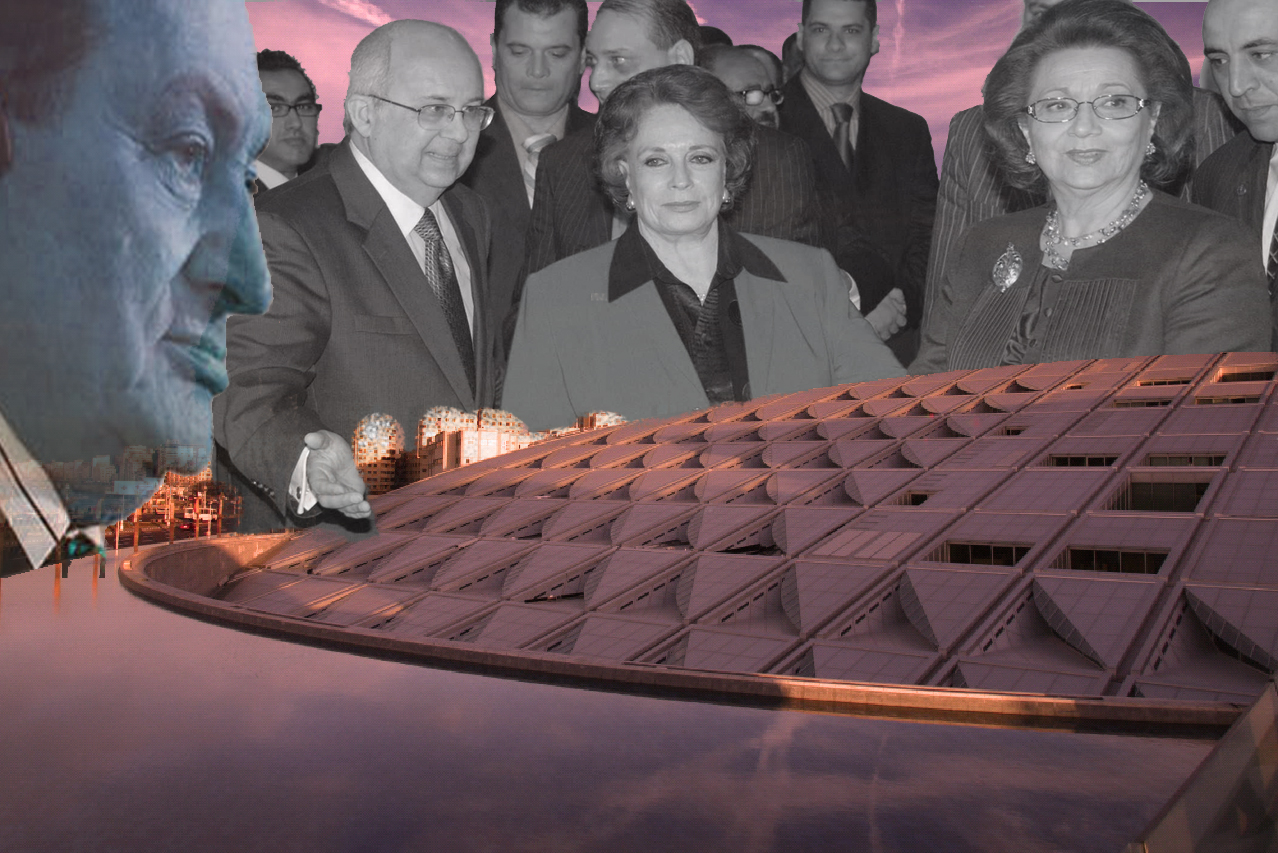
The late Samer Soliman argues in his brilliant work The Autumn of Dictatorship: Fiscal Crisis and Political Change in Egypt under Mubarak (p 87) that centralization also meant a shifting of resources to Cairo, which contributed to a dispirited Alexandrian public psyche that their city, which had relatively prospered in the monarchical era, was now relegated to a shadow of its former self. This was apparent in the self-styled culture wars of Alexandria’s elites to wrestle away from Cairo the reins of the country’s cultural leadership. Their significant achievement was the unveiling of the reincarnated Library of Alexandria in 2002.
An Illusionary Seduction
Alexandria’s ability to sway political dynamics throughout Egypt has much also to do with the socio-cultural relationship the coastal city establishes with population centers.
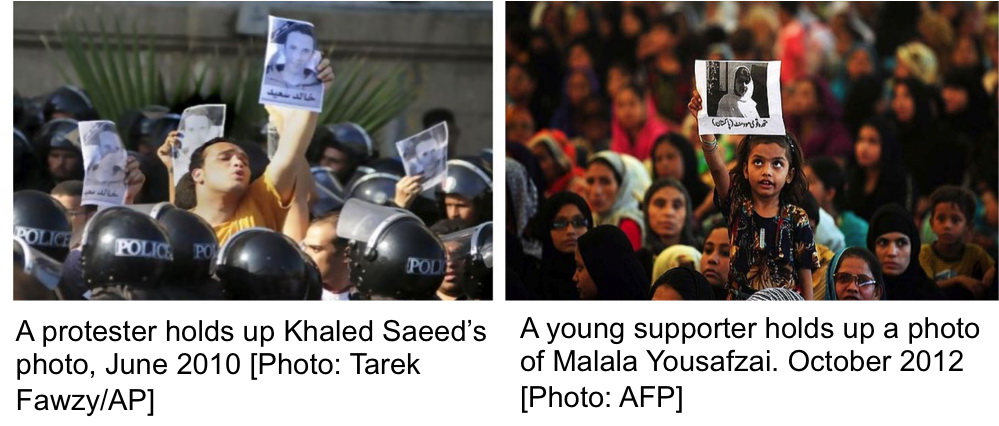
Power is relational and the Alexandrian diffusion of ideas and trends beyond city boundaries works, not so much because Alexandrians are effective in projecting their “pre-eminence”—underscored by cliché titles such as “Bride of the Mediterranean” and “Champion people”—to the rest of Egypt, but rather because Egyptians are predisposed to associate the coastal city with romance, escapism, summer holidays, and various positive connotations—connotations that are culturally reinforced by the popular arts. An idea or political actor coming out of Alexandria, the conventional story goes, can only be “good” for their equivalents in other cities, towns and villages. Therefore, Alexandria’s revolutionary actors, for example, embolden other revolutionary actors in areas of Egypt. This ideational soft power relationship operates effectively because influencer and recipient have an unspoken pact that is disproportionally favorable to Egypt’s second largest city. It partly explains why Khaled Saeed, the young Alexandrian beaten to death (some fifty meters away from the beach) who would be the spark of the 2011 Egyptian revolution, was elevated to chief martyr of the nation. This would have arguably been unlikely had Khaled died in Sohag or Aswan.

[Films set in Alexandria. The popular arts shaped multiple generational perceptions of the coastal city. Design by Amro Ali]
The other powerful effect of Alexandria has over the country’s imagination works effectively because most Egyptians have not been to Alexandria, and, therefore, it remains just part of their imagination. Islam Asem, a second generation Alexandrian, tells me “when I go back to my father’s village in upper Egypt, I am treated with such adoration as if living in Alexandria was like living in Germany.” Upon their excited first arrival in Alexandria, visitors often complain to me of the high rates of sexual harassment (arguably worse than Cairo), anti-Cairene merchants and taxi drivers, suspicions, snobbery, and a general in your face conservatism. It is not that these factors are alien anywhere in the country else, but Alexandria is held up to a higher standard and is expected to fill the shoes of its forebear that shaped generations of Egyptians in the twentieth century of how they relate to the city.
Cairo-based Ahmed Bahgat, Representative of the Lotus Revolution Coalition, spoke in July 2011 in downtown Alexandria to crowds of activists and protesters: “It is a great honor to be here in Alexandria, from which came the first martyr, Khaled Saeed…Your sit-in here gives us protesters in Cairo the motivation to continue our sit-in as you lend us emotional support. If you disperse, we cannot continue, as we draw our strength from you.”
Such an outlook is characteristic of Tahrir and revolutionary activists. Alexandria helped lay the mythical foundations of the revolution, particularly with the death of Khaled Saeed, but more so, it gave way to the title “Revolutionary Alexandria” following the victory of secular-Nasserist Hamdeen Sabahi who vanquished his opponents in the city by a large margin in the first round of the last presidential election (thirty-four percent as opposed to the fifteen percent that would be-President Morsi received that same round).

[Activists and Soccer Ultras from Cairo descend on Alexandria’s corniche for the second anniversary of Khaled Saeed’s death (6 June 2012) and to “inaugurate” their new revolutionary base. Photo by Amro Ali.]
Also for Salafists, Alexandria remains the home and metaphysical origin of their movements and for the Muslim Brotherhood, the incubator of their plans and base of their business networks. Importantly, the city’s utmost role for Egypt’s Copts, it is the official seat of the Pope and hence the title – Pope of Alexandria.
A Referendum’s Fracturing of a City, a Nation
Many observers were surprised at the recent referendum results in which Alexandrians voted to approve the constitution by a ratio of fifty-six percent. This figure, however, does not necessarily reflect the Islamists’ strength in Alexandria for a variety of reasons: The overall national turnout on the first stage of voting was low, thirty percent, compared to the presidential election of over fifty percent. Alexandria correlates with this trend. Out of a total of 3,347,770 Alexandrians registered to vote, only 35.76 percent turned out to vote.

[Breakdown of the recent constitutional referendum results for Alexandria’s districts. Diagram by Amro Ali based on data provided by the Coalition of the Revolution’s Youth]
Each election that took place in Alexandria since the outbreak of the January 25 Revolution operated under different circumstances and dynamic external factors, making it quite complex to compare them. However, the purpose of the above patterns is not to attribute causality based on correlations, but rather to emphasize that they are indicative of broader patterns that would need to be examined more closely by systematic research. Thus, it is clear that there is a tentative pattern that emerges, whereby voting behavior seems to be correlated with socio-geographic factors, and, perhaps relatedly, the degree of penetration by the Islamists’ social services and welfare network.
The largest anti-constitution camp came from heartland Alexandria, apart from the working class districts ofMoharram Bey and Karmus. The areas constituting the heartland have historically been the base of the public and private sector, coupled with a general societal harboring of suspicions of the Muslim Brotherhood. They also represent largely the Alexandria that existed prior to the 1952 revolution before mass urbanization over the successive decades would force the city to expand outwards—described sometimes as the “Alexandria Emigration”—with the state unable or unwilling to extend basic services to the new areas.
The heartland, which roughly stretches from El-Labban (Old Alexandria) eastward along the coast toward Sidi Gaber,[1] has more sway by the revolutionaries due to the progressive politics that permeates urbanization and relative social mobility. This was quite telling in my middle class suburb of Cleopatra Hamamat (also Khaled Saeed’s residence where his middle class stature connected with street activism), which falls under the Sidi Gaberjurisdiction, where the ‘No’ vote triumphed significantly, specifically 56746 to 32540.
Radwa El-Barouni, assistant lecturer at Alexandria University, points out that Alexandria’s “Yes” vote came primarily from severely impoverished districts and Greater Alexandria’s outskirts that are mainly made up of immigrant communities from the surrounding villages and the Nile Delta. The overlapping factor in places like East Alexandria’sMontazah and Raml Thani are overpopulation, extreme poverty levels, and, therefore, these are places where Islamists have been able to make inroads – through social welfare services, medical care, religious education – over the years at the expense of the failure of the state.
The grinding poverty in certain districts underpins a double advantage for Islamists. For example, Borg El-Arab andEl-Amreya have conservative Bedouin roots, and Mina El-Basal is strongly connected to its Upper Egyptian roots. In other words, Islamists who provide social services to their home of origins are not unfamiliar to such migrant communities who form part of the forgotten Alexandrians.
Overall, Islamist groups have been able to capitalize on their entrenched social services and welfare networks with two primary modes of attack. Voters would choose an Islamist position at elections and referendums out of a gratitude factor, as one lady told a BBC reporter that I viewed during the parliamentary elections “The Brotherhood helped me when my husband died.” But also the Islamist framing of the “Yes” vote as a religious duty connected to afterlife ramifications or even the play on identity politics sheds some light on poorer districts voting patterns.
To a considerable extent, the real strength of Islamists tends to be overestimated and poverty does not necessarily hold a causal relationship with conservative voting patterns. There are other factors that seem to contribute to Alexandria’s voter preferences, and which I observed during my volunteer work for Shayfeenkom (the voter fraud watchdog) in May. For example, grassroots support fostered by socialist Abul Ezz El-Hariri in Moharram Bey was prevalent during the presidential elections, as well as Sabahi’s neo-Nasserism, which resonated with the working class district and saw voters abandon conservative candidates. This makes sense when one considers that during the 1950s and 1960s Moharram Bey saw established families move out and rural migrants move in to undertake work in factories set up during Nasser’s reign. Since then, they have been a die-hard Nasserist constituency.
Moreover, the low turnout in the referendum may have been a sign of voter fatigue, “their rationale being we have voted five times in less than a year and a half and nothing seems to be working,” says El-Barouni. Apart from the pro-stability card, voting took place in a climate of extreme polarization and shortage of time for the public to undertake proper discussions over the proposed constitution. Moreover, the reported irregularities have been of great concern (and, thus, if anything, the diagram should be used as a rough indicator of trends rather than actual results).
The Ecosystem of Street Politics
An accident of geography and urban planning determined how Alexandria’s protests would unfold and communicate with the rest of Egypt—in ways that, in my view, recent events aside, are better coordinated compared to the chaos in Tahrir. The city’s street politics were long hindered by the absence a large public space like Tahrir Square to accommodate the masses. Qaed Ibrahim was chosen during the 2011 uprising because Sheikh Mehalawy’s anti-Hosni Mubarak sermons were seen as the natural gravitational center—that is, at a time when he was less divisive. Distant public spaces such as Mahatet Masr and Mansheya were gradually abandoned in favor of the new frontline.
Yet the vicinity of Qaed Ibrahim could hardly be considered large enough, and this frustrated protest organizers that they, alternatively, pioneered various styles of protest marches across the city, projecting a heightened political exposure to crucial communities. Eleven suburbs, which incidentally voted “No” in the referendum, are crossed by the time such marches would reach the endpoint of Sidi Gaber. Alexandria’s urban politics is advantaged due to it being closely tied to the crisscrossing of people and ideas, which is arguably more rapid, unlike the capital, in the coastal city due to its linear grid-like structure and low transportation cost. This means street mobilization is more feasible than it is in other cities—a feature that works well for revolutionaries and Islamists alike.
What strengthens Alexandria’s revolutionary modus operandi is its close proximity to key, intertwined battlegrounds. The Bibliotheca Alexandrina, with its debates, seminars, exhibitions on the revolution and how to move Egypt forward, was transformed into the soul of the revolutionary youth community and civil society. More significantly, the revolutionary movement also benefited from the Bibliotheca’s physical grounds which are often used for protests. This is reinforced by the adjacent Alexandria University’s colleges of arts, law and commerce, which provide the vigor of student politics – while weak in organization but deliver the numbers to their respective causes – to the extended revolution. Thousands of disaffected students, who gravitate from apolitical spectators to hardened activists, enhance the creativity and momentum of the erratic doorstep away street politics that maneuver between the grounds of the campus, library and mosque.
Such dynamics fuse youth politics, religious politics, with an intellectual-creative drive that energizes the street and acts as a temperament, more often than not, against violent forms of protest. All these dynamics are important to note as it means a certain honing in of messages that carries a particular media-fuelled “Who runs the show” narrative to the rest of Egypt and are digested by respective actors. (See the visual timeline of the revolution in Alexandria on my blog).

[The close proximity of the three zones of unrest. Design by Amro Ali.]
Where to after the Constitution?
Such factors should not mask what social scientist Samuli Schelke insightfully points out, that Alexandria is relatively divided into two forces. On one side are a diverse set of revolutionary leftists and liberals who, from the ideological standpoint, seem to have the upper hand, and are more in line with Alexandrian urban public opinion. The other happens to be the conservative Islamists who excel at exerting their organizational clout and have now been re-armored with the emergence of a number of loosely organized Islamist movements that are unaffiliated with political parties but seek to defend the Islamist project. These include Hazemoun, the Third Islamist Current, and the Salafist Front. The crisis that started with President Mohamed Morsi’s power grab and the constitutional referendum has left deep fractures throughout the nation. Alexandria, once known as the Islamist bastion, has thrown up a range of political bastions and which actor prevails will depend on who can hold their fort out the longest.

[Revolutionary protestors battle out Islamists in the back streets of the Azarita neighborhood on 21 December 2012. Photo by Sameh Meshally from Alex Eyes Facebook Group]
In some ways, Alexandria, as the nation’s bellwether, highlight the troubling dilemma that Islamists face: To hold onto power, they will have to rely mainly on rural, low-income constituencies. If Morsi continues the same unimaginative Mubarak era neoliberal policies – in a worsening economic climate wherein the Egyptian pound has fallen to an all almost decade low and Egypt’s credit rating has dropped to “Greek” proportions – then unrest will be ignited sooner and will be more difficult to contain.
Yet even if the Morsi government devised a miraculous economic and social plan grounded in their economic orthodoxy to pull Egypt through, it would eventually (though it can also be argued that it has already happened) nurture the growth of an environment that structurally strengthens a progressive and anti-system politics, and this will eventually create further unrest and a much stronger opposition.
The looming danger for the Islamists is not a failure of policies, but the rapid erosion of Morsi and the Brotherhood’s legitimacy in public discourse. Their gamble at abandoning the urban gravity centers of Cairo and Alexandria means they will remain an organized but fractured political actor. In order to achieve tactical objectives (such as elections), Islamist activists will be forced to become more beholden to the Brotherhood’s meddling Guidance Bureau, seek the services of the Brotherhood militias (like at the presidential palace early in December), appeal to Salafist allies, fan the flames of sectarianism, and play the identity politics card. Whereas tactical objective may be achievable, the trajectory employing the above inevitably destroys their strategic longevity as a credible political player. Morsi and the Brotherhood could have earlier on chosen to form broader coalitions to build up political capital to heal a polarized nation and reform the stubborn institutions, instead they chose a course of action that put them “past the point of no return.”
One of several concerns for me over the past two years has been the appropriation of religion and thrusting it onto a dangerous identity based politics trajectory in the city of Alexandria. I cannot help but make a personal contrast. As a child, my uncle, a Muslim Imam at a local mosque, would often take me with him on routine runs, in the Alexandrian suburb of Camb Shezar (Camp Caesar), to assist an old widowed Christian lady, and in contrast with the conventional discourse adopted by “TV celebrity sheikhs,” I had never heard him use the word infidel, demonize others, or even raise his voice. To me, what he humbly did and does until this day is a revolutionary act in the face of an encroaching reactionary Islamist conservatism that continues to inflame the toxic mixture of religion and politics. Not only is this trend severely harming the social fabric of the coastal city, but also it is sending disturbing signals throughout the country.
It is often said the one who controls Tahrir, controls Cairo, and controls Egypt. Yet it can also be said the one who wins the ongoing “Battle of Alexandria” is handed the baton, like a Maestro, to wave and direct the tempo, rhythm, nuances, and dynamics of Egypt’s political orchestra that plays to an 83-million strong theatre—all yearning for a happier ending.
[1] It can also be argued that this extends, based on similar voting behavior and socio-economic patterns, up until San Stefano where it dilutes before the Salafist stronghold of Sidi Bishr, where the head of the Salafist movement,Sheikh Yasser Borhami, resides.
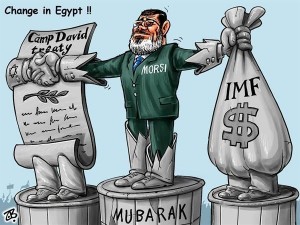 In 2007, Mohammed Morsi, then chairman of the Brotherhood’s political department and member of the Executive Bureau, complained of the inability of Washington to match its rhetoric on promoting democracy in Egypt. He said that Israel had no interest in a democratic Egypt as it, “would do more to support the Palestinians.” Now Morsi, having brokered a Gaza ceasefire has shown that his policy on the Palestinians is no more imaginative than Mubarak-era policies and, partly as a result of US approval, has undertaken a democratic rollback that has ignited Egypt’s streets.