Bringing Philosophy and Sociology to the Egyptian Public

I wrote a brief essay for the Forum Transregionale Studien on the techniques I undertook to teach sociology and philosophy to the Egyptian public and to elevate the agency of the audience members.

تجد/ين هنا النسخة العربية لهذا النص.
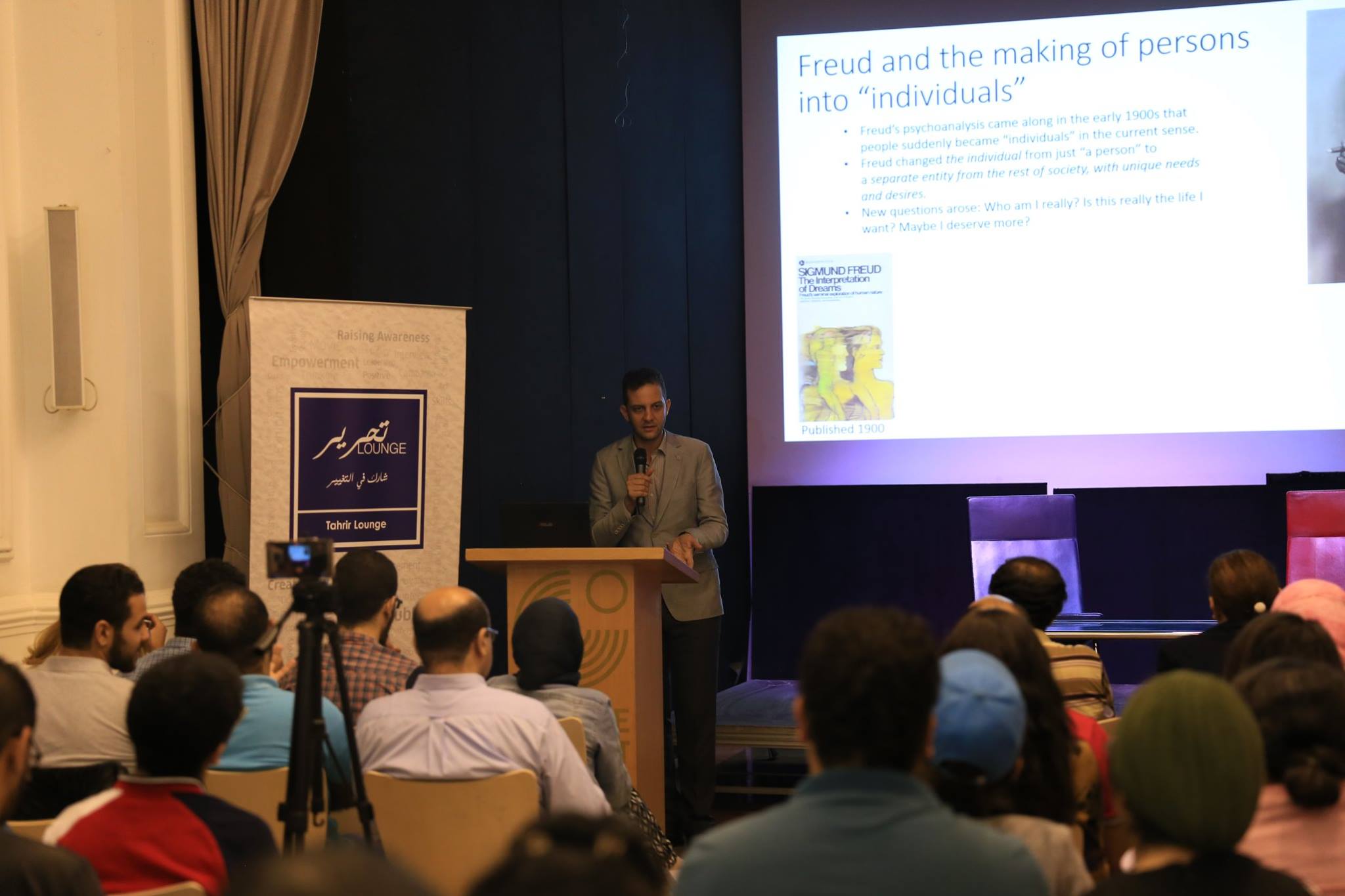
An enthusiastic Egyptian youth exited the closing of a lecture event in late November 2017 and rushed to a coffeehouse near Tahrir Square to meet up with his friends. He told them about this woman thinker called ‘Hannah Arendt’ who he just learned about and her peculiar idea of ‘new beginnings.’ Several nearby curious patrons overheard the chatter and enquired about the philosopher. The social circle widened, and the youth continued discussing the lecture that he had just attended. It would see some of the patrons coming to the next lecture session on Walter Benjamin’s loss of aura concept.

The youth had attended the first event in a long series of lectures and workshops (2017–2018) that I co-ran with Mona Shahien, the director of Tahrir Lounge Goethe, in Cairo, Alexandria and Minya, mostly in Arabic and some in English, that aimed to introduce philosophy and sociology to the Egyptian public in a comprehensible and practical way. I want to focus on the audience participant as an agent and I will outline, albeit not exhaustively, how the public teaching of sociology and philosophy can be merged with a certain structure, approach and content that elevates the agency of audiences. The project consisted of ten lectures; a workshop on Benjamin’s storytelling and aura, Arendt’s Vita Activa and Vita Contemplativa, and a theater play. I will focus mainly on the lectures as they were the primary thrust of the project and hold promise for academics, intellectuals and practitioners who seek to convey the ideas of the academy to the public.

Amro Ali at the “Animating Spaces of Meaning” event (10 April 2018). © Tahrir Lounge Goethe Institute Cairo.

The Theatre of Thought (not a theater as such but lectures) manifesto could be summed up as:

the public should be recognised, and elevated, as the primary ideal, and the individual’s present difficulties in experiencing or attaining pluralism and civic responsibility is tied to the city’s loss of meaning and the citizen’s alienation from one another. The development of philosophical thinking can help address this malaise.[1]

The project explored the notion of restoring the individual’s dignity and agency by ‘recalibrating’ them both to relate to the city. It raised the following questions: How can historical imaginaries, ideas, persons, sensibilities and aesthetics work their way into renegotiating the citizen’s relationship to the city? How can a crippling nostalgia be appropriated for a forward-looking civic vision? How do philosophical themes make one understand the familiar spaces, such as neighborhoods and coffeehouses, better? How can individuals and groups endow their urban terrain with a clearer identity and a relatively better coherent narrative? Does self-expression disguise a different set of established rules and practices in which nonconformity begins to look quite similar? How do we reconcile the digital order with the terrestrial order? What are the implications of perceiving the other, in terms of trustworthiness and reliability, when they are dissolved in a digital swarm?

Poster for the “Ambiguous Promises and the Fragmentation of Responsibility” event (1 November 2018) that probed into what becomes of the idea of responsibility when today’s digital communications are perilously thrusting the individual into a world of arbitrariness, nonbinding obligations and short-term gains. © Tahrir Lounge Goethe Institute Cairo.
Amro Ali and Mona Shahien, “The Creative Public: How New Publics Are Born.” An event (5 December 2017) that drew from the ideas of Václav Havel and Gilles Deleuze to examine how publics are summoned into being through intellectuals, musicians, artists, books, proclamations and events. © Tahrir Lounge Goethe Institute Cairo.

It has been my long-running interest to merge the field of sociology and the ideas of philosophy to produce a particular type of discussion for Egyptian and Arab contexts. One way to do this was to approach an underdeveloped subdiscipline: Sociological philosophy. The American sociologist Randal Collins describes and validates this area as such: “[N]ormative self-reflection is a fundamental aspect of sociology’s scientific tasks because key sociological questions are, in the last instance, also philosophical ones” and “[i]f knowledge (or discourse in general) is social, then sociology should be in the most important position to reflect on the nature of philosophy as a form of knowledge or discourse.”[2] To put it another way, philosophy on its own is akin to the blazing sun, while sociology lends the shades that slightly obscure but reveal hues, tints, tones, tinges and contours of the philosophical subject. Philosophy in its ‘purest’ essence can be at high risk of handicapping itself from conveying ideas, making dense texts inaccessible and driving away readers and listeners.

Engaging Agency

Why would a university student in Assuit take the five-hour train journey specifically for an event in Cairo and return the same night? How do we end up with a peculiar scene of an Azhari scholar seated next to a worker from a jeans factory? The why question is critical to make sense of agency and what motivates people to come to an event mostly out of their domain of studies or usual interests. The answers to these questions were helped by the post-lecture conversations and the efficient feedback mechanism instituted by the Tahir Lounge Goethe. Part of the reason why the events could attract audiences was due to Shahien strongly believing in the project’s endeavor, prioritizing it, and putting resources into organization, promotion, and translation. In Cairo’s case, it was also helped by the venue, the Goethe Institute, being central and easy to reach by metro. Moreover, like all cultural spaces, there is often a significant number of returning audience members. However, there were overlapping and distinct factors that need further explanation.

“Thinking in the Swarm: When Awareness and Knowledge Succumb to the Information Deluge,” the final event in Alexandria (22 November 2018) that explored how digital technology bulldozes the principles of thinking: Discernment, discrimination, selection and even forgetfulness. © Tahrir Lounge Goethe Institute Cairo.

The motives included many attendees seeking, to an extent, to compensate for a dysfunctional education system. For a number of young women from conservative families, the evening events were a way to justify their absence from home to gain extracurricular educational value. It was often some sort of dissatisfaction with the status quo as a sufficient underlying motive for going to these types of events. A number of audience faces at the start of the session revealed a weary gloom as if they had stepped out of the trenches of the suffocated public sphere. They did. The facial expressions are what one would expect after a two-hour long-winded session. Ironically, in many instances, it was the reverse in these events. Where frowns can also eventually turn to smiles. These places have become, in some sense, the last spaces of refuge from a public sphere that is increasingly criminalizing independent thought and non-officially sanctioned culture.

The “Animating Spaces of Meaning” event (26 April 2018) at the Jesuit Cultural Centre, Minya. © Tahrir Lounge Goethe Institute Cairo.

The audience participant’s voice and disclosure of identity was essential to their agency; the lecture often allowed a rolling conversation as the presentation unfolded. It was important to create sufficient breaks and meetings after the session, actively introduce members of the audience to each other and ask for their names. What may seem as banal or routine in any lecture event was often a profound experience for many of them. Some had never been in a situation at university in which their ideas were solicited or allowed to challenge the instructor. This was not unique to the project, but it did emphasize the importance of building a small community out of the sessions. The other approach to agency involved throwing down a challenge. Instead of me simply giving book recommendations, I asked them to head to the used book markets in Cairo’s Azbakeya or Alexandria’s Nabi Daniel street to engage with the books that seize their interest. Many did so. For some, reading a book after graduating from university was unheard of unless it was for work purposes.

The event always started with a powerful relatable metaphor. It would be the spearhead that set the tone for the lecture. Metaphors included, for example, the legend of Icarus, the Flying Dutchman and a vintage photo of a woman at the station waiting for the train. The metaphor when employed compellingly enabled the audience to project themselves onto the unfolding narrative of the night and add depth to the dizziness of their alienation, review their perception of social problems and kindle a reconstruction of imagination capacities needed for thinking through social and moral quagmires. It also helps to focus on the philosopher’s topic rather than the philosopher to avoid the problem of mini cults growing around the respective philosopher. This is why the philosopher’s name was not included in the lecture titles.

One of the hurdles can, at times, be dispelling the myth that philosophy is opposed to religion. This often needed to be discussed from the outset, and it helped by pointing out that Abu Hamid Al-Ghazali and Augustine of Hippo, among many others, were philosophers. A Muslim woman in a hijab in Minya said to me during the lecture break, “I had always feared philosophy as I felt it was atheist-driven, but I came to it through Kierkegaard because he was Christian.” This was interesting although not unusual. The religiosity of the philosopher or books that show a substantial overlap with faith made audiences highly engaged. Starting off with Arendt’s idea of forgiveness and briefly referencing Islamic and Christian texts on forgiveness, for example, helped to give the philosophical conversation a holistic formation and relatable intimacy without losing sight of the ongoing discussion.

“Animating Spaces of Meaning” poster. © Tahrir Lounge Goethe Institute Cairo.

Conclusion

This paper briefly examined the conditions and method of bringing sociological-philosophy to the Egyptian public, as well as the role of agency that engages audiences. I hope in future to expand comprehensively on the concept and look at class, social strata, generations, audience dynamics, content delivery, translation and the project’s successes and setbacks, among other factors.

Following the closing of the “Creative Public” session in 2017, a boy scout leader from the audience approached Shahien and said he wished he brought a 19-year-old boy scout he knew to these events. Shahien replied that he can bring him to the next session. The elder replied this was no longer possible as he had recently met the youth at a Cairo coffeehouse to discuss his future that would see him enter the college of engineering. During the chat, the waiter serving the coffee overheard them and stated that he himself had recently graduated from engineering. The prospective student was struck with horror that this could also be his future – serving coffee after completing some four hard years of engineering studies. Two days later, he committed suicide.

This tragic incident would shape successive events. Animating Spaces of Meaning sought responses to the rise of mediocrity and fragmentation of meaning that have become a familiar part of everyday urban life. It also elucidated that all study disciplines, professions and workplaces of all stripes can have their dignity, respect and even charm. Engineering and medicine should not be the only attainable routes to powered social mobility; the social sciences, arts and humanities, and any other stigmatized disciplines, for that matter, need to be elevated into highly respected areas of study. Conveying the sociological-philosophy lessons also means keeping a pulse on the lives and stories that the public brings to the sessions and then responding and shaping the following session accordingly. In some respects, it echoes Hannah Arendt’s personal axiom that “thought itself arises out of incidents of living experience and must remain bound to them as the only guideposts by which to take its bearings.”[3]


[1] Amro Ali, “When the Debris of Paradise Calls,” Amro Ali, 15 December 2017, https://amroali.com/2017/12/debris-paradise-calls-philosophical-concept-play/ [accessed 15 February 2021].

[2] Collins, Randall, “For a Sociological Philosophy,” Theory and Society 17/5, 1988, 669-702, 671. https://doi.org/10.1007/BF00162615.

[3] Hannah Arendt, Between Past and Future: Eight Exercises in Political Thought, Harmondsworth: Penguin, 1977, 14.


This project is part of the activities of the Arab-German Young Academy of Sciences and Humanities (AGYA). The introduction to this blog series by Nuha Alshaar, Beate La Sala, Jenny Oesterle and Barbara Winckler can be found here.


Citation: Amro Ali, Bringing Philosophy and Sociology to the Egyptian Public, in: TRAFO – Blog for Transregional Research, 15.04.2021, http://trafo.hypotheses.org/28053
Unhappiness and Mohamed Salah’s Egypt

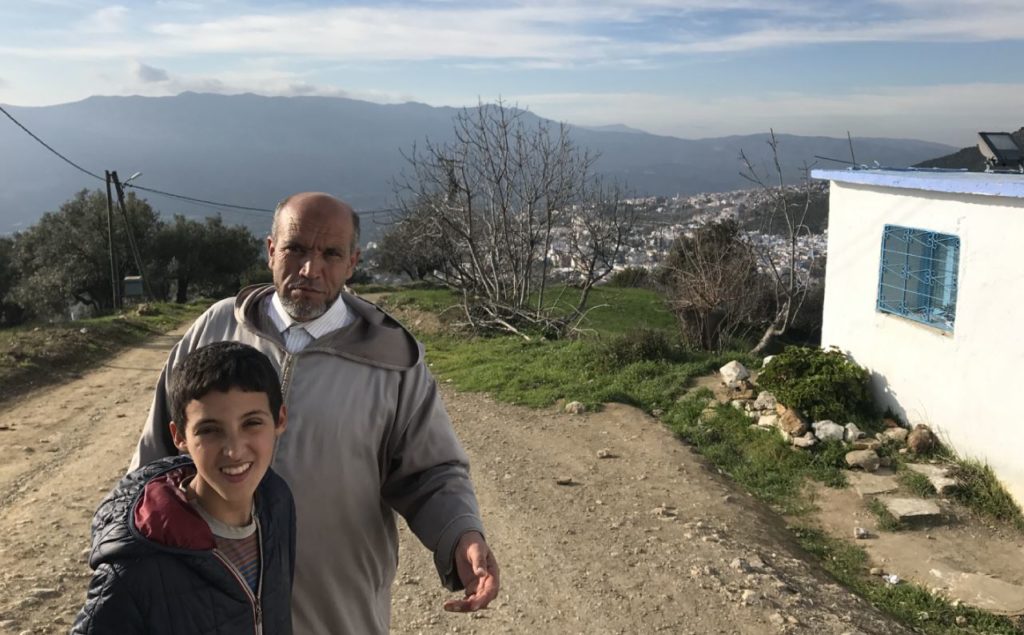
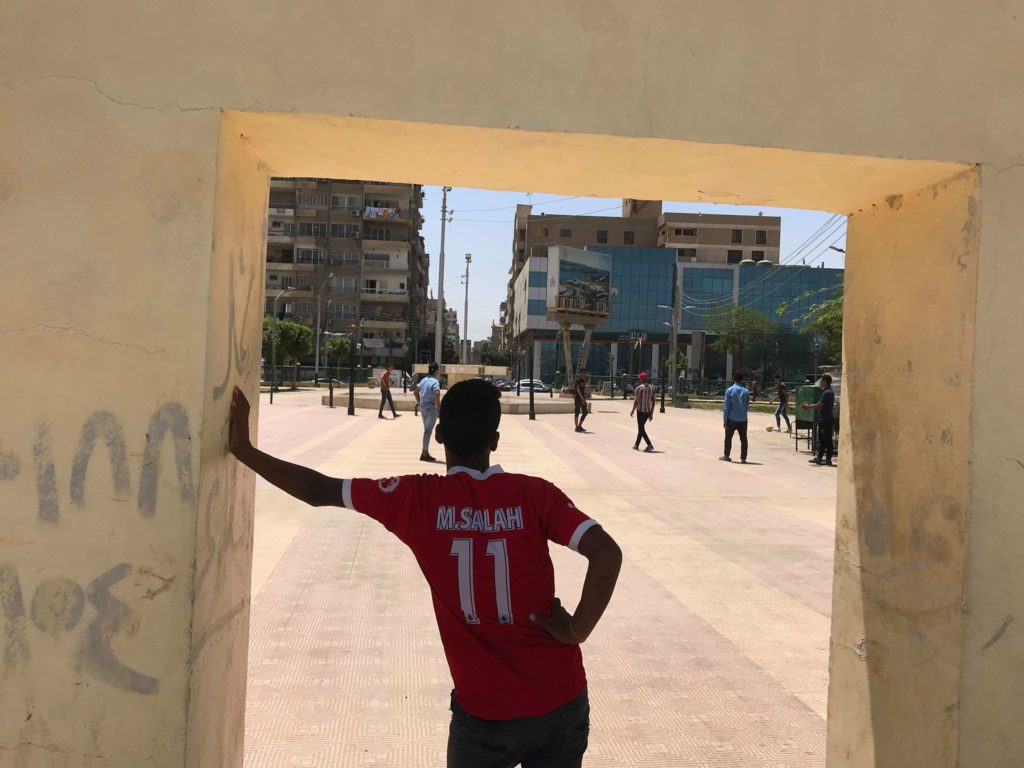
Football in Minya, Egypt.

 Published in Mada Masr, republished in openDemocracy, and Internazionale (Italian print edition)

“Unhappy is the land that breeds no hero,” Andrea cries in the 1938 play, Life of Galileo, by German dramatist Bertolt Brecht, to which Galileo responds: “No, unhappy is the land that needs a hero.”

Egypt can be that unhappy land, a land where farewell parties have outstripped homecoming parties. Where a young female doctor laments she wants to leave because “to give birth to a baby here feels morally wrong, it feels sort of illegal.” Where a juice seller sarcastically quips, “We no longer have time to think of anything else but survival, we don’t even have time to contemplate suicide.” When a country is mired in endless social and economic problems, and smothered in despair, the yearning grows for that batal (hero), that one human figure where all painful and complex abstracts will be realised within and resolved without.

Something happened in Egypt that short-circuited a sport that is often treated by governments of all persuasions as a distracting bread and circus for the masses. Something interrupted the despotic drive to stamp out the uniqueness from the flow of Egyptian life.

Enter Mohamed Salah armed with a moral code.

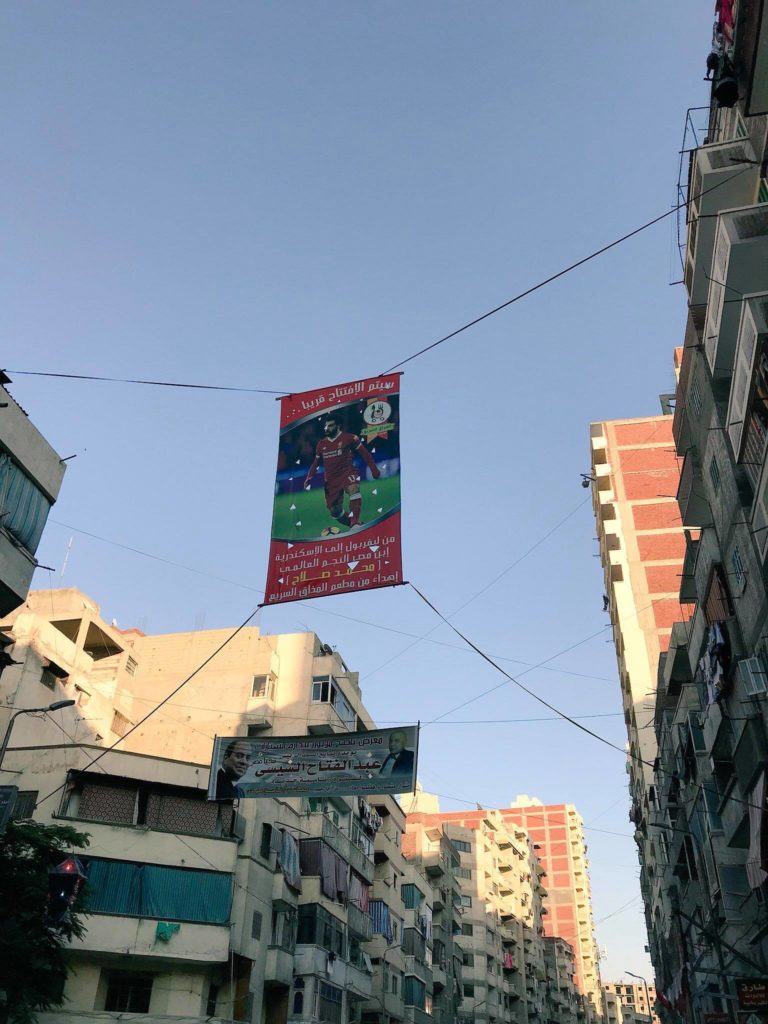
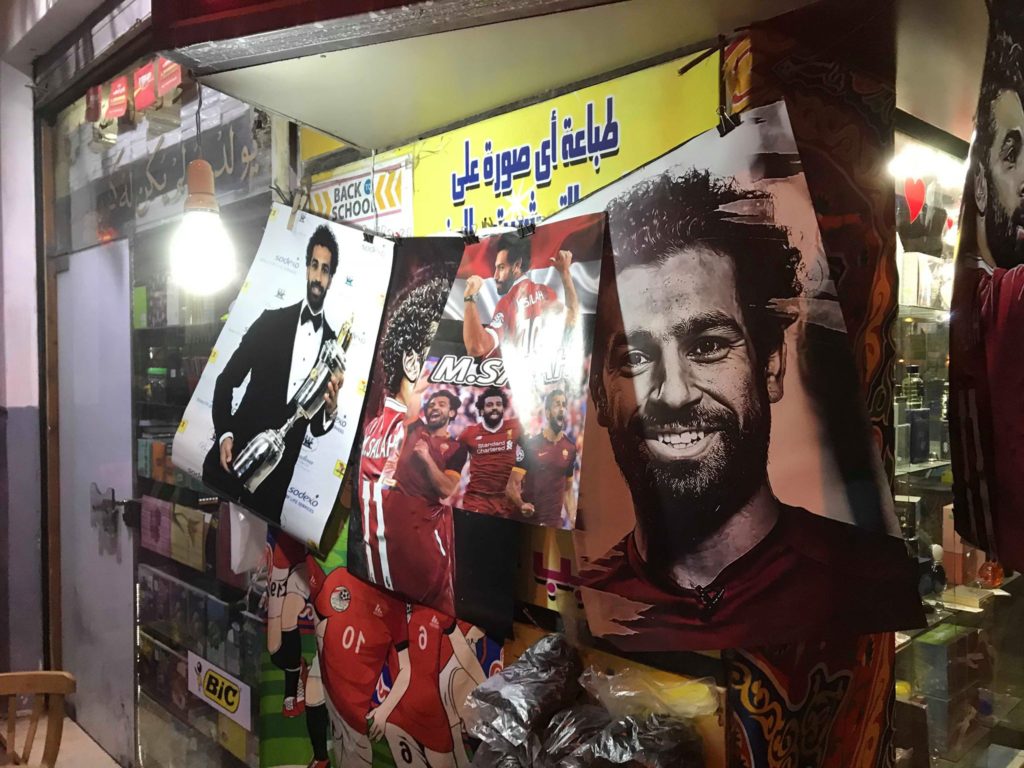
Mohamed Salah banners and merchandise (Sporting, Alexandria).

While Salah is seen to bring hope to many, he is an unsettling spectre that silently haunts the establishment, for he has options, international prestige and the perception of untouchability. He has grown to be more than a hero of football success. Salah is a different sort of hero, he is a hero of disruption, and a living paradox of a political voice without talking politics. Salah operates in a politics of juxtaposition in which his perceived immaculate persona is unconsciously contrasted with the familiar polluted forces of high politics.

While many of Egypt’s prominent and established figures seem to have an answer for everything, Salah shows up and we’re faced with difficult questions. Namely, why are we investing so much hope in one man? This is more than about the World Cup.

Salah is not a substitute for viable high politics. He is, after all, a football player, and a very good one at that, but his insertion into the volatile Egyptian climate sheds some light on what has gone wrong and why the current fervor around him can illuminate the question of Egyptian unhappiness.  

Salah’s stance to steer away from politics, or from inadvertently disclosing his political leanings, has given him an amplified united base. Since the 2011 revolution, Egyptians have had to live with binaries: revolutionary versus counter-revolutionary, secular versus Islamist, civilian versus military, liberal versus hyper-nationalist, pro and anti-Brotherhood, among others. While many of these binaries have diminished under the shadow of the generals, the unity that has come in its place is a negative unity. It is almost always against something, such as terrorism, and when it stands for something, let’s say Egypt, it’s a nationalist straightjacket that is imposed, with no room for plurality of thought or voices.

Salah might just be the first figure in a while behind which pro- and anti-regime supporters can unite. In the words of an Egyptian doctoral candidate studying in California, “Salah is the reason I’m mending my relationship with Egypt.”

It has become commonplace to argue that unhappiness in Egypt is caused by high unemployment, poverty, dysfunctional education, censorship, a crackdown on independent voices, and overall human rights abuses. While there is no doubt these factors contribute to the misery of many Egyptians, there is something worse and pathological that lurks behind them all: The grim reality that new possibilities no longer emerge on the horizon. The dilution of hope that once offered the promise that unhappiness was a temporary moment, now feels for many like the ink of sadness has dried. Depression disarms you before repression even has time to put on its uniform.

For this reason, Salah is like a sudden assertion of human values within a dehumanising system. This did not arise when Salah helped defeat Congo, propelling Egypt into the World Cup last October. Astonishing football talent is not always enough to convert non-football watchers. Nor did his story of humble beginnings to stardom take hold in this moment. There was nothing original in any of these individual success stories. Perhaps because they remained just that: individual.

But then came the other, and equally decisive, side of Salah. Barely two weeks after this victory, and because of it, Salah was offered a luxury villa by entrepreneur Mamdouh Abbas. He politely declined the gift and suggested that a donation to his village Nagrig in Gharbia would make him happier. This move, along with many of his charitable acts, for non-football fans, including myself, was thunderous to say the least, and swayed us to his camp.

To put the implications of this act in a wider context: Cairo’s highways are nauseatingly choked with billboards flaunting the latest exuberant luxury real estate and gated compounds. It is an assault on the senses of millions of Egyptians who are puzzled as to how such developments take place in an era of painful austerity measures, in which they are being asked to continually sacrifice. The billboards, almost always in English and at times with white, blue-eyed European faces, loudly proclaim, “It’s time to think about you,” and, “This time it’s personal.” It is not enough that Egypt’s capitalism on crack and real estate speculation is skewing the economy, but it also ramps up hyper-individualism, greed, and various strands of self-hatred.

Salah’s rejection of the villa was a violent piercing into a culture of the grotesque and excessive, and signified his upholding of the values born, or crystallized, during the 2011 revolution that put the common good above all. His refusal was a significant breach in the business-as-usual patronage and wheeling and dealing circles. If Salah was loved for his victory over Congo, he was now respected more for this move and the many charitable stories that emerged, making it obvious that this has been his character for a long time, and that he didn’t reinvent himself for PR purposes. Love and respect are two different beasts. Egyptians have long missed looking up to someone who commands respect, at least someone who is not in exile, in prison, or long dead.

In recent years, Egyptians have had to live with the exhausting spectacle of doublespeak in which official interpretations are often in conflict with lived realities and common sense. The train heading to Alexandria is declared to be on its way to Aswan, as veteran journalist Yosri Fouda once put it. This war of attrition on rationality has plunged Egyptians deep into a spiral of conformity, scepticism and indifference toward each other. The idea of the higher good receded as officialdom continued, in Czech philosopher Václav Havel’s words, “not to excite people with the truth, but to reassure them with lies.” The intervention of Salah did not necessarily change all that, nor did it reverse the Orwellian trend, but he did help restore meaning to terms that had become scrambled: dignity became dignity again, principles became principles, kindness became kindness, and happiness became happiness.

Salah touched on another existential question within Egyptian state and society: the strong desire for international recognition. This phenomenon weaves its way through Egypt’s modern history. There have been concerted efforts to export Sisi’s branded Egypt, for example, with the new Suez Canal project billboards dotting New York’s Times Square with the slogan “Egypt’s gift to the world.” Salah, instead, lived up to fulfilling that slogan in a much more dramatic and compelling way. In fact, Salah has arguably had more impact on the world’s positive views of Egypt than all the recent years of tourist campaigns, international conferences and mega projects combined. In light of this, mentioning Salah in conversation can give many Egyptians a feeling of breathlessness, tingling hands and a sensation of weightlessness.

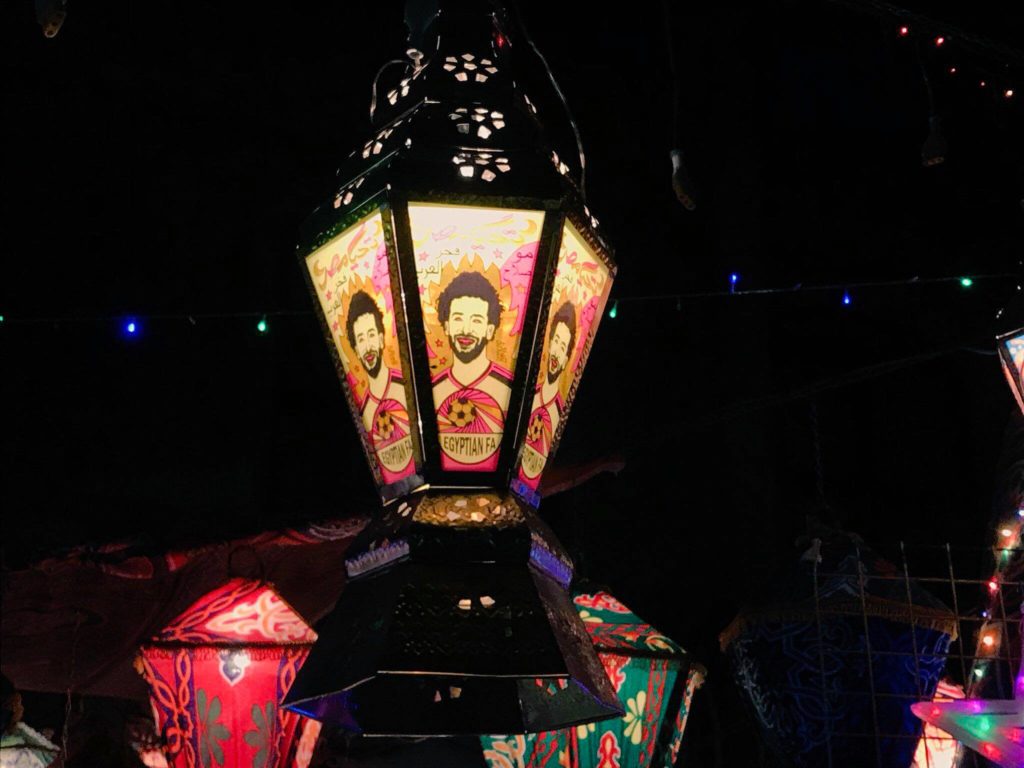
Ramadan lantern (Camp Shezar, Alexandria)
Ramadan lantern (Maadi, Cairo)

This in part has to do with the function of happiness and meaning. If the regime is not suffering from cherophobia (fear of happiness), it believes it can commodify happiness by stating it intends to make “Egyptians among the world’s happiest,” or through the recent discussions with the UAE’s Ministry of Happiness to “export” some of their cool psychedelic juice to Egypt.

Happiness is a question that spans a history of philosophical musings, from Aristotle’s Nicomachean Ethics, to Al-Ghazali’s Alchemy of Happiness, to Nietzsche’s Twilight of the Idols and the Antichrist. All of them would shun the Anglo-inspired utilitarianism of John Stuart Mills that speaks of happiness as the ultimate net objective and has been largely repackaged for neoliberal modernity, rather than a meaningful higher life that produces happiness as a by-product. In other words, you cannot separate the attainment of happiness from respect for justice, dignity, honour, etc. It doesn’t seem to phase the authorities that happiness is meaningless without rescuing vibrant citizenship, opening public spaces, providing fair trials, encouraging pluralism, and preventing overall existential meaning from being fragmented.

Salah offers glimpses into the voids spawned by the above fractures as he communicates not only on the instrumental level of football success, but with meaningful and empathic qualities that come with an honourable character. It is no wonder that Salah was able to inspire calls to a drug user helpline to shoot up by 400 percent.

Salah’s fame, coupled with his stance on religion, comes interestingly at a time when many Egyptians are renegotiating their faith, identity markers and boundaries. The norms of what once constituted a religious person are breaking down under the weight of the country’s endless contradictions. All this takes place beneath the purview of a state that uses religion to arbitrarily police the public space, and preachers who continue to push a baroque Islam at the expense of the religion’s humble essence.

The rise of a widespread spiritual passivity contrasts with Salah’s faith, which has come to animate his public life. He saw no need to dismiss or distil his Muslim identity, even after he achieved a turbo-charged social mobility and stardom. This is not lost on many. The sight of Salah’s veiled wife, Maggie, by his side on a green oval in a European city before the eyes of millions, is a hypnotic sight to Egyptians (and the rest of the world) precisely because it is unusual, particularly at a time of heightened anxieties toward Muslims in the West. “I respect him as he is not embarrassed nor does he try to hide his veiled wife after all that success,” an Alexandrian barber says.

It is for the same reasons that Salah can sprout pan-Arab and pan-Islamic wings across the Arab and Muslim world. He has made it into Lebanon’s graffiti scene and protest ballots in the Lebanese elections (just like Egypt) to a bizarre planned peaceful protest outside the Spanish embassy in Jakarta after the injurious tackle by Sergio Ramos. The Arab world’s traditional idea of a leading, strong, vibrant, noble and outward-looking Egypt – one that spearheads the arts, preserves the seat of intellectual Sunnism, champions pan-Arabism, and stands up for the Palestinian cause – is projected onto Salah with deafening force. Between prostrating on the grass and raising his index fingers to the heavens, hundreds of millions of Muslims are drawn to this well-understood language of piety.

But this attraction transcends culture and religion. As the western world is bogged down in neoliberal sterility, rampant consumerism, loneliness, high-level scandals, populism, xenophobia against refugees and immigrants, anti-Muslim bigotry, anti-Semitism and fake news, the multi-layered Salah – the intimately relatable footballer and loving father who kicks a ball with his daughter Makka – stands out like a moment of truth and living universality, with a mammoth mural recently going up in Times Square reflecting his larger than life image.

Albert Camus wrote to an estranged German friend in 1943: “I should like to be able to love my country and still love justice. I don’t want any greatness for it, particularly a greatness born of blood and falsehood. I want to keep it alive by keeping justice alive.”

Salah perhaps embodies this ideal. That love of country does not require drums and chest-beating, but grace, sincerity, modesty and charity. He is a reminder to Egyptians that there exists a better human nature in a landscape barren of prominent reverential role-models. To Egypt and even the rest of the world, Salah is the outlier that proclaims the alternative to nationalism is not treachery but civic responsibility, the alternative to stifling religious conservatism does not always have to be apathy or mockery of the sacred, but breathing faith into a sound value system, and the alternative to injustice can be forgiveness. Ultimately, people had almost forgotten what humility among those with renown looks like. Particularly, a humility that is relentless and consistent, despite being trialled under the stadium floodlights and the stars sprinkled across the Liverpool night sky.

A Salah poster in Sidi Bishr, Alexandria.

Salah is the rare homecoming party Egyptians have long awaited. His face on dangling lanterns lights up dark alleyways, and his colourful posters germinate over the debris of fading election posters in a country that sees official and media-manufactured heroes reckon with publicly-anointed heroes.

While it cannot be implied nor expected that Salah could impact the political situation in Egypt, his animated existence spotlights entry points back into the realm of authenticity. He widens the moral imagination of an attentive public and parades the possibilities that infer that the rhythm of life involves more than birth, marriage, death and even sports. He also raises questions that many power-holders will have to grapple with eventually, someday: That, above all, there are reasons why people ache for heroes in the first place. — What have you done to make them this unhappy?


How Egypt Functions in the Moroccan Imagination (photo essay)

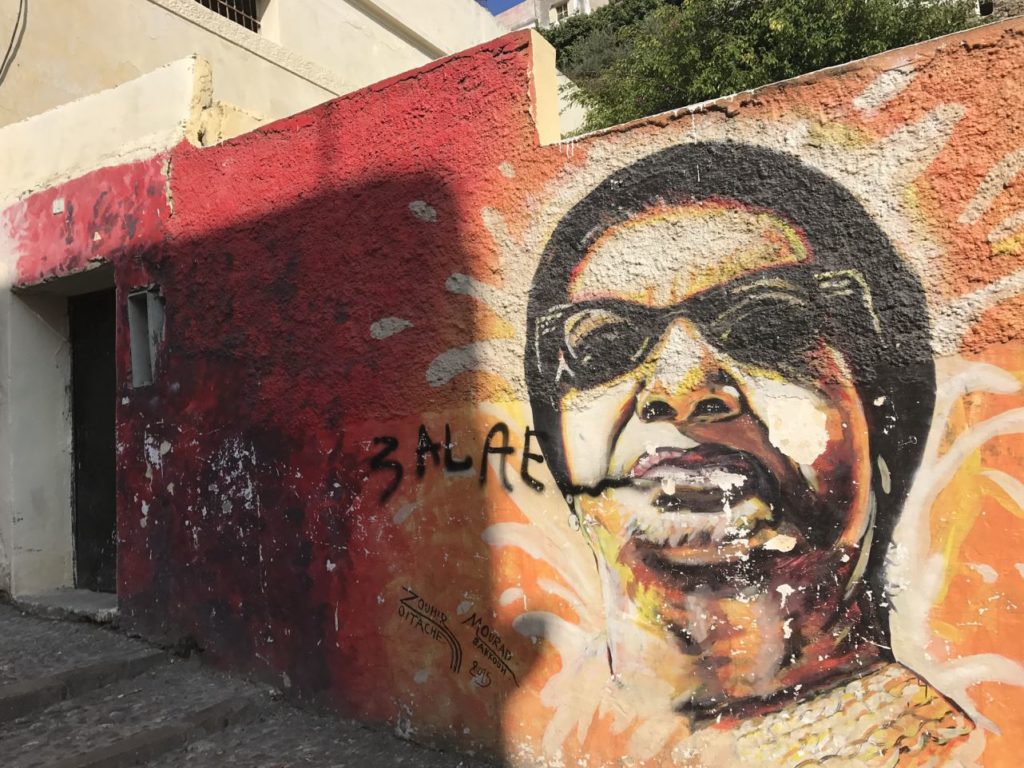
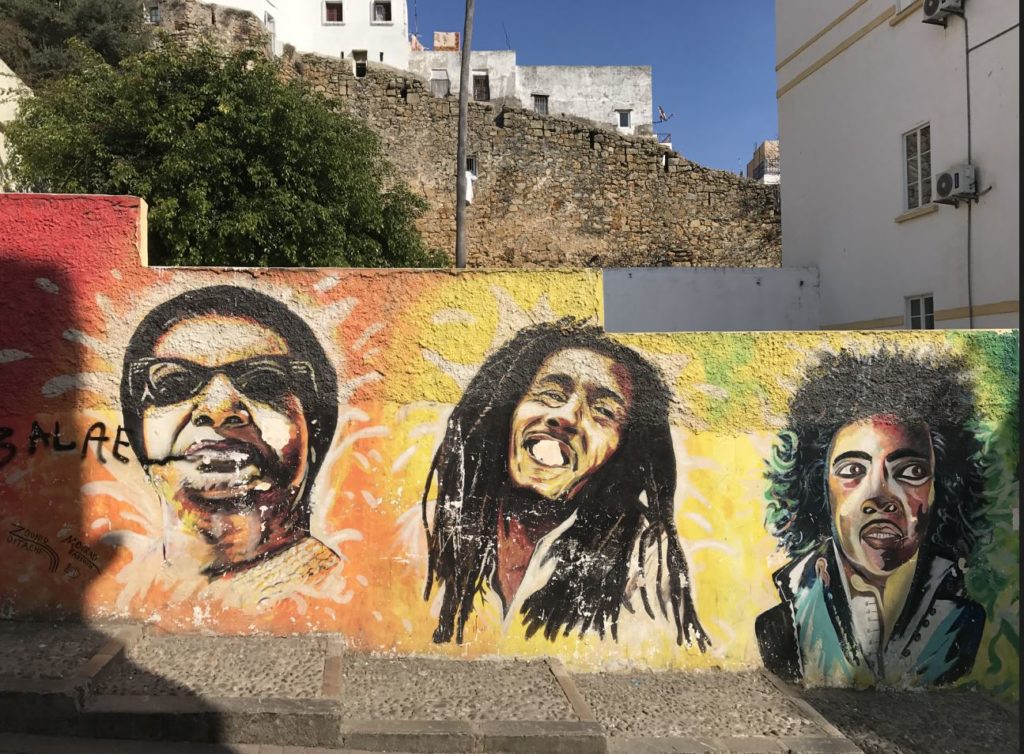
Street art of legendary Egyptian singer Oum Kalthoum at the old medina, Tangier.

Republished in openDemocracy

I cracked a self-deprecating joke to a friend in Cairo upon my return from Morocco, “I think Moroccans have a highly favourable view of Egyptians because many have never actually met one.” I did not encounter a single Egyptian through my travels through Morocco. What it often means is that you might be the first Egyptian a Moroccan ever meets. A matter not unfamiliar with my colleagues who have experienced this.  This was surprising given the intimate history between Egypt and Morocco. Therefore, the idea of Egypt in the Moroccan worldview was not usually based on tangible encounters as much as it was based on popular arts and religious discourse.

The Egyptian dynamic accentuated the already quintessential Moroccan hospitality. I was overwhelmed with the warmth and openness. From the heartfelt greetings to the insistence of staying over peoples homes, to the complementary desserts and soft drinks at restaurants. Egypt’s soft power at the geopolitical level may lay in tatters, but at least it has enough spark to result in receiving free caramel tiramisu and Miranda lime.

Facetiousness aside, I thought the recent Economist article on the decline of Egyptian Arabic (read: Egyptian culture) over the Arab world failed to capture the complexities of how influence works. The article certainly makes valid points, particularly with the decline of the linguistic monopoly Egypt once held, but answers cannot be sought from the Dubai International Film Festival and Arab Idol. To neglect, for example, how Egypt functions in the lower socioeconomic strata and religious discourse in areas of the Arab world would be to distort the image.

While I am not claiming to have done a comprehensive methodological study (although I would hope to do so in the near future), I have sought to diversify the spaces I engaged with to see how Egypt themes and references operate in Rabat, Marrakesh, Fez, Chefchaoun, and Tangier. I focussed on lower-socioeconomic neighbourhoods, upscale cafes, but the heaviest focus was given to mosques and coffeehouses, simply because it was the expected and common space of discussions.  I preferred the free-flowing conversations and story-telling format, in which I extracted themes and meaning from the pattern of discussions.  Unfortunately, I did not spend enough time in Casablanca to gauge substantial perceptions (which I feel is a weakness in my notes given it is the largest city). While I did some questioning, it is not wide enough and deep enough to merit writing it. In light of the above factors, this piece should be looked upon as an essay with meaningful indicators.

Egypt appeared to hold the strongest sway among the poor, middle class poor, and the religious streams of Morocco. This was reflective in the appeal to the popular arts, literature, or religious texts. Statements such as “Egypt is our dear brother”, “Egypt and Morocco are like this” (with hands clasped strongly together) or masculine-fuelled lines such as “Egypt has real men” were commonly heard. There is even a cross-sectional friendly inside joke among Moroccans to the timeless Egyptian claim Masr Um al-dunya (“Egypt is the mother of the world”)¸ they respond weh Maghrib abuha (“and Morocco is [Egypt’s] father”). It was partly funny because everyone telling me thought I was always hearing it for the first time.

My Marrakesh neighbours who never tired of saying “we love Egypt, and they love us”

Grafitti artists in Fez

They were mesmerised by the Egyptian dialect (Fez)

The favourable view of Egypt begins to fragment as you move up the socio-economic ladder. Residents of Tangier who portrayed themselves as socially mobile, liberal, globalised and tinged with a Euro-centric view, could at times express a ridiculing view of Egypt (the above “inside” joke now takes on a different meaning) as a backwater of poverty and extreme conservatism.

However, this alternates among these same social groups who might identify with a clear religious, Arabist or leftist bent, or have a liberal arts background. Accordingly, there was a sort of sympathetic heartbreak expressed at “what has become of Egypt,” with Cairo’s declining regional influence, harmfully erratic position on Palestine, the diminishing quality of films and a media circus gone crazy.

Om Kalthoum songs could be heard in shaabi (common, working class) restaurants and AbdelHalim Hafez in the souks. What surprised me was to hear the mahraganat music played by Chefchaoun’s disenchanted youth from their mobile phones. Adel Imam was still it seems the most popular actor, Ramez Galal was disdained not just for the mindless pranks he played in Morocco in Ramadan but may have come to symbolise the disheartening state of Egyptian entertainment. Egyptian authors, from Naguib Mahfouz to Youssef Ziedan, featured prominently in bookstores and were read by the Moroccan reading public that I encountered.

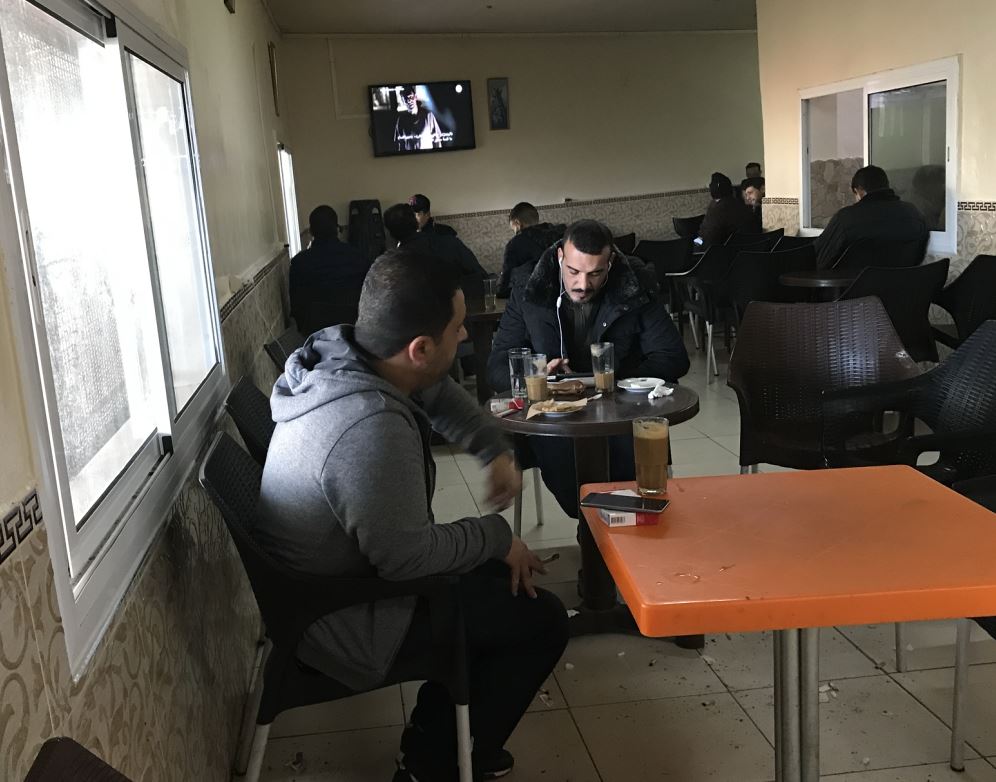
Coffeeshop in Tangier

On the political front, not a single Moroccan had a positive view of Egyptian president Sisi when his name was mentioned. However, it was not unusual for imams and worshippers at mosques to tell me the religious precept “do not rebel against the ruler,” alluding repetitively that Egyptians would have lived “better” if they did not overthrow Mubarak.

Gamal Abdel Nasser was surprisingly only mentioned twice (mainly in a neutral way). A few references were made to his era. While Morocco had a marginal role in the pan-Arabist wave of the 1950s and 1960s, it was interesting to see (or not) its lingering effect.

University students and recent alumni developed a shared narrative with Egypt as a result of the 2011 Egyptian revolution and the Arab uprisings, but this identification has become more ambivalent over the chaotic years (This area I did not pursue in any worthwhile depth but there are studies that have explored the question of Moroccan identity after 2011).

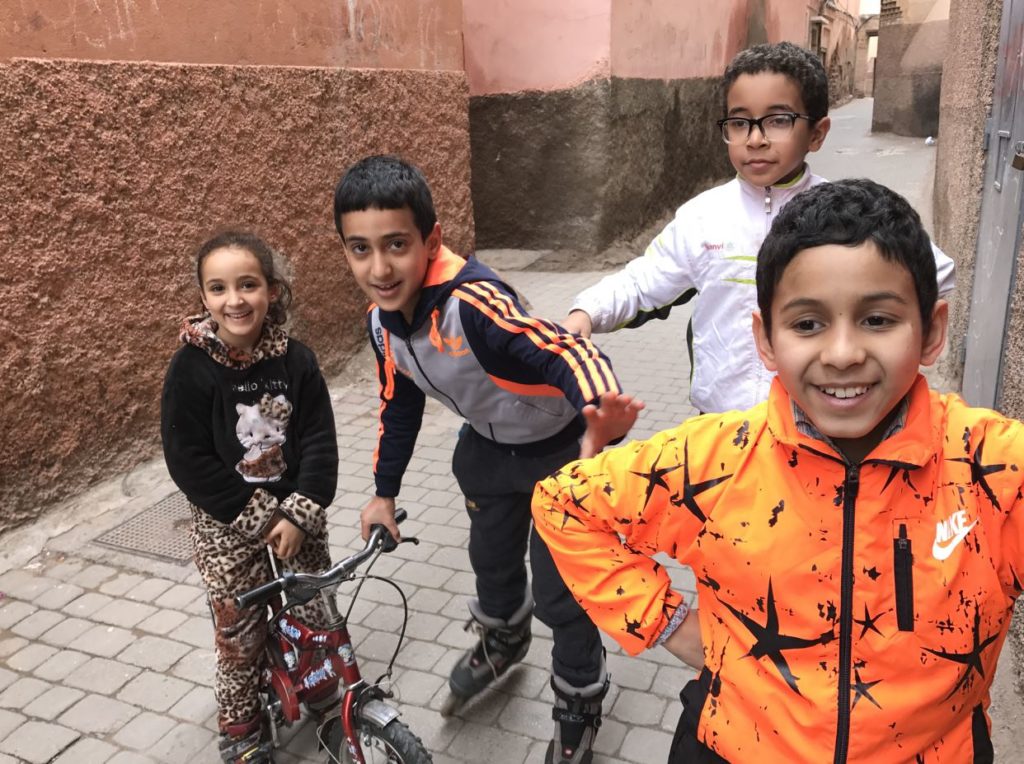
When it comes to religion, Egypt performs the strongest. With even children in the kasbahs mentioning Abdul Basit Abdus Samad (a prominent Quran reciter, 1927-1988) in the same breath as the pyramids. Al-Azhar was, predictably, mentioned frequently.

Pharaoh Ramses II was the most commonly referenced figure in regards to Egypt. The pharaoh of the Quran and Old Testament projects an unusual hold over the imagination. While in urban Egypt, the use of ‘Pharaoh’ in the popular discourse can often serve no more than a superficial labeling of every dictator who shows up on the scene; he was treated by Moroccans, however, as a sort of existential question on evil and oppression.

Tour Hassan Mosque, Rabat

In mosques, the imams and congregants alike frequently invoked the following Quranic verses to not only frame Egypt, but, at times, to position their conversations with me.

“And We revealed to Moses and his brother, saying: Take for your people houses to abide in Egypt and make your houses places of worship and keep up prayer and give good news to the believers.” Jonah 10:87

“And the Egyptian who bought him said to his wife: Give him an honorable abode, maybe he will be useful to us, or we may adopt him as a son. And thus did We establish Yusuf in the land and that We might teach him the interpretation of sayings, and Allah is the master of His affair, but most people do not know.” Jonah 12.21

“Then when they came in to Yusuf, he took his parents to lodge with him and said: Enter safe into Egypt, if Allah please.” Yusuf 12.99

And Pharaoh proclaimed among his people, saying: “O my people! Does not the dominion of Egypt belong to me, (witness) these streams flowing underneath my (palace)? What! see ye not then?” Zukh’ruf (The Gold Adornment) 43:51

Apocryphal accounts arose when you tapped into Moroccan folklore.  While Abdullah, a farmer in Chefchaouen, narrated some sound and verifiable stories such as “..A big part of our community migrated to the city of Alexandria over the centuries.” It was the tales that I found quite interesting: “[Pharaoh] Ramses came here and gave Morocco its name. Yet he preferred to die in Egypt.” 

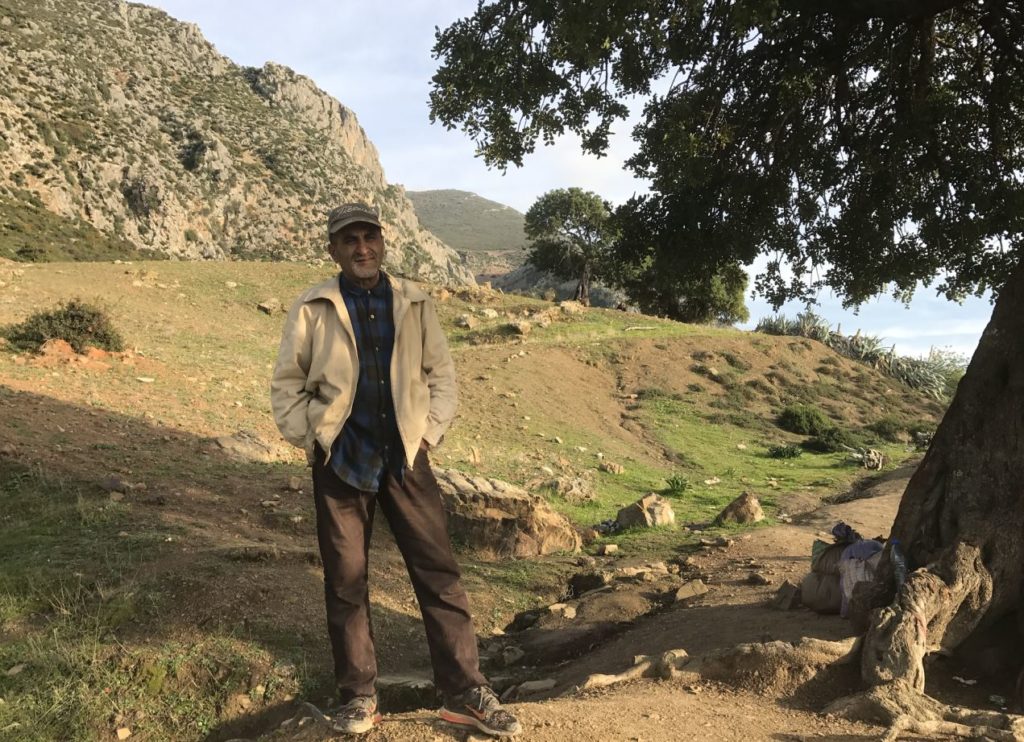
Abdullah (Chefchaoun)

The hadiths on Egypt and other matters were also quoted, but it was the below hadith by Islam’s prophet that struck me because of how I understood its function in Egyptian discussions.

Abu Zar reported that Allah’s Messenger (Sallallahu Alaihi wa Sallam) said: “You will conquer Egypt, a land where Qirat (a measure of weight and area) is used. When you conquer that land, you have to treat its people kindly since they have a right of kinship upon you.” [Reported by Imam Muslim Ahmad]

I developed a different relationship to these hadiths in Egypt (here I mean mainly Cairo and Alexandria). When they were quoted, it was difficult to tell how much of it was clothed in nationalist sentiments. The absence of humility, at times, of narrating it did not help. But my concern grew at how it can be used to disarm activism and accept the status quo, as if the divine simply takes care of Egypt, the Prophet blesses it, and thus human action need not apply to better a situation, for eternity.

However, voiced by Moroccans who are not entangled with Egypt’s endless political problems gave it a somewhat impartial sincerity. For example, Imam Ahmed, a warm and humble man at a small mosque in the mountains of Chefchaoun, repeatedly used the word Qirat to drill into me the gravitational importance of Egypt, at least how he understood it.

Imam Ahmed, his smile will brighten your day

Local children at Chefchauon’s mountains

The religious and mosque-attending Moroccans correlated strongly with a positive view of Egypt. In fact, I did not find a single exception to this rule. While the Amazigh people (mainly in Fez and Chefchaoun) emphasised the Islamic relations with Egypt at the expense of the Arab dimension, they did not necessarily shy away from the latter (it’s complex to explain, but I will be reductionist and say that it came down to the perceived problem being with Moroccan Arabism than the Egyptian version).

Transnational groups like Islamists and Sufis had visiting relations with their counterparts in Egypt. These relations were formed either on the Hajj (pilgrimage) to Mecca, visits to key mosques or educational spaces popular with Sufis. For Islamists, it was not unusual for friendships to have been formed in France where they once worked (but returned to be in a “Muslim country”). Their lived experience of Egypt seems to be fundamentally shaped by these close relations.

Final Thoughts

Some 700 years ago, the Moroccan explorer Ibn Battuta narrated his encounter with Cairo. What is fascinating is that today’s Moroccan descriptions of Egypt can easily paraphrase his account.

“I arrived at length in Cairo, mother of cities and seat of Pharaoh the tyrant, mistress of broad regions and fruitful lands, boundless in multitude of buildings, peerless in beauty and splendour, the meeting-place of comer and goer, the halting place of feeble and mighty, whose throngs surge as the waves of the sea, and can scarce be contained in her for all her size and capacity.”  (1326 CE) 

One should also take into consideration how the Moroccan imaginary of the Arab and Muslim world developed over the centuries:

“For many centuries, the pilgrimage caravan was the most important, if not the only means of travel to the Holy Lands. On their way, Moroccan pilgrims were forced to cross the majority of Arab Muslim lands. This fact alone gives the Moroccan travels a complexity that is reflected in the texts and colours the perception of sacred space and time.”
Abderrahmane El Moudden, “The Ambivalence of rihla: community integration and self-definition in Moroccan travel accounts, 1300-1800” in Eickelman, Dale F (eds.) Muslim Travellers: Pilgrimage, Migration, and the Religious Imagination Comparative Studies On Muslim Societies (1990) p 73.

Modern Morocco is a vast social reservoir that needs to be explored further in juxtaposition with Egypt. The other side of Egyptian influence is that Morocco shaped Egypt over the centuries, among them: dynasties, architecture, religion and philosophy. I do not see why we cannot better examine some of their concepts and approaches to help address questions that trouble us in Egypt’s urban, social and religious settings. That is for another essay.

Finally, the street art of Oum Kalthoum shown at the start can put matters in perspective when you see it as part of a larger mural in Tangier. Instead of simply the decline of Egyptian influence, it can perhaps be said the stage just got more crowded.

What Are We Sacrificing?

Published in Mada Masr. (Click here for the Arabic translation). Republished in the Asia Times.

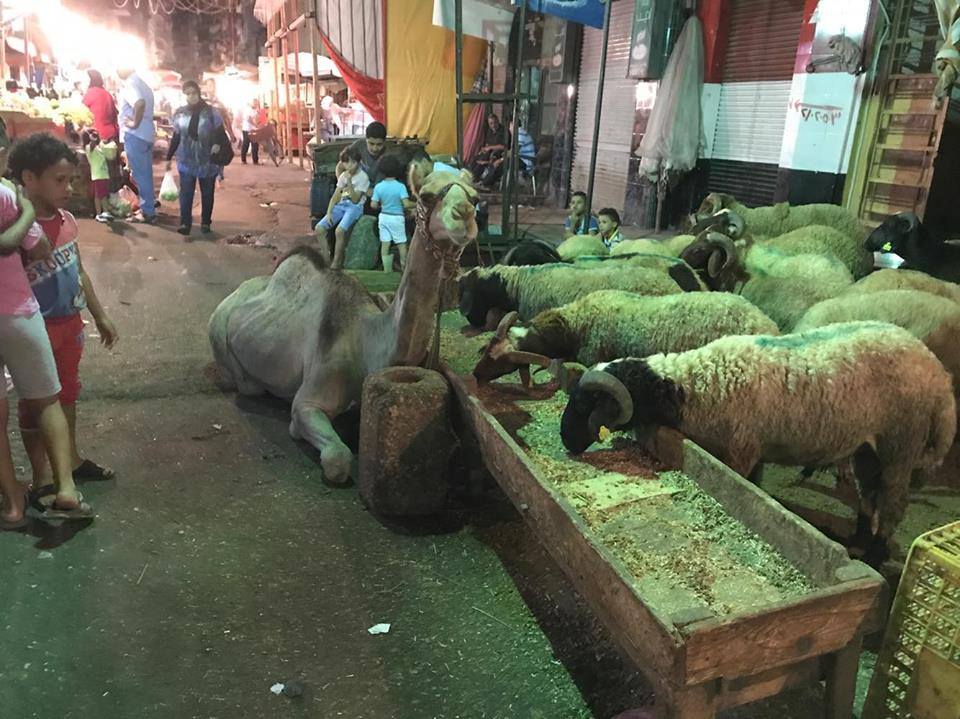
I have grown accustomed to gradually seeing religious festivities being disemboweled of their meaning, whether it’s the entertainment-saturated Ramadan, or the hyper-commercialized Christmas. But the Islamic Eid al-Adha (Feast of the Sacrifice) stands out starkly, as it has been built on an all-encompassing annual spectacle, with the blood of sheep and cattle running through the veins of Egyptian cities. To live in a part of Alexandria surrounded by butchers, as I do, is to be unfortunately placed at one of the city’s aorta.

Eid al-Adha, which celebrates the Prophet Abraham’s sacrifice, is rich in meaning and symbolism, from the perseverance of the human condition to the traditional binding of families and community, as well as allowing, at the very least, a metaphorical reaching out to Jews and Christians who can relate to the tribulations of Abraham. More so, given that many poor Egyptians are “vegetarian” by default, as they can rarely afford meat, Eid is an opportunity to put meat on their tables. This is not to mention the money and other charitable gifts that are given out generously on this festive occasion.

When it comes to charity, Eid Al-Adha is an exemplar. When it comes to the actual sacrifice, it has become frighteningly lacking.

Egyptian society over the years has developed an unhealthy obsession with ostentatious displays of piety. Eid al-Adha has regressed to the point where public piety meets peak voyeurism, leading to the collapse of any semblance of a public sphere. The origins of this problem came with urbanization that saw the ritual move from farms and slaughterhouses to the streets. And for a long time, the practice was undertaken in the building’s manwar (interior) by a few families. Now, driven by the flaunting of wealth, it has reached an industrial scale, with minimal supervision, regulation or consensus. The authorities, despite being against it and issuing fines here and there, would rather react swiftly to one innocent protester holding a sign than the instigators of thousands of liters of blood clogging the fragile drainage system, overwhelming the minimal sanitation standards and releasing the smell of dead animals into the air.

The withering of Islamic ethics regarding the practice of slaughter is obvious when basic questions are not even asked as to why animals are kept in dire conditions in the lead-up to their fate, why they are forced to witness others being slaughtered and why are children watching this bloodbath. What is halal anymore?

Moreover, the implication is that the animal is the centerpiece of the festivity, obscuring the underlying message and normalizing our problematic addiction to meat.

Meat consumption was extremely limited in the early days of Islam. The Prophet and his companions were semi-vegetarians. One, in fact, was an outright vegetarian. The sources consistently showed the Prophet’s favorite foods to be dates, barley, figs, grapes, honey and milk, among other non-meat foods. The Prophet never ate beef, going as far as saying, “The meat of a cow produces sickness, but its milk is a cure.” The Caliph Omar warned to, “Beware of meat, because it is addictive like wine.” Historically, it was only rich Muslims who could afford meat, and it would only be eaten on Fridays, while the poor had to wait for Eid to eat meat.

These historical factors ought to be considered in light of the need to reframe Eid Al-Adha away from the morass it has been dragged into. Perhaps meat can be treated as that rare luxury that is eaten infrequently across the social strata. I’m no vegetarian, but the excessive quantity of meat produced and consumed, the social signifiers that accompany it, the deep inequalities that it sharpens and the troubling medical problems that it exacerbates, not to mention the additional pressure meat production places on the planet, means that there is an urgent need to diversify cuisines and elevate non-meat options.

Whatever is happening, it is no longer about the story of Abraham, it is something that you just do because you did it last year and you will do it next year as well.

More and more, each year, we experience a nihilist Eid on the streets. The butchers don’t know why they are slaughtering, the donors don’t know why they are paying for it, the public doesn’t know why they are witnessing it, and the sermons have hit a tone-deaf level. The only ones who seem to have some awareness that something is not quite right are the sheep, goats and cattle.

The Vanishing Videos of Arab History (and what can be done)

I have noticed over the past year that archival footage on Egyptian history and post-2011 videos on Egypt’s events are (mysteriously?) disappearing from YouTube, even when the issue could not be one of copyright. Similarly, the vanishing act is reportedly happening to content produced in other Arab countries. A video that is deleted is an assault on our collective memory and our post-2011 quest to build an unfettered archival culture (despite how contested archives can be). 

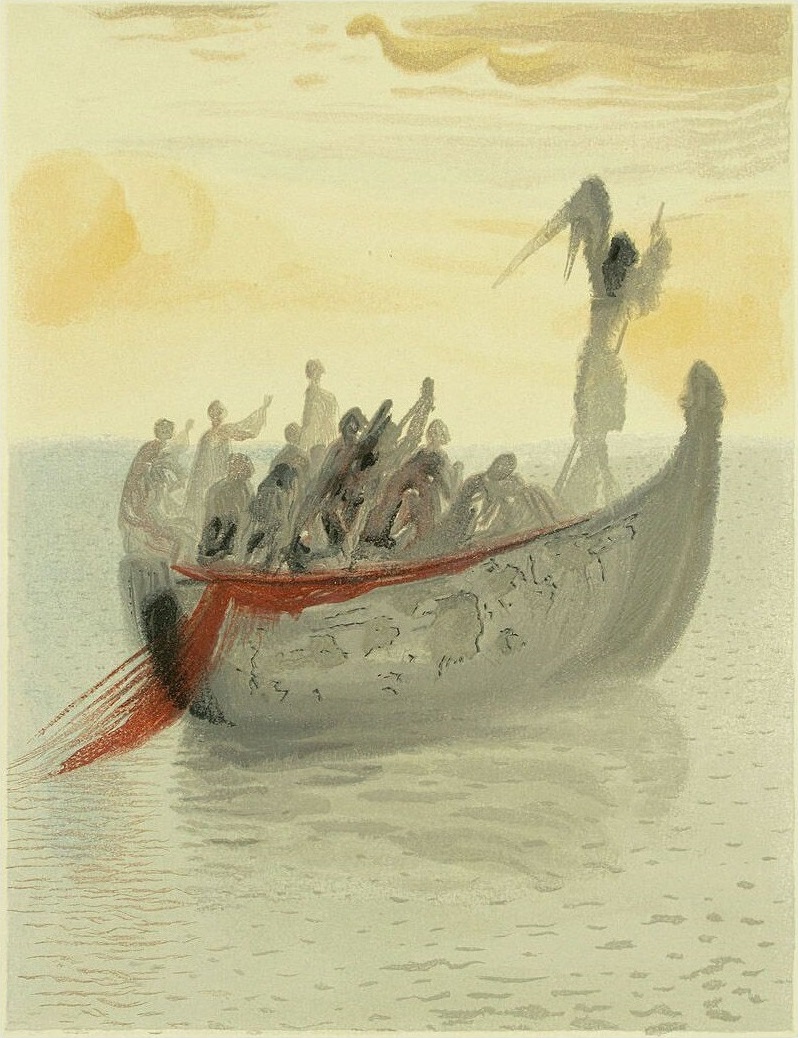
*The mythical river of Lethe, that appears in Ovid’s Metamorphosis, caused forgetfulness when drank from (Painting by Salvador Dali). English poet John Milton described Lethe as the river of oblivion that “whoso drinks forgets both joy and grief.”

We have long taken for granted that a video on YouTube was left untouched unless it violated copyright rules like a song, TV program, or film. It was always assumed that historical footage, even the most mundane type to the authorities like 1950s village life, would be unharmed given it posed no political threat. However, even these videos are fading. We can no longer take for granted that such videos will remain in perpetuity. 

The four possible reasons for this that I can think of include:

  • Egyptian authorities or pro-regime trolls are misleading YouTube into thinking an Arabic video in question is violating copyright. Perhaps the content’s language barrier would stifle YouTube’s ability to verify the claim.
  • Such ambiguity enables videos to be deleted and because of “multiple third-party notifications of copyright infringement” which also raises a question as to who owns a Nasser speech given at a stadium in 1962 or a protest video from 1950s Alexandria uploaded by a former Greek resident?
  • Certain YouTube users have been identified by officialdom and are being threatened into deleting their content.
  • YouTube Users are removing any digital traces for safety reasons (Similar outcome to the third point, but I find this one highly implausible as the termination message often shown is the user being suspended or deleted for some violation, not “user no longer exists”). 

Irrespective of any reason, the end-result is the same and fits a pattern: The authoritarian attempt at drowning Arab publics in the mythical river of Lethe (forgetfulness).* 

How can the situation be resolved? For the time being, and I say this with a sense of urgency, if you think a video is worth saving for posterity, then it would be wise to download such videos through this link: http://www.clipconverter.cc

It’s quite a simple three step process. This is the most important step even if you don’t carry out the next steps. In any case, you will probably require these videos in some personal or work capacity in the future. 

The next step is to make it accessible by uploading it to Google Drive, OneDrive, DropBox etc, and setting access permissions for that specific folder or video to public. Then notify the web by sending out the link and using the hashtag on social media: #SaveArabHistory (Or any universally agreed hashtag). 

This is an ad-hoc approach until there is a concerted, organised and collective way to preserve, catalogue, and offer video access for offline and online use. But once they are gone, they are gone! There is no guarantee that the original user (who may have passed away) will upload them again or can be contacted. If there are already existing initiatives doing this, then they are welcome to advise and get involved. 

When I assign my sociology students certain videos to watch but it turns out the respective videos have perished, then it not only means my students have been partially deprived of a comprehensive understanding of their subject matter (which is worrying enough), but the way we deal with technology, in an era that is seeing censorship and blocked websites slowly normalised, needs to change. 

Alexandria’s anti-Fellah problem

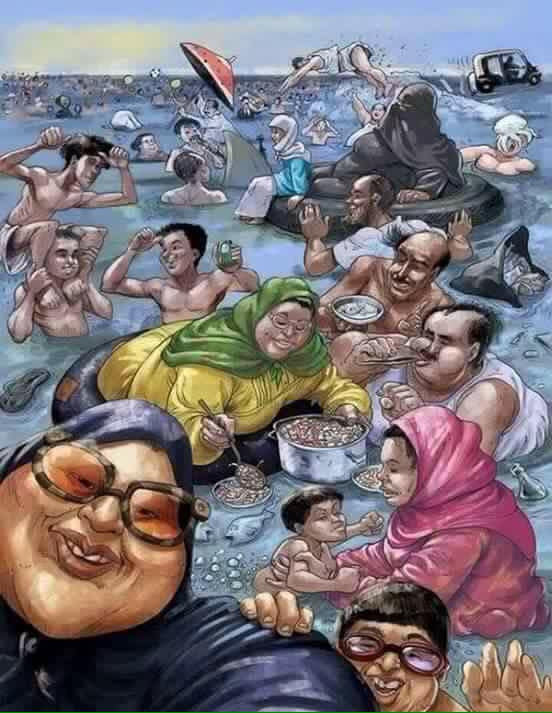
Caricature mocking the less privileged visitors to Alexandria

It’s that time of year, the “let’s dehumanise the Fellahin” season (or any rural visitor for that matter), as they escape the villages for some summer relaxation in Alexandria. The above-circulated caricature feeds into all the vile remarks made daily about the Fellahin, and echoes their ill-treatment on the corniche. 

Let’s just go through three of the tired and misleading statements that Alexandrian residents frequently make. 

1. “Fellahin make a mess of the beaches and the city.”

Because Alexandria is generally clean the rest of the year? The issue here is a lack of rules being applied and the shrinking public beaches that forces them to squeeze into tinier plots of public beaches. This is a governorate problem.

2. “Fellahin are the worst sexual harassers.”

Because Alexandrian sexual harassment is more refined? Nothing beats winter sexual harassment? By making such accusations, the responsibility is shifted away from the rule of law being applied equally to all, in order to fight harassment, and pushed, rather towards a particular group. This is a governorate problem.

3. “As soon as they arrive, I’ll leave Alex” or “they need to put a fee of 50 pounds at the city’s gates to reduce the numbers coming into Alex.”

The obvious bigotry and classism aside, putting blame on the citizen for over-population and lack of public space will continue to give a green light to the businessmen and mafia who keep eating up what is left of the city’s spaces. Once again, this is a governorate problem. 

Don’t forget that similar insults were hurled at middle-class Cairenes who came in the summer up until the 1980s, that is before they gradually decided Sahel, Ain Sokhna etc were more fitting. It seems allowing rural visitors and the poor to access the sea, often for the first time, is beyond many to even contemplate.

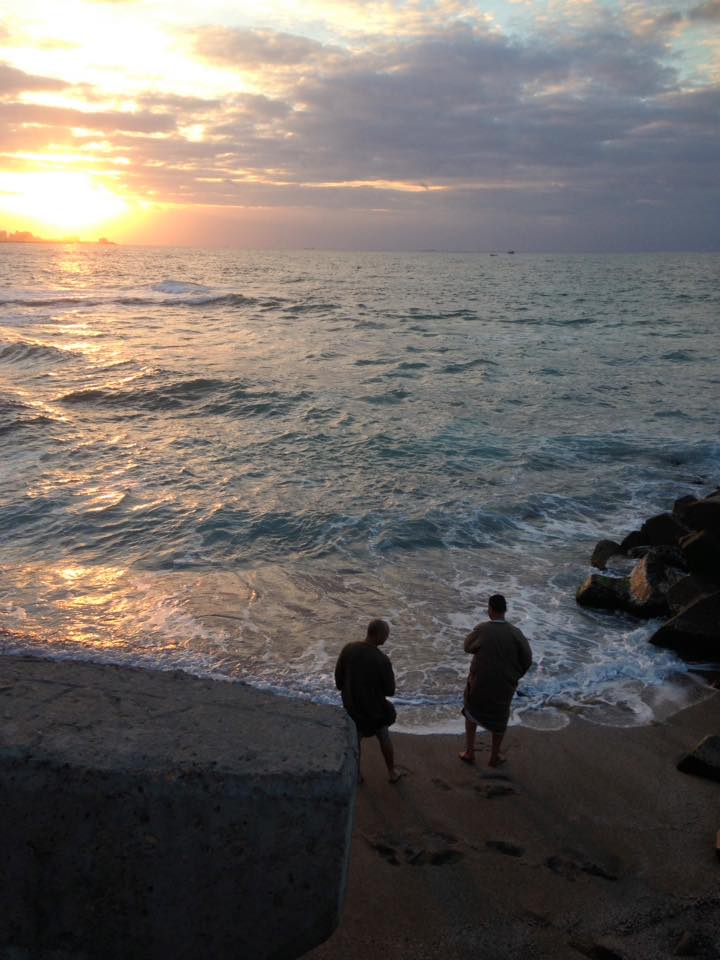
Perhaps this denial of their rights can be put in perspective. The below photograph shows two middle-aged Ṣa’īdi men seeing the sea for the first time in their lives. They slowly entered the water with a profound curiosity and glee, and when I asked them how it felt, one turned around and shouted with a big smile: “meya meya!” (a hundred out of a hundred). 

With all the economic misery and hardship that Egyptians, especially the poor, are enduring, do you really want to be complicit in the web that worsens their plight? By denying them their right to view, touch and enjoy the sea? To deny them access to the last remaining strongholds of beauty that has already been mostly privatised? 

Two middle-aged Ṣa’īdi men seeing the sea for the first time.

Alexandria’s church bombing and the deepening of melancholia

An extended piece of my former blog post for Mada Masr on the ways in which pain, anger and grief are being internalized vis-à-vis the state and the city after the tragic church bombing in Alexandria.

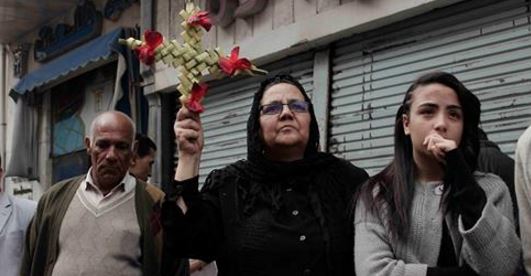
Image by Sara Younes


It was not supposed to be like this. The week leading up to the annual Sham el-Nassim holiday is usually filled with joy and elation as we welcome the spring. And it certainly was not supposed to be like this for Christians on their holy Palm Sunday. Twenty-eight victims lost to the bombing at St. George Coptic Orthodox Church in Tanta, and 17 lost to the bombing at St. Mark Coptic Orthodox Church in Alexandria.

Dark clouds had spread on Sunday morning, and I had remarked to a friend that this was quite unusually gloomy for April weather in Alexandria. It turned out to be fitting for the events that were to come in a few hours. Alexandria, historically, seems to understand itself as a city when it is confronted with tragedy.

In the wake of the bombing, the downtown streets were on lockdown and traffic appeared frozen in time. This was not the average traffic standstill, as rarely was a car horn sounded. It was as if everyone had sensed, or was in the process of being informed through their mobile phones, what had just happened. Now, the trademark noise-sutured impatience of traffic dissipated as drivers perhaps realized that arriving late to your destination may not be the worst that can happen in your day. The scene along the Mansheya corniche could have been ripped out of a Hollywood blockbuster in which immobilized commuters had transfixed their gaze at some impending meteorite about to strike their city. A bombing in Tanta, a bombing in Alexandria, a reported (but later dismissed) second bombing in Alexandria. Where next?

The subtext was the reemergence of the eve of 2011, when a devastating terrorist explosion targeted the Two Saints Church in the eastern district of Sidi Bishr, leaving 25 dead and over 200 injured. This was supposed to be the last tragedy of its kind, giving birth to a new civic spirit to counter the infamy and set the tone for the 2011 revolution a few weeks later. In a stage by stage process, it went roughly something like this: shock; melancholia; outrage; refusal of the status quo (which was illustrated, for example, through the adoption of the cross and crescent logo as a social media avatar or draped over one’s balcony); joining up with the growing street vigils; publicly denouncing the Mubarak regime as many mourners shouted at the funeral of the victims, “We want to fire the president and interior minister!;” as well as, significantly, the re-appropriation of the idea of Alexandria from the state by the public.

A new civic-driven discourse placed the city at the heart of political problems. This can be understood when, following the brutal security crackdown after the Sidi Bishr tragedy, the Muslim Brotherhood’s Sobhy Saleh cried, “It’s like we’ve been occupied by a foreign power. Alexandria has become an occupied country.” Or at times the tone was subtler, as AUC’s linguistic professor Reem Bassiouney pointed out in her recent work of an Alexandrian journalist who broke linguistic conventions and used the Alexandrian dialect in her reports, to imply “a shared identity that surpasses religious differences.” Therefore, a robust civic identity based on the popular trope agda nas (Bravest people) that the reporter is “authentic, tough, and, first and, foremost, a typical ‘Alexandrian’.” In other words, if the Egyptian identity could no longer furnish inter-religious cohesion and agency, the Alexandrian identity would have to step in.

But the mood was different this time. People’s reactions and emotions seem to be trapped in the intermission between shock and melancholia. In the days leading to the Palm Sunday tragedy, the biggest complaint dominating Alexandria’s conversations was the military’s economic project in Sidi Gaber, which has severely disrupted traffic flow. (This project has been perceived as negative enough to even sway pro-military supporters I know from their traditional positions.)

Yet there was an exposed fracture that could not be easily hidden. To the average resident, the military appears focused on its exclusive economic ventures, often to the detriment of the economy and the public good, while the police have developed a rapid method of cracking down on political protests and imprisoning countless activists, or in the case of bread-driven protests, swiftly negotiating them away. All the while, 17 dead bodies were strewn at the gates of a church of historical magnitude. These are questions the authorities will need to deal with — when they promise security in return for the citizen’s forfeiting of progressive governance, but are now unable to deliver that security.

However, the high talk on regimes, Sisi, the Islamic State, terrorism and geo-strategy, can be lost on the day-to-day life of an individual who struggles to survive and make meaning of forces beyond his or her control. The day following the bombing, life attempted to go on as normal but with a broken spirit and tinge of despair under the, still, grey skies. The men at the coffeehouse in front of my place smoked shisha without conversation, at times looking down to the ground; customers calmly bought their ful and falafel breakfast without the usual jostling; the fruit sellers did not yell to market their produce, and the signature smiles across the bakers’ faces were all but gone. No visible public argument or fight broke out on the streets in a very long time. There was a shared language of mourning that consisted of frequent silences, occasionally punctured by the innocence of cheerful children running around. Yet, melancholia deepened its claws to stunt the growth of any budding civic flower.

Even in these dark times you need to seek out a spirited hope and consolation. In the context of this discussion, it’s never far. I’m blessed to live between a Coptic Orthodox Church and a Catholic Church, both stand strong and resilient, and as a powerful reminder that this is, and will always be, one of the things that is beautiful about Alexandria and Egypt. The sound of church bells is a message to the forces of fanaticism and sectarianism (and even to the smug individual who deems Christians as second-class citizens) that churches, as well as the Christian life and evocative prayer chants within its heart, will not be silenced.

As a Muslim, these churches are my churches, they complete my identity, colorize my worldview, and deepen any understanding of my faith. Any harm that comes to them, its worshippers, and those who protect them, is a savage assault on my very being.

I wish I had clear answers to give. I don’t, and I hate to admit a sense of helplessness in all of this. I can only, along with others, ask questions, and keep asking questions, in the hope that the sinister matrix that oppresses and exterminates human lives in different manifestations — in Alexandra, in Egypt, in the Middle East and elsewhere — is eventually and somehow unravelled.

Mubarak Died Long Ago

Many are disappointed in seeing Mubarak walk free,
but perhaps we can look at it from another perspective – Mubarak’s perspective?

Since 11 February 2011, Mubarak has had to live with the fact that he has been condemned by history, being toppled in such a humiliating way and vomited out by the body politic. The court decision is not his redemption and never will be unless he is reinstated as president.

In June 1974, White House reporter Lawrence M. O’Rourke speculated that US president Nixon would have wished to be assassinated on his state visit to Egypt’s Alexandria rather than go through the inevitable and ignoble resignation as a result of Watergate. Nixon did not want that moment of shame and degradation to come. Martyrdom suddenly looked more appealing (it worked well for Kennedy). But that moment did come. And Nixon died a painful metaphorical death that he never recovered from until his actual death 20 years later.

Whether in a democracy or dictatorship, the forced surrender of power is an excruciating pain that a leader can be put through – more than facing prison time or even the death penalty. For every one of them is obsessed with the historical legacy they will leave. A perceived noble legacy cannot happen if they feel they have been short-circuited by a different form of power arrangements. When the facade came crashing down bringing the leader down in the process. The point is the leader lived to see, and bludgeoned by, a politically quintessential and unerasable humiliation. 

The days between the moment they are forced to step down and the moment they breathe their last – are the most harrowing days they will live through, as every single day they will murmur and mumble at how they have been wronged. Their toppling from power should never have happened – they are haunted by it in their living days, tormented by it in their sleep.

It does not take much imagination to realize that Mubarak, being the narcissistic monster he is, hates his political successors more than he hates the revolutionaries who overthrew him. Because the (faceless to him) revolutionaries have receded into the background, while al-Sisi and the military generals have come into the limelight – the very limelight that was exclusively reserved for Mubarak. Every newspaper’s front page and news broadcast will agonizingly remind Mubarak of his stupidity and utter failure to hold onto the power he loved most.

His current existence is his ultimate prison, if not death, sentence.

And yet, irrespective of Mubarak’s status or pain, our work that began in 2011 still continues. Often limping with much difficulty in these repressive times, but it continues.

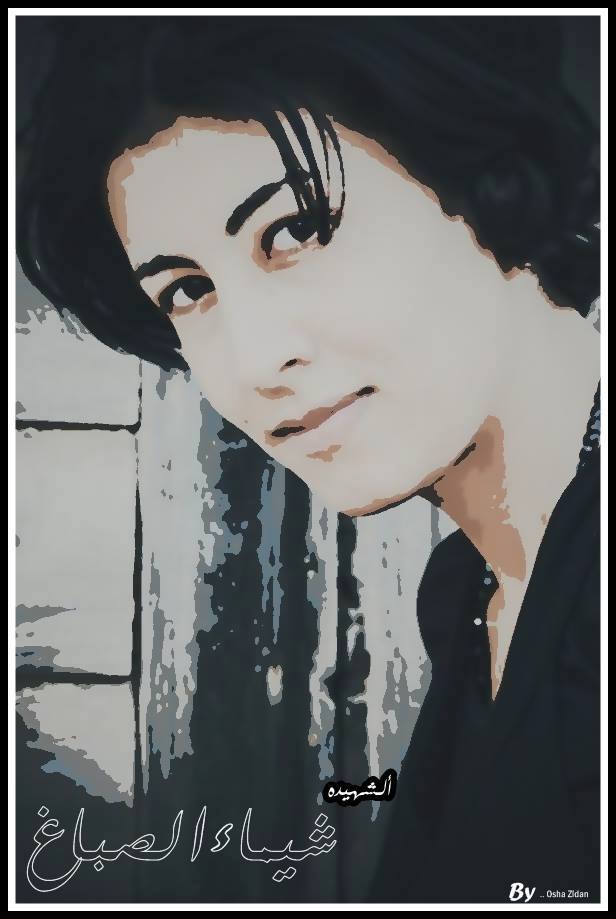
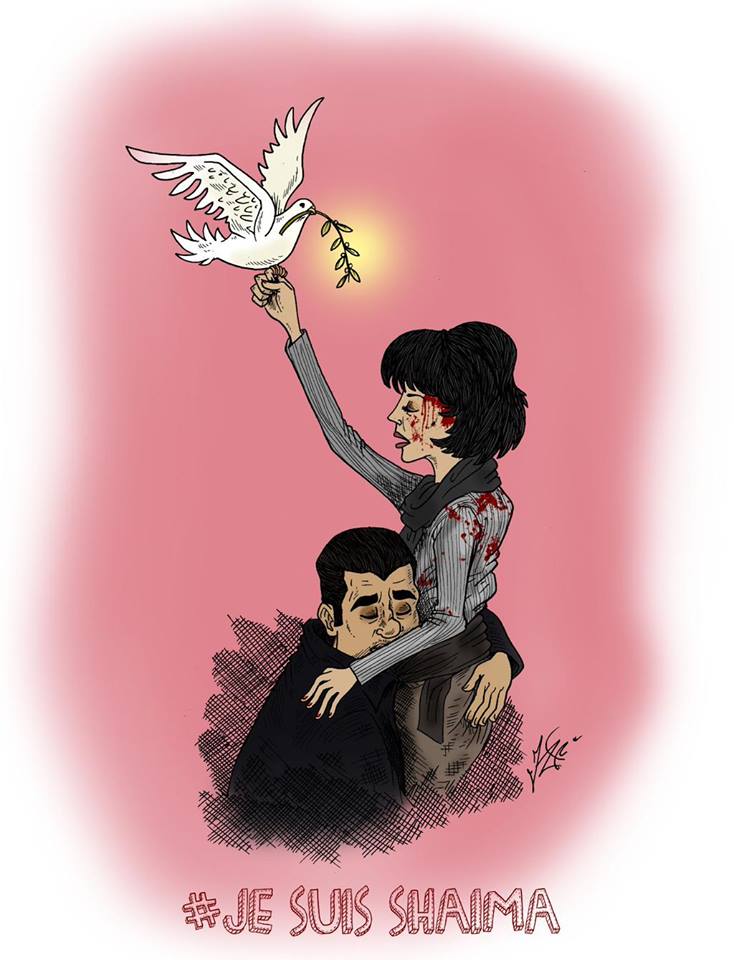
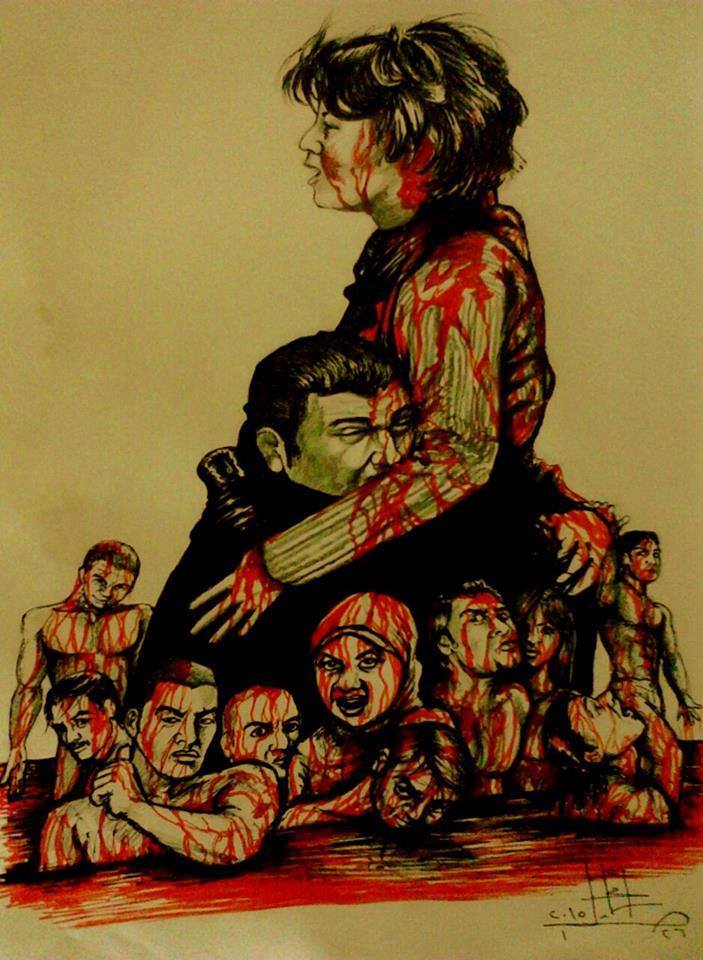
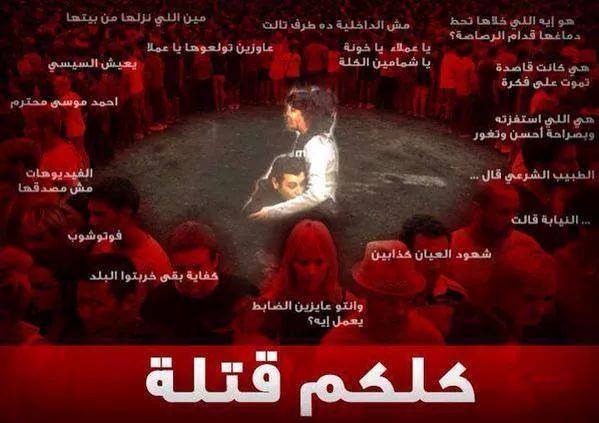
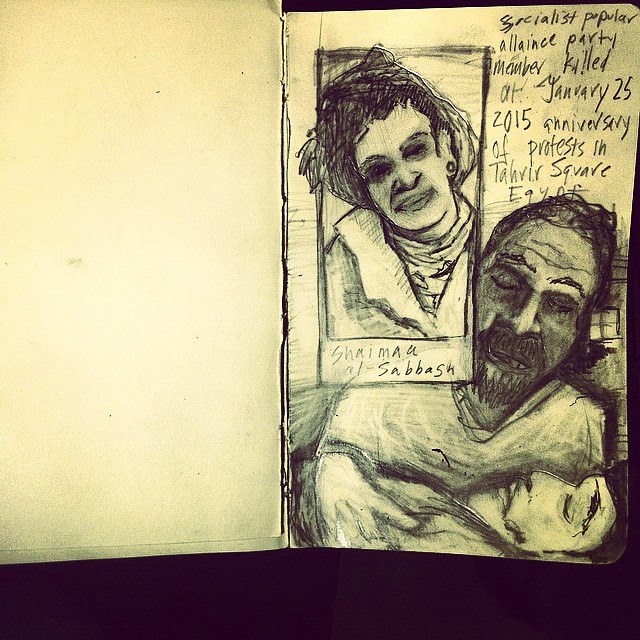
Shimaa ElSabbagh in art

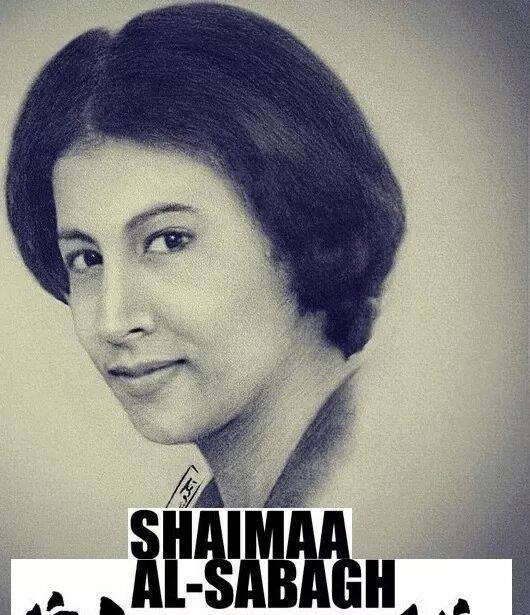
I have been absolutely gutted since Shimaa ELSabbagh (also spelled as Shaimaa el-Sabbagh) was killed by security forces two weeks ago as she headed to Tahrir Square to lay flowers on the eve of the fourth anniversary of the 2011 Egyptian revolution. While I never personally knew Shimaa, we shared numerous common friends who have been in tears and heartache since that tragic afternoon. Many will ask why focus on Shimaa when other protesters also die. That is true, Sondos died the same day in Alexandria but she got little attention. Since 2011, countless lives have been lost and we don’t hear much about them. But what makes Shimaa’s death much more sharper is that her final moments in life were filmed. As a human, you can only react to the theatrics that will naturally shock you and scar it into your memory for life. It doesn’t mean we think less of other deaths. It is why we are moved by the imagery, followed by the posthumous story, of past icons such as Khaled Said, Omar Salah and Mina Danial. Shimaa’s demise will not be in vain, and she will hopefully be a signpost to illuminate the other lesser known activists killed by the state.

I believe memorialisation is important to sustain the story of Shimaa and all that she stood for. She was a writer, poet and activist, and Egypt has lost an irreplaceable asset. An innocent woman killed while carrying flowers. Like I have said before, Pablo Neruda’s words are the most appropriate here: “You can crush the flowers, but you cannot delay the spring.”

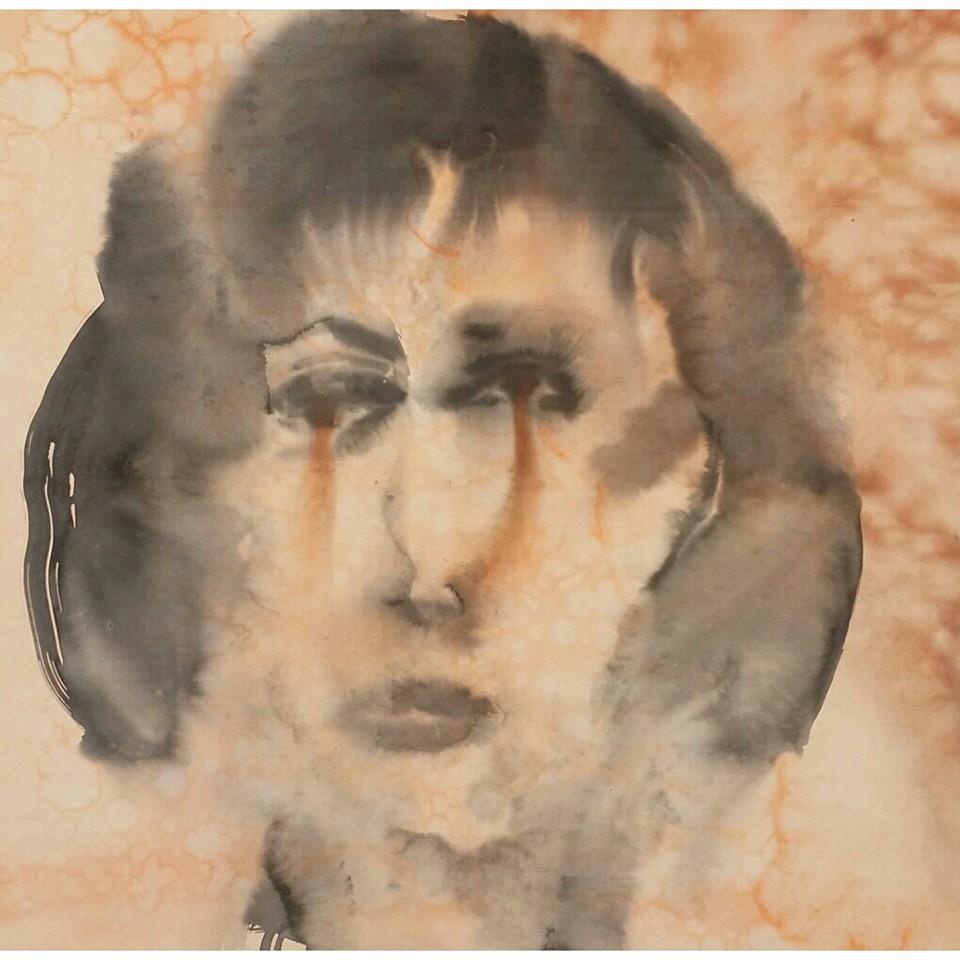
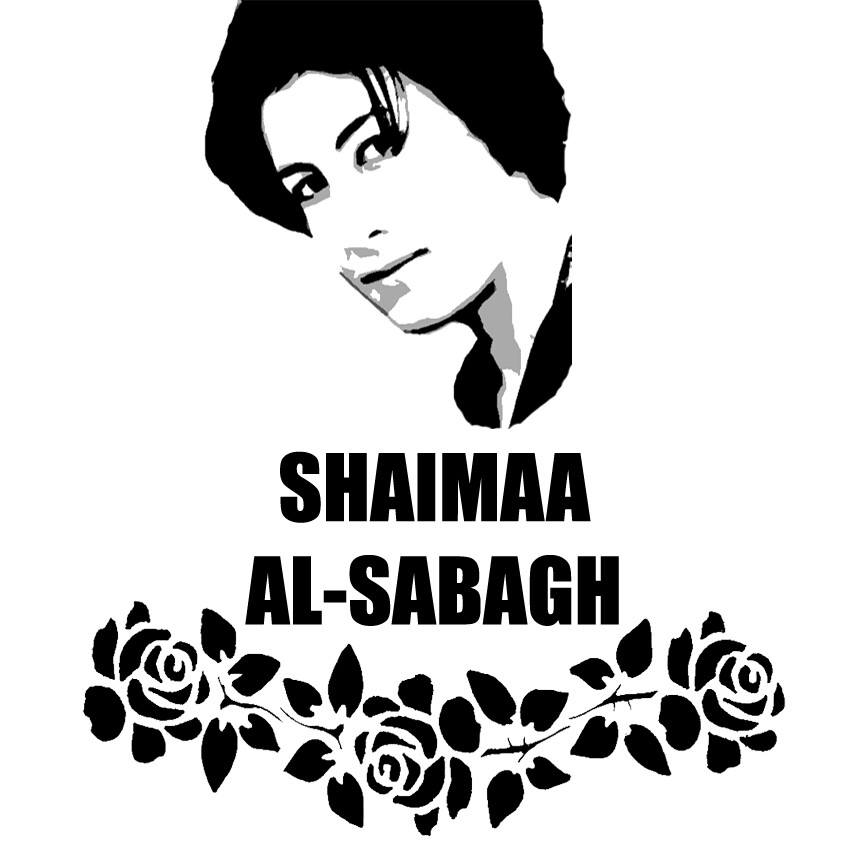
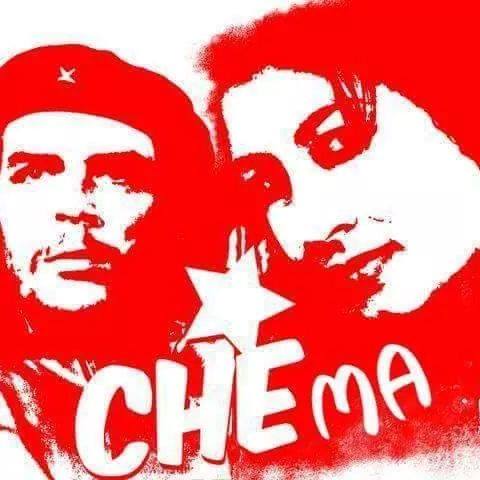
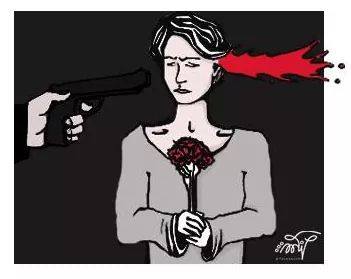
These are some of the painted, hand-drawn and digital images of Shimaa that have been floating around social media. RIP.


ses13


ses1 ses3
ses5

ses6 ses7 ses8 ses9 ses10 ses11
ses12ses4

Egypt’s Long Walk to Despotism

Published in the Tahrir Institute for Middle East Policy

There is a menacing wind sweeping through Egypt engulfing bureaucrats, journalists, judges, celebrities, and the average “patriotic citizen” in its path, remolding them into carriers of despotic ideas. This system is not a clear-cut case of top-down power relations in which an established power asserts itself over its supporters and against its opponents, real and imagined. Rather, in this system, the citizen is brought center-stage in the political arena. Egypt is currently witnessing an age-old political phenomenon of citizens’ “voluntary servitude” to a repressive order – specifically, despotism. Through their collective complicity, citizens hand a carte blanche to the state for violence, nepotism, and corruption.

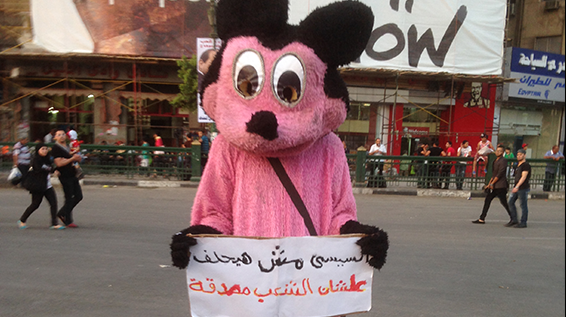
The dishevelled Mickey Mouse costume, worn by a regime supporter. The sign reads “Sisi does not need to take an oath because the people trust him." Tahrir Square, Cairo, 8 June 2014 (the day of Sisi’s coronation). Photo by Amro Ali‬‬
The dishevelled Mickey Mouse costume, worn by a regime supporter. The sign reads “Sisi does not need to take an oath because the people trust him.” Tahrir Square, Cairo, 8 June 2014 (the day of Sisi’s coronation). Photo by Amro Ali‬‬

While despotic regimes rely on violence for control, this violence is rarely targeted toward the average citizen. Rather, one of the paradoxes of despotism is that it relies on citizens’ “passions” and psychological isolation, making them anxious to gain the meager favors of the regime.1 Mutual suspicion forms the cornerstone of despotism and prevents the “communication necessary for any organized political opposition.”2

In Egypt, the citizen plays a role in reinforcing the repressive status quo – from a middle-aged woman reporting innocent journalists to the police to a sycophantic lawyer suing an actor who deviated from the state line. The fertile ground of suspicion enables the creation of legislation on a community police that would allow citizens the power to arrest each other and is also manifest in the many citizen’s names and photos posted on Facebook, who are tarnished with labels like “terrorist” and “foreign agent.” An old Egyptian proverb says, “Oh Pharaoh, who turned you into a tyrant?” “No one stopped me,” he replied.

Continue reading “Egypt’s Long Walk to Despotism”