Me and my younger brother featured in a special report by Austrian TV on Australia’s immigrant challenges. (If below video is disabled, then click on the following link > Migration to Measure )
[youtube]http://youtu.be/U97c2hnPoD4[/youtube]
Political Sociologist · Public Scholar · UNESCO Advisor
Me and my younger brother featured in a special report by Austrian TV on Australia’s immigrant challenges. (If below video is disabled, then click on the following link > Migration to Measure )
[youtube]http://youtu.be/U97c2hnPoD4[/youtube]
[nggallery id=15]
Radio Interview on ABC Triple J regarding Mubarak’s trial. Starts at 11:55
Web: http://www.abc.net.au/triplej/hack/stories/s3286737.htm
Interview: Mubarak to face court over Egypt unrest (MP3)
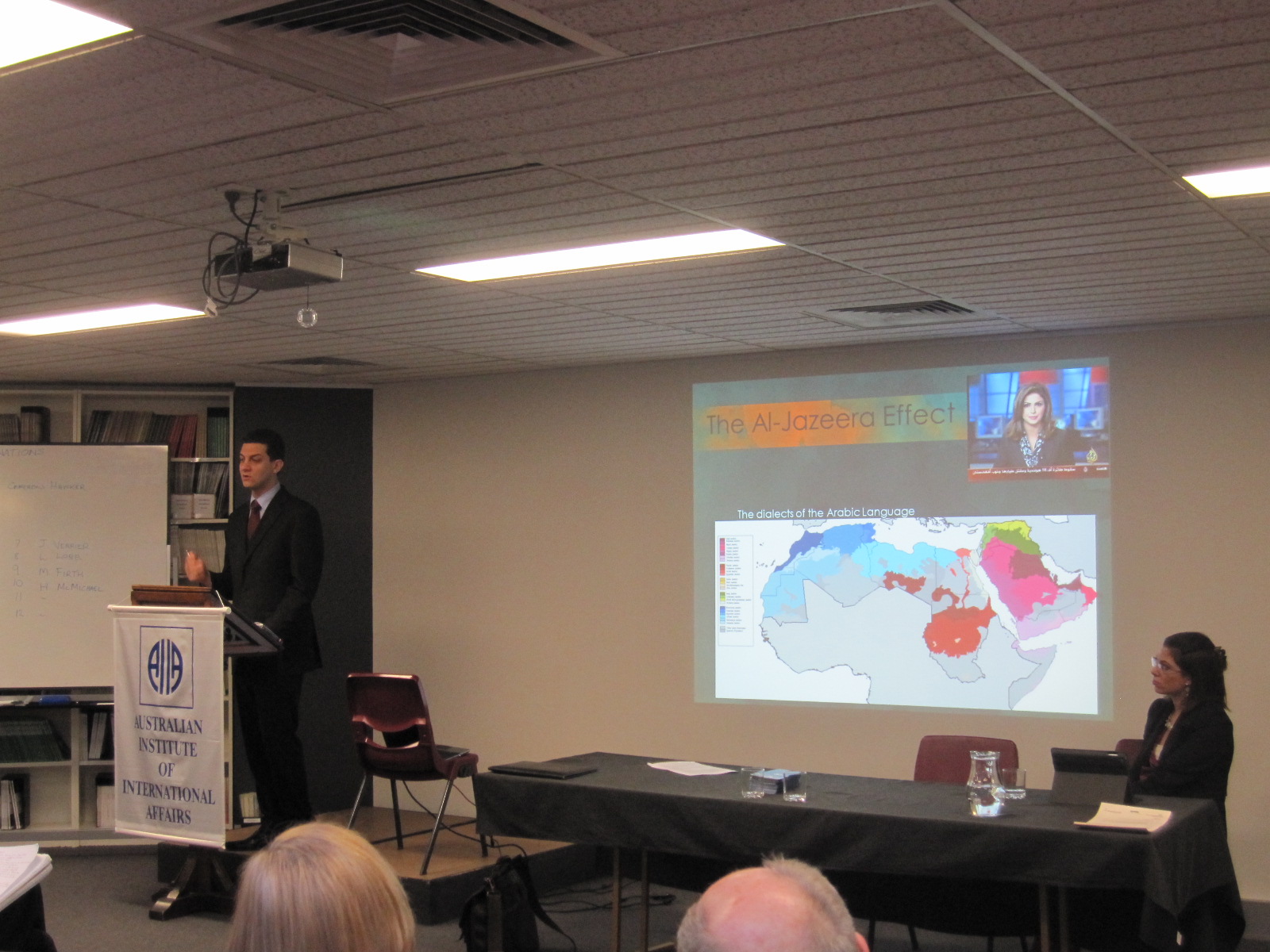
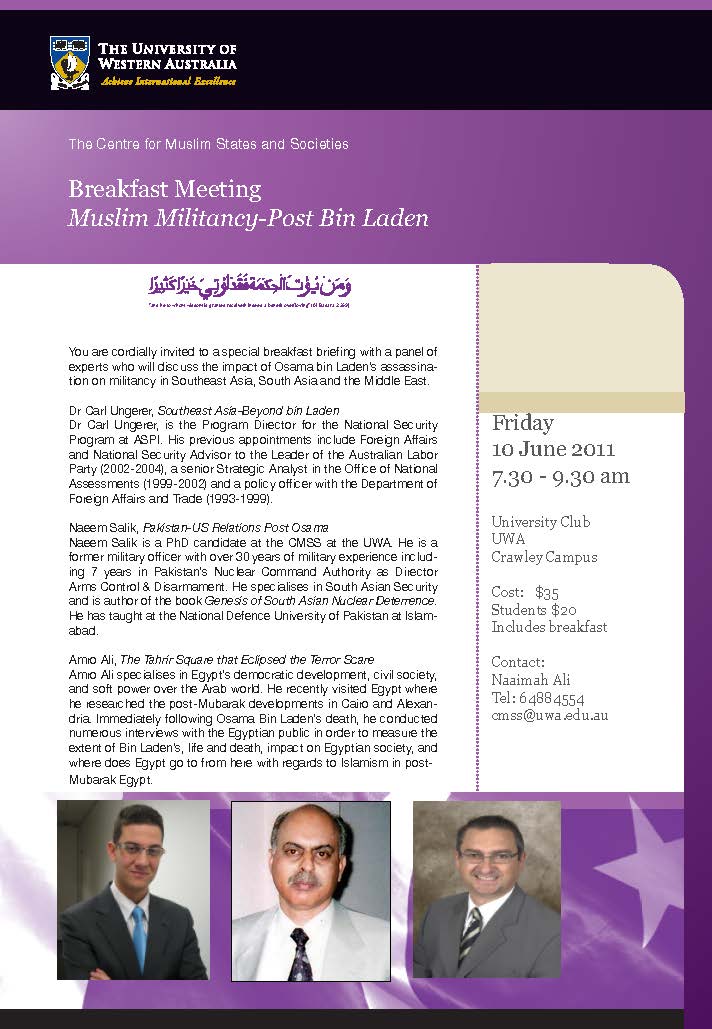
Transcript of my speech presented at the University of Western Australia
click here for details of the event UWA Panel
Abstract: The presentation will seek to argue that while Osama Bin Laden and Egyptian society shared two similar key goals: end to oppressive dictatorship and US meddling in the region. It was Bin Laden who lost considerable legitimacy on Egypt’s streets prior to and, more significantly, as a result of the 2011 Egyptian Revolution. Mubarak’s Egypt was central to Bin Laden’s narrative of repression and political revolution in the Arab world, ideologically underpinned by his deputy, Egyptian physician, Ayman Al Zawahiri. Three main dynamics came into play to sideline an already waning Al-Qaida narrative: the opening of an alternative route of political and social dissent; the growing Al-Qaida-Egyptian Islamist divide as well as the latter’s political maturation; and, critically, societal perception shifts vis-à-vis the burden of responsibility in the ruler-ruled paradigm.
[youtube]http://www.youtube.com/watch?v=9YZ8sqJI6qY[/youtube]
(If above video not working, go directly to link: http://www.youtube.com/watch?v=9YZ8sqJI6qY)
On a windy evening, 27 April, a momentous event occurred that received little international headline but was significant to Egypt’s future, and, by extension, the Arab world. An unprecedented debate took place between the Muslim Brotherhood, led by Sobhi Saleh, and the secular liberals, led by Amr Hamzawy.
The event was scheduled to be held in the famous Library of Alexandria. But a last minute unexplained decision shifted the event across the street to the College of Law, Alexandria University.
The venue packed over ten thousand into the theatre, with students, activists, and the general public, cramped into seats, spread on the floor, dangling off windows. Doors were forcibly shut to stop the public from entering an already over-crowed venue. Continue reading “Forget Osama, The Battle for the Arab World’s Future is Underway”
When Henry Kissinger once queried the Chinese Premier Zhou En Lai in 1971 for his views on the consequences of the French Revolution, Zhou famously respond, “It is too early to tell”. In other words, 180 years notwithstanding, Zhou’s point was that the consequences of social revolutions do not crystallise until much later.
Academics who specialise in revolutions and Middle East studies are often fond of quoting the Zhou lesson yet are quick to omit social media from the discourse explaining the recent revolutions in Tunisia and Egypt. Since January, I have attended countless academic seminars discussing the uprisings where specialists are downplaying social media to such an extent as to make it inconsequential. You know you are in for the long haul when a speaker remarks smugly that Facebook did as much for Egypt as the fax machine did for the fall of the Berlin wall.
The line goes something like this: “The revolutions of the French, the Russians, the Iranians, are proof that you do not need social media”. This argument has been repeated to me ad nauseum. Moreover, the critics are engaged in the logical fallacy they often warn against: argumentum ad antiquitatem, “appeal to tradition”, that is to say, because it happened in this manner in the past, it has to be correct. Continue reading “The War of Academia on Social Media”
After the SBS Insight show, the question was posed to us, “Could there ever be a good dictator. I like Akmal Saleh’s answer, “I would support a dictator who is handsome, but the current lot are ugly bastards”
SBS Insight Forum “Monumental change is sweeping across the Middle East and North Africa.
Overview: “Powerful dictators are being toppled and long-entrenched regimes are under threat. Insight looks at the unfolding new order in the region and how democracy might work there. What do the people actually want … and what will they get?”
Part One: http://www.sbs.com.au/insight/video/2074117102/revolution
Part Two: http://www.sbs.com.au/insight/video/2074117102/revolution-part-2
Part Three: http://www.sbs.com.au/insight/video/2074117102/revolution-part-3
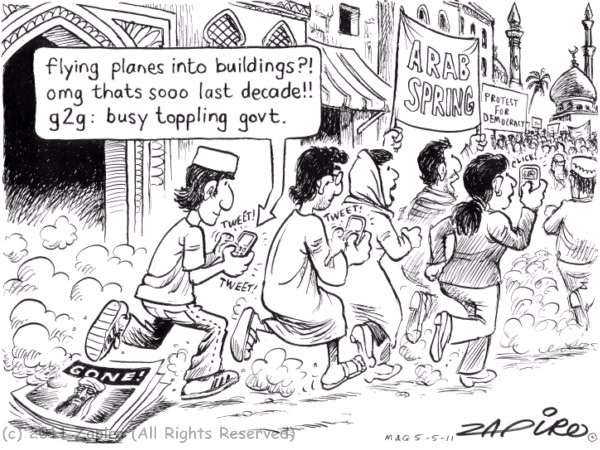
A collection of political cartoons from around the world regarding the January and February 2011 Egyptian Revolution.
[nggallery id=16]
[album id=1 template=extend]