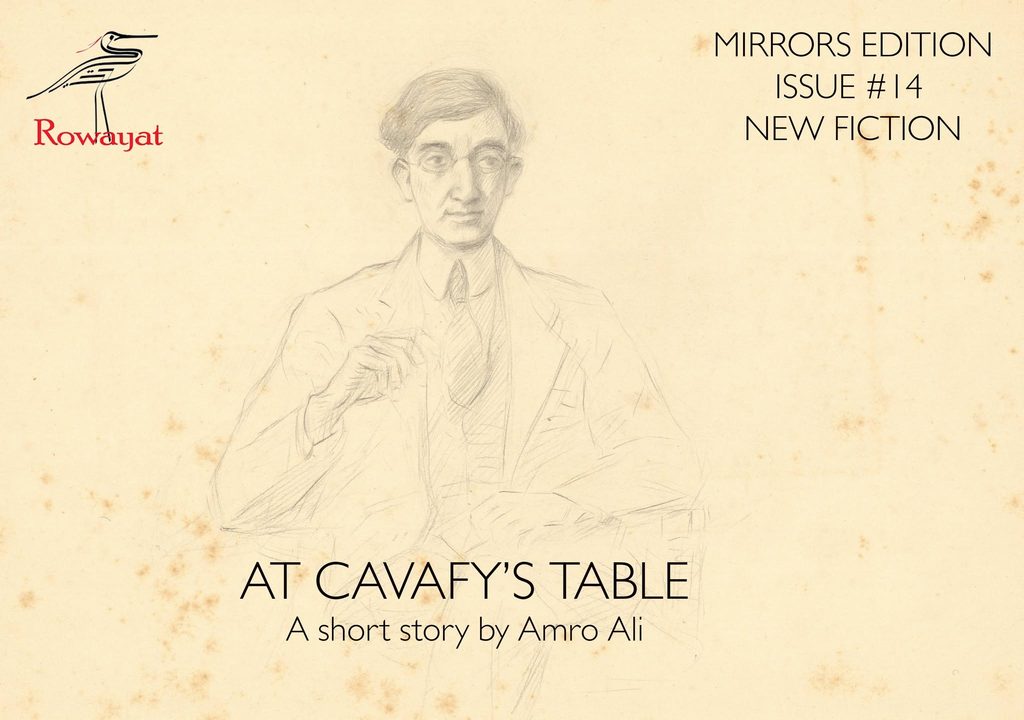
Constantine Cavafy and Ahmed Shawqi, the prince of poets, did meet more than once. Yet only a few lines of their conversations survive, most is lost to us.
So what happens in that silence? I tried to enter that silence. In At Cavafy’s Table, literature enters it.
In January 1929, during the Al-Karam winter storm, Cavafy and Shawqi meet at Baudrot Café in Alexandria in their final reunion. There is also a waiter named Mina.
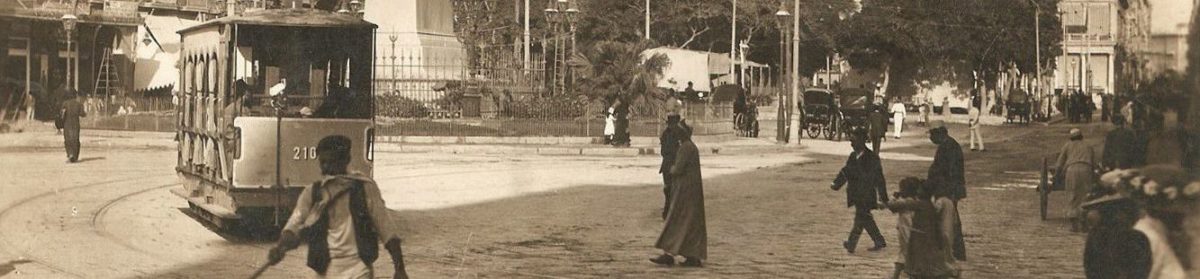
I spent quite some time reconstructing this world from Cavafy’s notebooks, Shawqi’s habits, correspondence, poems and the surviving literature of the city to give us fragments of the world around them in a year that saw Alexandria’s only recorded snowfall of the twentieth century.
At Cavafy’s Table is published in the Rowayat literary journal, Issue 14, Mirrors edition.
The Mediterranean sends storms and Alexandrians respond by naming them. Al-Karam, Generosity, is the January storm that drenches Alexandria and stays for days. It sends people indoors, street cats under the canopies, and birds to the balconies. The city finds itself alone with the sea that made it. When you live beside this sea long enough, you know that naming a thing is the closest you can get to someday taming it.
“Who takes twenty years to reply to a letter!” Cavafy shouted in the middle of Fouad Street.
After a bout of heavy coughing, he kept walking, passing under a fluttering white banner strung high between two lamp poles, hand-painted with Happy New Year, 1929! in Arabic, Greek, Italian, English, and French. It was, however, already a few weeks past the new year. The banner struggled but held, saved only by the torn holes that let the wind through. More thunder drew Cavafy’s face to the night sky as flashes lit the neoclassical and Belle Époque facades.
The rain resumed, but he kept the same pace as he turned the corner of Cherif Pasha Street toward Baudrot Café. He stood at the door that was ringed with frosted light bulbs. He hadn’t expected it to be packed on a winter Thursday. Cotton brokers, tobacco traders, artists, intellectuals (and self-proclaimed ones), playwrights, actors, and the odd one or two anarchists overfilled the art deco space. Men in tailored suits with fedoras and fezzes, women in silk coats with cloche hats. Many Egyptians fresh from a rehearsal of Ahmed Shawqi’s The Death of Cleopatra at the nearby Mohamed Ali Theater mingled – politely, if a little awkwardly – with Europeans from a French comedy at the Alhambra. They all sought refuge from the rain.
Cavafy lingered at the coat rack, slowly taking off his coat and hat, mapping the room. Some familiar faces approached. He was quick to mumble a Bonjour, Kalispéra or Buonasera with a forced smile, extending brief, stiff handshakes when he couldn’t avoid them. He made it through the crowd toward his usual corner table by the window. A waiter recognized him and rushed to remove two Cypriots from it, giving them the excuse that it was reserved. Cavafy took his seat while looking out the window. “Is he coming or not?”
He pulled out the telegram and checked it again.
GREETINGS C.CAVAFY. ARRIVING ALEXANDRIA THURSDAY EVENING.
RECENTLY REDISCOVERED YOUR LETTER 1909.
REGRET DELAY IN REPLY.
WISH TO HEAR REQUEST.
BAUDROT CAFÉ .30 PM.
The hour was smudged. He could not tell if he was early or late.
“Good evening, Mr. Cavafy. It has been a while since I’ve seen you here, I’m sure”
The waiter gabbled, eager to show off his English skills before Cavafy cut him off.
“Get me a raki!”
The rain eased. The customers slowly left, until the cafe belonged to one man. Cavafy looked up at the empty tables a few times, his hand resting on the cane. He had wanted the quiet, at least he thought he did, but now that quiet felt different. He doodled circles on the back of the telegram. He then leaned the cane against the wall and took out an Irma cigarette, snapped it in half, lit one end, and returned the other to the packet.
The same waiter, Mina, approached him.
“No poem tonight, Mr. Cavafy?”
Cavafy waved him away. Mina remained.
“I never write properly outside my apartment,” Cavafy said, taking a deep puff of his cigarette, and exhaling toward the street. He took out scraps of paper from his pocket and continued the doodling, then screwed them up.
Mina paced about clearing the tables. When he moved closer to the entrance, he found the leg of a wobbling table that hadn’t been repaired in years. He steadied it and stood there for a moment. The singer Sayed Darwish had complained about this table in the final months of his life. Specifically, irritably. In the way that dying men sometimes fasten on to the smallest of things. Mina even thought of the table at the funeral. One of the other waiters placed his hand on Mina’s shoulder. “We were there when nobody else was,” he said.
Mina nodded. “Barely anyone saw him lowered into the ground,” he said. “The whole country was swept up in Saad Zaghloul’s return from exile.”
Mina took some folded papers from his pocket. Some poems he had written that morning – or last night, or last week. He couldn’t remember when. He read the first line, then crumpled them up. He brought Cavafy a couple of sablés. He took a few steps back as one of the waiters whispered, “Are we seriously going to stay open for this Greek crank?”
“Yes, it’s the rules,” Mina replied.
Continue reading “At Cavafy’s Table”