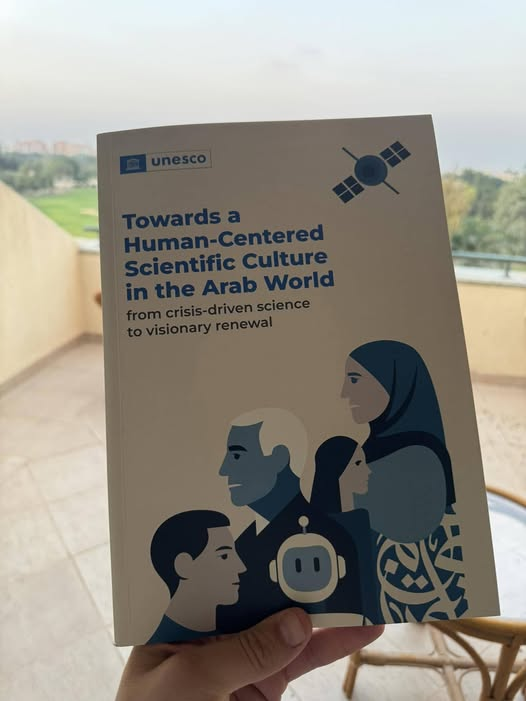
My UNESCO report, Towards a Human-Centered Scientific Culture in the Arab World: from crisis-driven science to visionary renewal, has finally been published and is now publicly available.
Summary:
What if science in the Arab world could again be a cause for wonder, critical thinking, civic engagement, and citizenship? This report explores how scientific culture can be re-humanized and re-enchanted, so that it confronts the most urgent challenges facing the Arab world today. It transports the reader from the jolts of the COVID-19 pandemic to the fast-rising age of AI. It asks: what type of science culture is demanded—not just for technological advancement, but to nurture empowered and inclusive societies from Tangiers to Baghdad?
Despite education and research investments, scientific engagement remains weak across the majority of the Arab world. Developed as part of UNESCO’s Management of Social Transformations (MOST) Programme, the report identifies deeply-rooted obstacles: illiteracy, disengagement, low trust, and mobility restrictions and urges an interdisciplinary and holistic solution that places science within the cultural and social experience of Arab cities.
With cities as incubators of imagination, and Arab-Arab collaboration as a strategic necessity, a new science culture can be constructed: pluralistic, mobile, socially embedded, and emotionally resonant.
From libraries and museums to public media and art, the report offers a vision for galvanizing scientific interest and civic participation. Readers are invited to imagine how this transformation can occur, and to become part of building a future where Arab science touches the soul as much as the mind.
