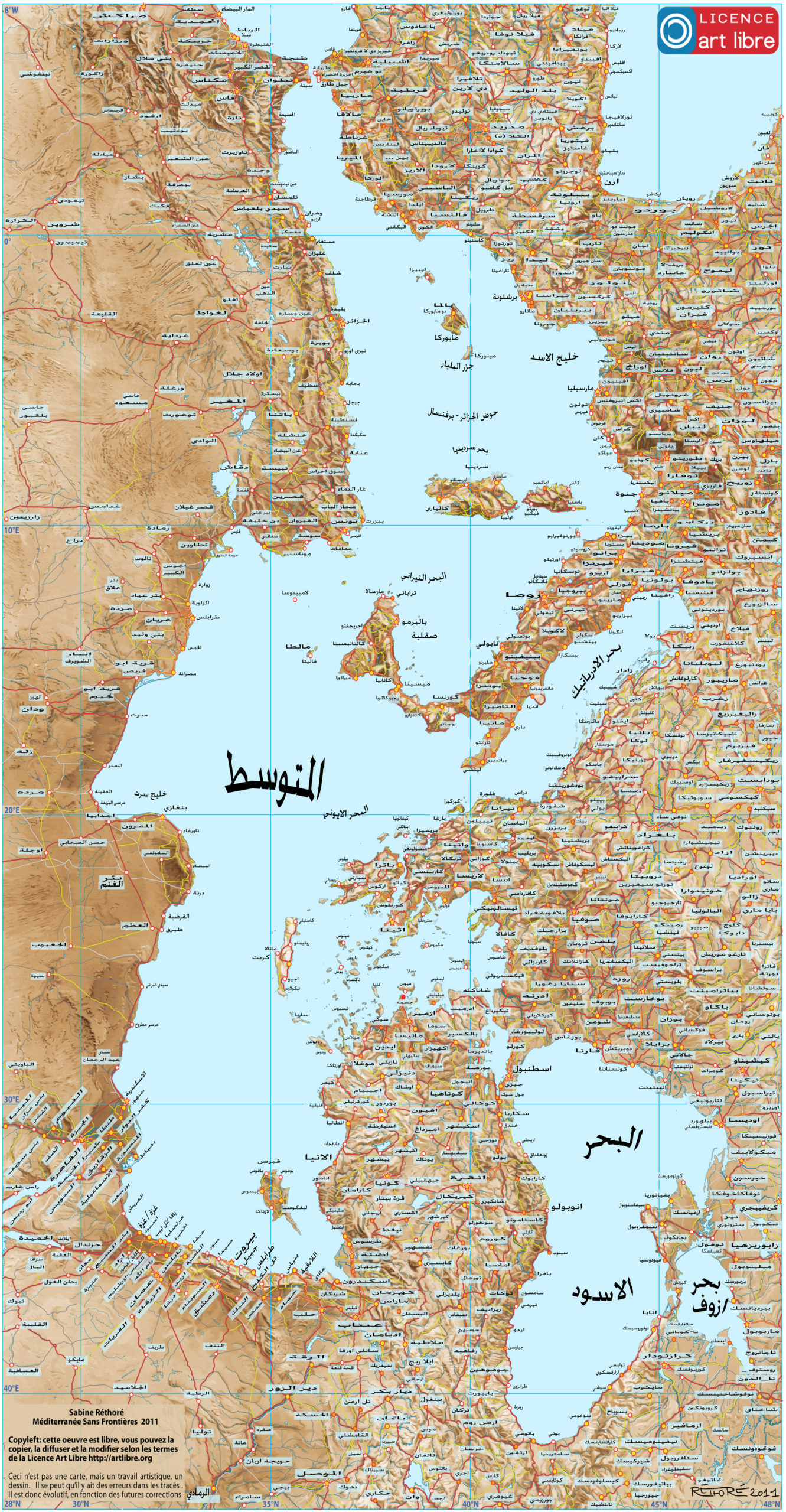
The “Mediterranean Without Borders” map was produced, in the political euphoria of 2011, by Paris-based artist Sabine Réthoré. Its profound simple 90-degree rotation not only underwrites an artistic streak, but can also largely impact one’s perspective. The end result is that the question is no longer about north-south as much as it is about parity and closeness. In the context of Mediterranean geopolitics, refugees crossing and drowning, fortress Europe, colonial history, skewed markets, condescending north to south (top to bottom) attitudes, post-colonial stagnation and so forth, means the simple rotation of the map is a big political statement with humanizing tendencies that make transnational ties look more intimate. That is an artistic statement in itself. This does not mean it will work for all maps, but it does so with the Mediterranean basin given the weight of its contemporary politics and long rich history.
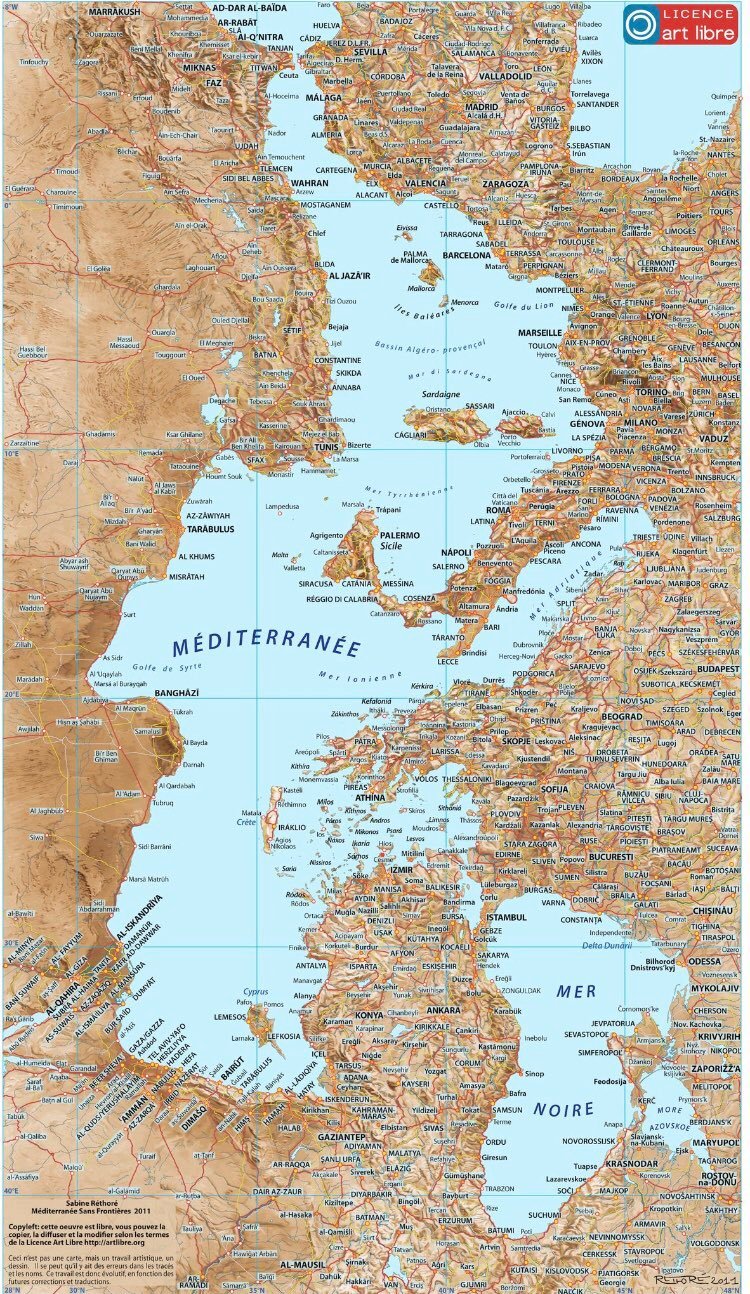
The map was shown at an event in Brussels in November 2019, where I was invited to speak to EU and MENA youth, the opening was made by Marseille-based writer Mary Fitzgerald who presented this curious map of the Mediterranean rotated 90 degrees to the right. Fitzgerald provoked a lively discussion and the audience related more to the alternative map than its standard appearance. When I shared the image with others, it elicited various responses from it looking like a fantasy map to the humorous old woman trying to avoid stepping into the mud. Intimacy was a key response to the map. When I posted it to Twitter, geographer Joshua S. Campbell responded “Amazing how rotating a map changes your perspective. Maps tend to ossify spatial relationships in your mind…tweak the map, break the pattern. Also why spatial thinkers are useful, they possess the ability to rotate spatial relationships in their mind.”
What Réthoré’s artwork also does is furnish a metaphysical canopy to Gianluca Solera’s idea of transnational Mediterranean citizenship and breathes life into the dying political imagination. Solera argues
“the Mediterranean could become again a cradle of a new Renaissance if conditions were put in place for a project of transnational citizenship. A shared political initiative, putting together the various experiences of resistance, protest and popular alternatives, and building a Mediterranean platform for a new social contract, so urgent in times of profound crisis both in Europe and in the Mediterranean” (Solera, 2017).
Indeed, it may appear that we are a long way from this, but the grim reality of securitization, refugee crisis, and a pandemic overturning the world as we know it, can eclipse the years that saw thousands of initiatives taking place, stories, theorizing, training, in what Solera has deemed a Mediterranean “Shadow government.” Moreover, the region is moving towards a thinking in which the social contract will require rewriting as it faces the pressures of epidemiological threats, climate change, alarm at the dominance of big tech, to the receding of the long-haul flight in favor of local and regional travel, a travel bubble in some cases.
This is crucial if civil society, social movements, and transnational Mediterranean responsibility is to take on meaningful qualities towards how the digital order and terrestrial order are to be negotiated. Italian sociologist Franco Cassano noted:
“Unbridled technology does not signify the abandonment of earthy grittiness, but its perfecting it through the will to power. Mediterranean man, instead, lives always between land and sea; he restrains one through the other; and, in his technological delay, in his vices, there is also a moderation that others have lost. The unbridled development of technology is not tied to the crossing of land and sea, but to the oceanic lack of moderation, the chasing of the sunset by the sun, the absolutization of the West.” (Cassano, 2011).
In other words, the Mediterranean world is a philosophical gateway to deconstruct fundamentalisms as it has the “capacity to transform our limitations in a common benefit, a tragic memory in the fight against all forms of fundamentalism” (Cassano, 2011). Be it techno-fundamentalism or else.
The above is a short modified extract from my paper, “Re-envisioning Civil Society and Social Movements in the Mediterranean in an Era of Techno-Fundamentalism,” published in the European Institute of the Mediterranean (Barcelona). The journal article is open access.