The Buck Dies Here: Why Egypt’s Interior Ministry Refuses to be Tamed

Article originally published in The Atlantic Council’s ‘Egypt Source’ (4 April 2013)

Ambushes, kidnappings, torture and murder have come to characterize Egypt’s security sector’s engagement with the Egyptian public in both pre- and post-revolution Egypt. This has left many asking: How did the interior ministry survive its pre-Mubarak incarnation given that one of the revolution’s key demands was police reform?

The issue is more complex than simply looking at how former autocracies were able to reform their police forces during their transition to democracy. The problem arguably starts with how Egypt’s elite – the military, the Muslim Brotherhood, and former regime loyalists – relate to the 18 day uprising.

Nabil Abdel-Fattah in his book “Elite and Revolution: State, Political Islam, Nationalism and Liberalism” argues that the elite are still unable to comprehend the gravity of the 2011 events. This view sheds light on why they are unable to generate a national post-revolutionary project, post-democratic movement or an overhaul of the security establishment, simply because a number of them conceive of the 2011 events as a “mere democratic protest movement.”

As Abdel-Fattah notes “The majority have not absorbed the nature of the event and the end of the legitimacy of 23 July 1952 with its generations, ideas and legacy…The conflict is still at its peak , and reveals two speeds running together in Egypt: one attached to the legitimacy of 1952 and another that claims a still unclear revolutionary legitimacy.” In other words Egypt is experiencing an ideational and generational war that has pitted two appeals to historical legitimacy against one another.

Continue reading “The Buck Dies Here: Why Egypt’s Interior Ministry Refuses to be Tamed”
The Maddening Betrayal of Potato-Seller, Omar Salah

Omar Salah: In life and death

Published in openDemocracy
Republished in Ahram Online

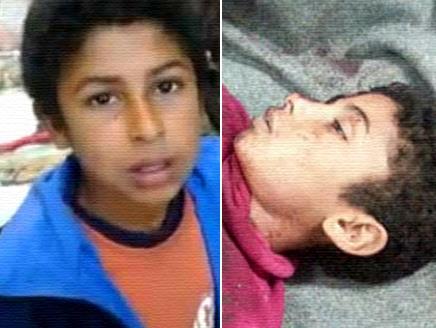
An Egyptian army conscript walks up to 12 year old Omar Salah Omran, a sweet potato seller – outside the front gates of Cairo’s US Embassy close to Tahrir Square – and requests two potatoes from the young street vendor. Omar answers, “I’ll do so after I go to the bathroom”. The allegedly untrained soldier retorts with a mix of cockiness and jest that he will shoot Omar if he doesn’t comply immediately. On Omar’s reply, “you can’t shoot me” – the conscript, on the alleged presumption that his weapon was not loaded, aimed two bullets piercing through Omar’s heart. He died instantly. (Based on Omar’s father’s television interview with host Mahmoud Saad)

The entire incident was over in ten seconds. The fallout continues.

Many Egyptians were humbled and awoken to another Egypt with the release of a gripping video of Omar speaking to a Life Makers charity member in which he says “I am tired of this job”: he says he wants to learn to read and write. There is an inherently troubling dimension in Omar’s demise that goes beyond the “accidental” nature of it. It is the callous disregard by the state that instigated and attempted to cover up the crime, and a society that no longer gives a second look to the plight of child labour.
Continue reading “The Maddening Betrayal of Potato-Seller, Omar Salah”

Silent Commanders-in-Chief: From Khaled Saeed to Malala Yousafzai

Article published in openDemocracyEgypt Monocle and Saudi Gazette

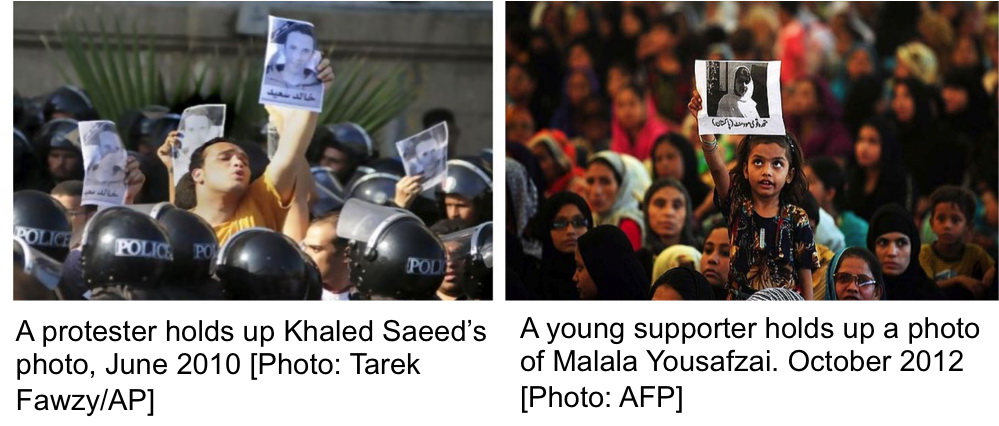
While reading the horrific case of Malala Yousafzai, the 14 year-old Pakistani girl who was shot in the face by the Talban for championing girls’ education, I came across a photo of a young supporter of Malala that triggered memories back to June 2010 of a similar image that has forever been engraved in my mind – an Egyptian youth protesting the tragic death of Khaled Saeed, the 28-year old Alexandrian who was beaten to death by policemen and would trigger the rapid countdown to the 2011 Egyptian revolution (See my detailed June piece Saeeds of Revolution: De-mythologizing Khaled Saeed).

The images provide a poignant and surreal expression of a protestor, in a repressive atmosphere, raising their hand held up high clenching a simple black and white A4 printout of their respective poster-child. It strikes deep at the heart of Arab regimes or fanatical organisations that have little appetite for dissent or any mere standing out from the crowd.
Continue reading “Silent Commanders-in-Chief: From Khaled Saeed to Malala Yousafzai”

Power, Rebirth, and Scandal: A Decade of the Bibliotheca Alexandrina


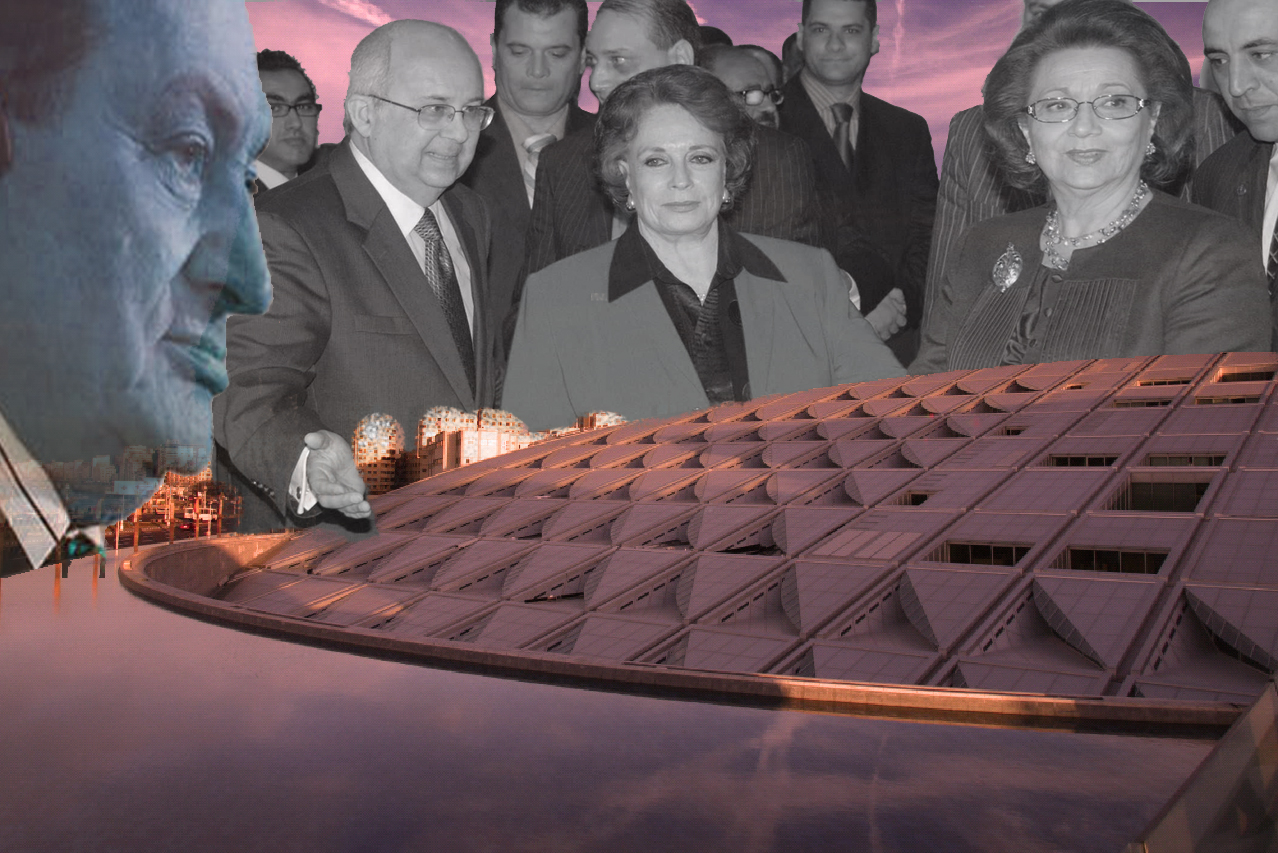
Deposed President Hosni Mubarak, Bibliotheca Alexandrina Director Ismail Serageldin, widow of the late President Anwar al-Sadat, Jehan, and former first lady Suzanne Mubarak; oversee the Library.

Click here to read my feature piece in JadaliyyaPower, Rebirth, and Scandal: A Decade of the Bibliotheca Alexandrina
(also republished in Ahram Online)

The piece examines the foundational politics and abuse of power behind the resurrected Library of Alexandria. “The library rests at the heart of international power plays seeking to carve out a stake in the ‘sacred drama’ of the Alexandria myth, Egypt’s political repositioning with the West, the Mubaraks’ unabashed narcissism, coupled with the self-styled “culture wars” of Alexandria’s elites. The foundational drama that midwifed the Bibliotheca would give way to a decade of corruption, abuse of power, while also positively shaping the socio-cultural landscape of the coastal city, even making it a vital player in the post-Mubarak environment.”