Political Sociologist · Public Scholar · UNESCO Advisor
Category: Arab World
“If the sun sinks in a sea of troubles. And a wave of darkness sweeps the world. And we can no longer see or understand and the way is lost in lines and circles. Then, all you wise and experienced ones, your only guide is the eyes of words.” – Ahmed Fouad Negm, Uyoun al-Kalamaz, “Eyes of Words,”(written in Egypt’s Qanatir prison, 1970).
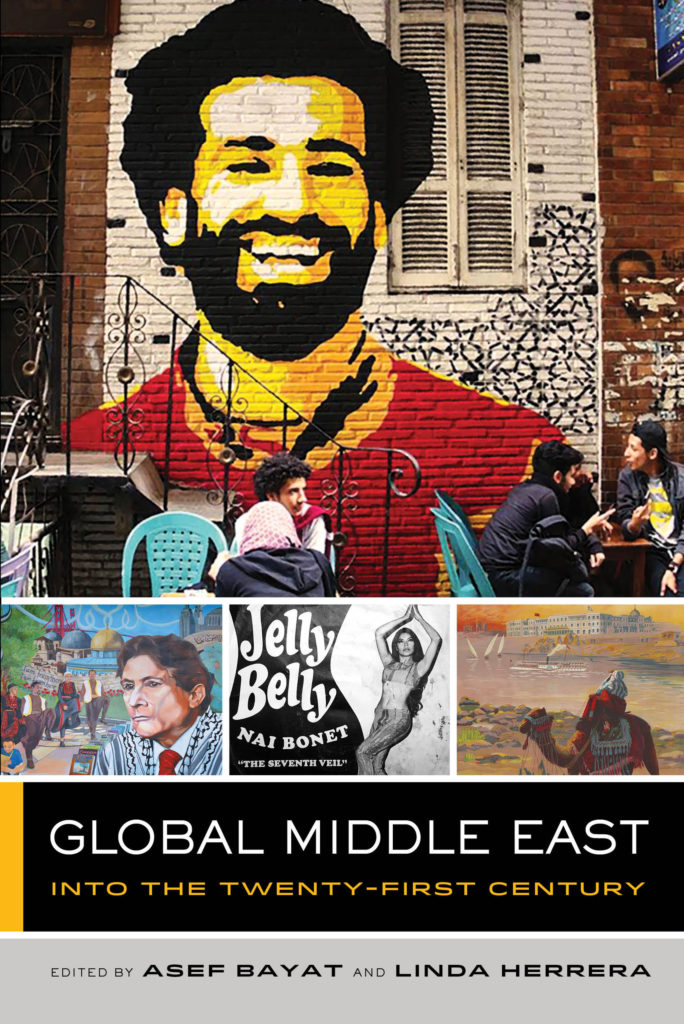
The edited book, Global Middle East: Into the Twenty-First Century, by Asef Bayat and Linda Herrera, is out now with the University of California Press. I have a chapter that explores the positioning of Mohammed Salah and moral codes within Egypt, the Middle East, and the world. I’m honoured to be with such a great lineup of names.
ABOUT THE BOOK
Localities, countries, and regions develop through complex interactions with others. This volume highlights the global interconnectedness of the Middle East—both ‘global-in’ and ‘global-out’. It delves into the region’s scientific, artistic, economic, political, religious, and intellectual formations and traces how they have taken shape through a dynamic set of encounters and exchanges.
Written in short and accessible essays by prominent experts on the region, the volume covers topics ranging from God to Rumi, food, film, fashion, and music, sports and science, to the flow of people, goods and ideas. It tackles social and political movements from human rights, Salafism and cosmopolitanism, to radicalism and revolutions. Students will glean new and innovative perspectives about the region using the insights of global studies.
TABLE OF CONTENTS
List of Illustrations
Preface
PART ONE: INTRODUCTION
Global Middle East – Asef Bayat and Linda Herrera
PART TWO – NATIONS WITHOUT BORDERS
God – Ebrahim Moosa
Algebra, Alchemy, Astronomy – Robert Morrison
Rumi, the Bridge Builder – Fatemeh Keshavarz
On Nations without Borders – Hamid Dabashi
PART THREE: HOME AND THE WORLD
Reflections on Exile – Edward Said
Mo Salah, a Moral Somebody? – Amro Ali
Gamal Abdel Nasser – Khaled Fahmy
PART FOUR: FOOD, FILM, FASHION, MUSIC
Circuits of Food and Cuisine – Sami Zubaida
Pictures in Motion – Kamran Rastegar
Musical Journeys – Michael Frishkopf
The Kufiya – Ted Swedenburg
PART FIVE – GEOPOLITICS OF GOODS
Water of Vulnerability – Jeannie Sowers
Cycle of Oil and Arms – Timothy Mitchell
Cotton, Made in Egypt – Ahmad Shokr
Ports of the Persian Gulf – Laleh Khalili
PART SIX: HUMAN FLOWS
Touring Exotic Lands – Waleed Hazbun
Outsiders of the Oil States – Ahmed Kanna
The Levant in Latin America – John Tofik Karam
PART SEVEN: POLITICS AND MOVEMENTS
Global Tahrir – Asef Bayat
Islamizing Radicalism – Olivier Roy
Global Movement for Palestine – Ilana Feldman
Human Rights, Indigenous and Imperial – Lori Allen
Cosmopolitan Middle East? An Interview with Seyla Benhabib – Linda Herrera
“In this podcast episode, AGYA member Dr. Amro Ali from Egypt and AGYA alumnus Dr. Kalman Graffi from Germany discuss Coronavirus warning apps, delving into their advantages, disadvantages and effectiveness from both a technological and ethical point of view.”
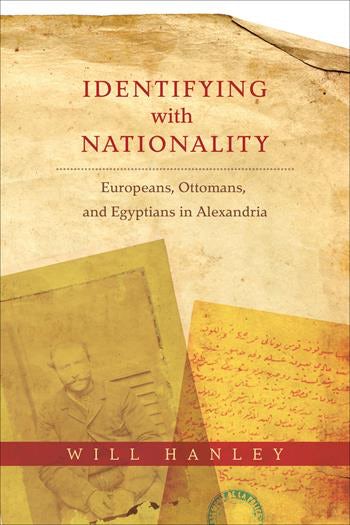
My book review of Will Hanley’s work “Identifying with Nationality: Europeans, Ottomans, and Egyptians in Alexandria” has been published in the Mashriq & Mahjar journal (Moise A. Khayrallah Center for Lebanese Diaspora Studies, North Carolina State University). The PDF article is open access.
WILL HANLEY, Identifying with Nationality: Europeans, Ottomans, and Egyptians in Alexandria (New York: Columbia University Press, 2017). Pp. XIV+391. $65.00 cloth, $64.99 e-book.
REVIEWED BY AMRO ALI, American University in Cairo
“Who are you?” is an all too familiar question
in everyday life, one that is neither bound by time nor place, but can carry
extraordinary consequences for the person being asked, and for history itself. It
is a question that is central to Will Hanley’s outstanding book, Identifying
with Nationality: Europeans, Ottomans, and Egyptians in Alexandria, which
illuminates Alexandria as a key sociolegal laboratory in the making of our
modern world, covering the decades between the early 1880s and the outbreak of
World War I in 1914. In this short pivotal span of history, Hanley telescopes
into an enriching fusion of people from different countries who crossed each
other’s paths on the streets, sidewalks, trams, trains, cafés, restaurants, and
theatres. For many, the idea of personal identity revolved around timeless
identifiers such as birthplace, religion, and marital status. They also had a
nationality label but this, particularly until the 1880s, was usually a dormant,
if not meaningless, category. That is, nationality suddenly meant everything
when it became both a formal and informal requirement by the authorities or
offered social and legal advantages.[1]
That realization would bring people, and hence cement their cases on paper, to
the police stations, consulates, and courts of Alexandria. The “wrong”
nationality, like a Cypriot, could be a burden on the individual, while a privileged
nationality, such as French or British, could mean protection from prison and
access to wealth.[2]
Egyptians, for whom the idea of nationality was yet to gain any social and
legal coherence, were disgruntled at the nationality scourge that not only
disadvantaged them compared to other nationalities, but the questionable court
sentences and dubious acquittals also served to prove that the “outward garment
of nationality concealed the domestication of the rule of difference.”[3]
Hanley’s book is divided into
three parts, containing twelve chapters, an introduction, and an epilogue. In section
one, “Settings,” Hanley illustrates the organizing concept of “vulgar
cosmopolitanism” in chapter one. This concept drives the book’s key theme that shifts
our familiar notion of Alexandria from a romanticized understanding and
elite-centered cosmopolitanism to the mundane everyday life of Alexandria. The
latter is where the matrix of passing, ignoring, jostling, and arguing occurs
with habitual frequency until it crosses into legal territory, such as breaking
the law, often lubricated by liquor and fomented by misunderstanding. Chapter
two fleshes out keywords: national, citizen, resident, foreigner, and subject.
The chapter aims to map out the book’s conceptual topology and the placement of
individuals and their identities in the making of the emerging world at the
turn of the twentieth-century.
In the second section,
“Means,” Hanley scrutinizes the mediums of identification in the daily lives of
society through the chapters of —“Papers,” “Census,” “Money,” and “Marriage” — which
taught the population to identify with new labeling practices and familiarize
themselves with a new vocabulary. The chapter “Papers” explores how passports
and identification documents became the portable and impersonal means for the
authorities to manage the mobility of individuals. While the chapter “Census”
looks at the product of the state’s appetite to amplify its state-building project,
negotiate disputes with diplomatic authorities over nationalities, and
centralize the certification of identity. [4]
The chapter on money fleshes out how currency became symbols for the emerging
political and economic order and, hence, it required that tokens be honored. In
light of this, counterfeiting was seen as an egregious crime, as it challenged
the official order and the state’s power to circulate and monopolize symbols of
value. The standardization of currency and material advantages sharpened the
ability for nationalities to gain access to benefits and favorable rulings from
judicial institutions that were predisposed towards wealthy national
communities. [5]
Finally, the last chapter of the section, “Marriage,” was a site of
administrative anxiety given that nationality was largely a gendered practice
by how easy it was for women to switch to their husband’s nationality or retain
their father’s nationality through marriage, remarriage, separation, or divorce.
But their transition depended upon the usefulness of the nationality in
question, thus making marriage the “driving wheel of nationality litigation and
legislation.” [6]
Hanley’s third section,
“Other Nationalities,” spans six chapters: “Europeans,” “Foreigners,”
“Protégés,” “Bad subjects,” “Ottomans,” and “Locals,” which takes up the larger
essence of the book, as it seeks to map out the triumph of the nationality
category, even with its precarities, over other markers of identification. Yet,
Hanley takes us into a more complicated field beyond “powerful” Europeans and
“weak” natives, as colonial privilege could not be easily deployed as
distinctions were rarely obvious. For example, outside the small circles of
European notables whom clearly had brazen privilege, poorer Europeans found
themselves constrained by class, race, or gender.[7]
Similarly, non-European foreigners like Tunisians and Maltese, who were
imperial subjects, could exercise benefits in Egypt that were not possible back
in their home country.
The case against Alexandrian cosmopolitanism that privileges elites and pioneers is certainly not new and has been fashionable in academic circles for many years. The author, however, gives the subject matter justice as he makes a strong case for shifting from the elites and small literary circles that intended to leave a legacy of written accounts, to the ordinary Alexandrians who did not. Thus, the book’s outcome is a one-by-one pointillist tapestry that draws you into a different Alexandria. Hanley argues against the proponents of triumphalist histories, writing, “We are not obliged to grant the nation the epic imaginary proportions,” and in making the case for the everyday ordinary, ironically, gives his work a distinguished epic of its own.[8] All accounts ended up in court and consulate documents, much like the recorded banal exchange between two Maltese friends, reading, “Today is Saturday, let us go and have a walk,” and ends with one friend fatally stabbing the other. [9] The dizzying number of accounts reads like miniature dramas with an endless cast of actors straddling the turn of the century, dazzling the city, and animating the era in fascinating ways. Taking the stage is the Cypriot realizing his Ottoman-ruled origins offered no protection from torture in a police station; the Egyptian woman who fell in love with an Italian man causing a scandal; the British consular official rushing to stop a marriage between a British Christian woman and an Egyptian Muslim man; an Irishman pretending to be an irrigation inspector to get a tasty meal and “borrow” ten francs from a priest; a French winemaker surprised that he would be imprisoned after he overestimated his foreign privilege by beating up an Egyptian tram conductor; And, eyewitness testimonies by Austrian barmaids pronouncing Islamic oaths. What Hanley’s book does is it upends what may have been thought to be established and predictable about nationality.
The label of nationality—the ever-recurring
term that leads you through the book’s thematic kaleidoscope—creeps its way
into the realm of individual identity, which was traditionally reserved for
one’s name, occupation, place of origin, sect, and physical description. These
attributes had to compete with “colonialism’s will to categorize populations
and its pervasive expressions of power through small mechanisms and technologies
and its modernity,” all of which were recognizable through nationality (though
not the same as citizenship, which is a concept that would later become a key
aim in decolonization movements).[10]
This can be seen in Alexandria’s Maghribis up until the early 1880s, who were
considered by local Egyptians as different, but not foreign. This invention of
a nationality category, however, not only now made them foreign, but their
status from a French colony also gave them further layers of protection (still short
of the full legal protections that French nationals received) that unnerved
locals, especially when nationality departed from the ordinary practice of the
social into an exercise of its legality.
Identifying with Nationality is part of a trend that slowly crystallized in the mid-2000s and accelerated following the 2011 Egyptian revolution, which saw scholarship on Alexandria breaking the historical imperial-nationalist dichotomy that left little room for nuances. This shift took place amid a form of culture war between generations of Alexandrians, political positioning, and struggles to reconcile with the contradicting elements of the past. Perhaps beyond the book’s scope, it would have been worthwhile to give a brief analysis on modern Alexandria in the epilogue given the city was the ground zero and laboratory for the invented nationality category. Particularly because Hanley notes: “Alexandria was thus a bellwether for nationality changes that would spread worldwide in the twentieth century.” [11] As a resident of Alexandria myself, I wonder if modern Alexandria is a bellwether or troubling parable for the dysfunctions of nationality, as one sees the book’s longue durée projected into the present day as residents dwell on the debris left by nationality, nationalism, and an enduring colonial logic, which still scars Alexandria.
Hanley offers readers poignant
lessons for our times, particularly given the triumph of nationality after
World War I, which canonized smaller subsets of nationalities that we grapple
with today, such as the “stateless, refugee, colonial subject, foreigner, and
minority.”[12]
Egypt’s Muslim-Christian relations, for example, were not without strain before
the nationality category, but they were at least resolvable at the local level
because differences were clearly known, understood, and mediated through a
familiar pattern to the respective population center. Nationality, ironically, exacerbated
religious tensions as it papered over differences and paved the way for state
intrusion into local community matters. Even “Egyptian” did not hold much
meaning for many Egyptians prior to the 1880s. The category only became
important for bureaucratic reasons, not for membership of the watan (nation)
or for paying homage to some pharaonic ancestry.[13]
Rather, it was Egyptian elites who adopted the mantle of nationalism in order
to wield “the resources of the state in their own interest” and saw to it that
“nationalism expanded along the stolid avenue of self-interest.”[14]
For the rest of the non-elite Egyptians, it would take decades to adopt the
nationality label in any legal and nationalist sense. This reluctance can be
explained, as Hanley puts it, because “the benefits of local status were often
more obscure than its costs,” especially in terms of the burden of taxes and
ruthless conscription, from which foreign nationals were free from.[15]
In traversing over four
thousand cases, with over ten thousand individuals, and drawn from archives in
five different languages from six different countries, Hanley delivers a superb
piece of work in historical research, rethinking social history, and reevaluating
national taxonomies, rather than assuming them. This book makes a significant and
original contribution to the fields of transnationalism, citizenship,
cosmopolitanism, comparative colonial studies, international law, Egyptian
history, Alexandria’s urban history, and Mediterranean migration. It would
appeal to both graduate students and scholars, but also to the informed public
interested in these topics, as Identifying with Nationality, to its
credit, does not intimidate the reader unfamiliar with legal jargon. The author
has been merciful in making legal terms clearly legible, as well as subsuming
them into captivating miniature narratives and vignettes that animate the
sociolegal story of a bygone Alexandria. Therefore, it is not only a book that comprehensively
adds to scholarship, but is ripe with countless gems to inspire future plays,
poems, and stories.
NOTES
[1] Will Hanley, Identifying with Nationality: Europeans, Ottomans, and Egyptians in Alexandria (New York: Columbia University Press, 2017), 2.
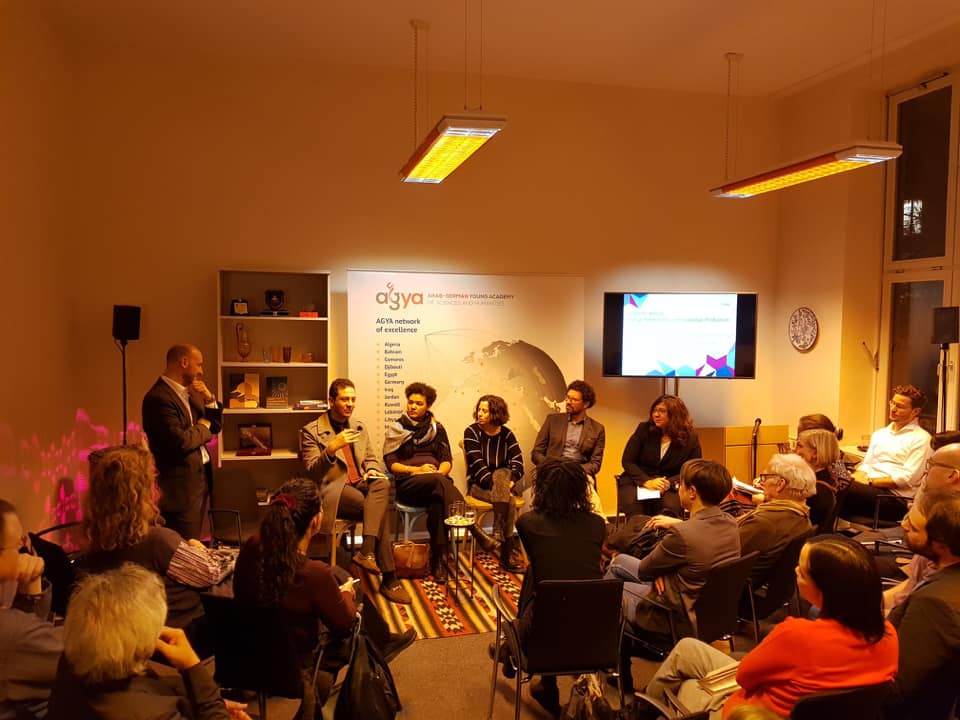
The event on knowledge production took place at the Berlin-Brandenburg Academy of Sciences and Humanities on 18 January 2020. I argued that if we do not address the scourge of passport restrictions and visa regimes, then the pace and orientation of holistic, transnational, and interdisciplinary knowledge production in the Arab world will continue to be skewed.
AGYA blurb: “With its contribution, AGYA invites the visitors to a critical examination of established concepts and patterns of perception of the world, the other and the self from German and Arab perspectives. AGYA is proud to present a program ranging from a panel discussion on ‘Scientific Worlds: Critical Reflections on Knowledge Production’, over a book launch of ‘Insatiable Appetite. Food as Cultural Signifier in the Middle East and Beyond’ edited by AGYA alumni and enriched by a tasting of different Hummus recipes, to a poetry slam and a photo exhibition on ‘Images of the Self and the Other in the Levant’”
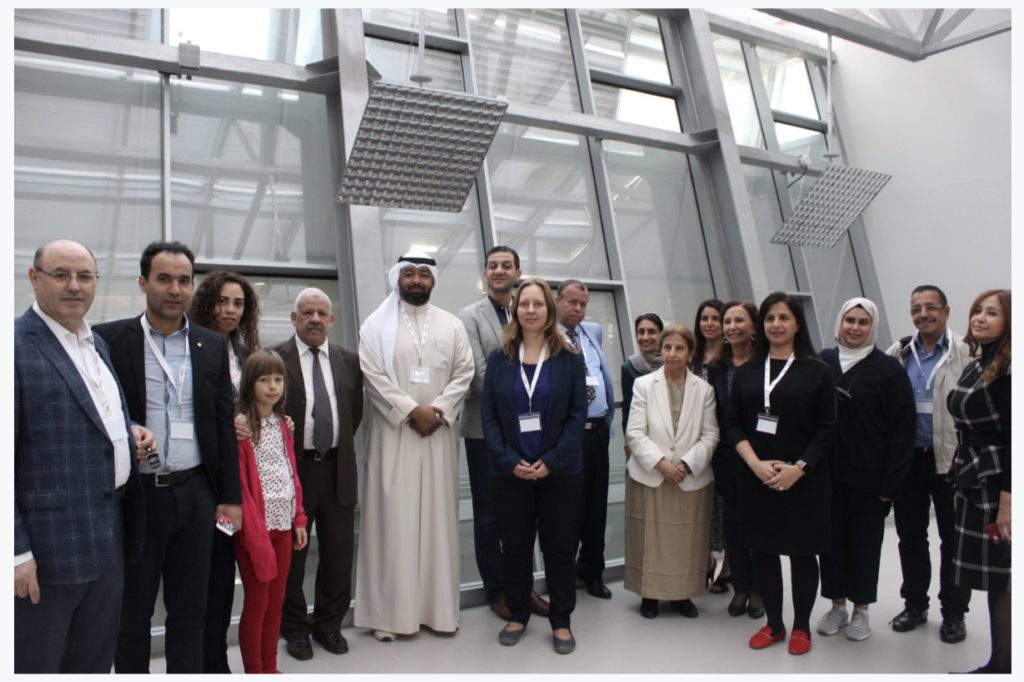
AGYA workshop at the Department of Philosophy, Kuwait University.
On 1-2 December 2019, the international AGYA workshop aims to explore the meaning of cosmopolitanism in Western and Islamic traditions and will provide a forum to investigate the mutual influences in the intellectual history of the concept in different cultural and intellectual traditions.
The concept of cosmopolitanism has always played an important role in philosophical and theological texts of various cultures, including Arab, European, Indian or Persian cultures. In its core, the concept of cosmopolitanism defines all human beings as world citizens— ‘kosmopolites’ in Greek—who thus are all part of a single universal community. The concept of ‘universality’ or cosmopolitanism also roots in Islamic theology and philosophy: in the history of Islamic thought, universalism is based on the concept of a shared humanity and equality. The unity of world citizens transcends all cultural differences or political borders, based mostly on a shared notion of morality.
In the eighteenth century, a cosmopolitan was a person that was open-minded, led a sophisticated life-style, and liked to travel. In current language, these are still some characteristics we are referring to today, when naming someone a cosmopolitan. Nowadays, cosmopolitanism is receiving more scholarly attention again: in the context of globalization, new (communication) technologies, and increasing digitization, there is a need to reflect in philosophical terms on the new prospects for the individual to interact and communicate with his or her fellow world citizens.
The AGYA conference focuses on intercultural exchange and its influence on the construction of moral and cultural paradigms. This is a rather new approach, considering the history of the concept of cosmopolitanism and the many contemporary moral, socio-political, and economic definitions existing in parallel today.
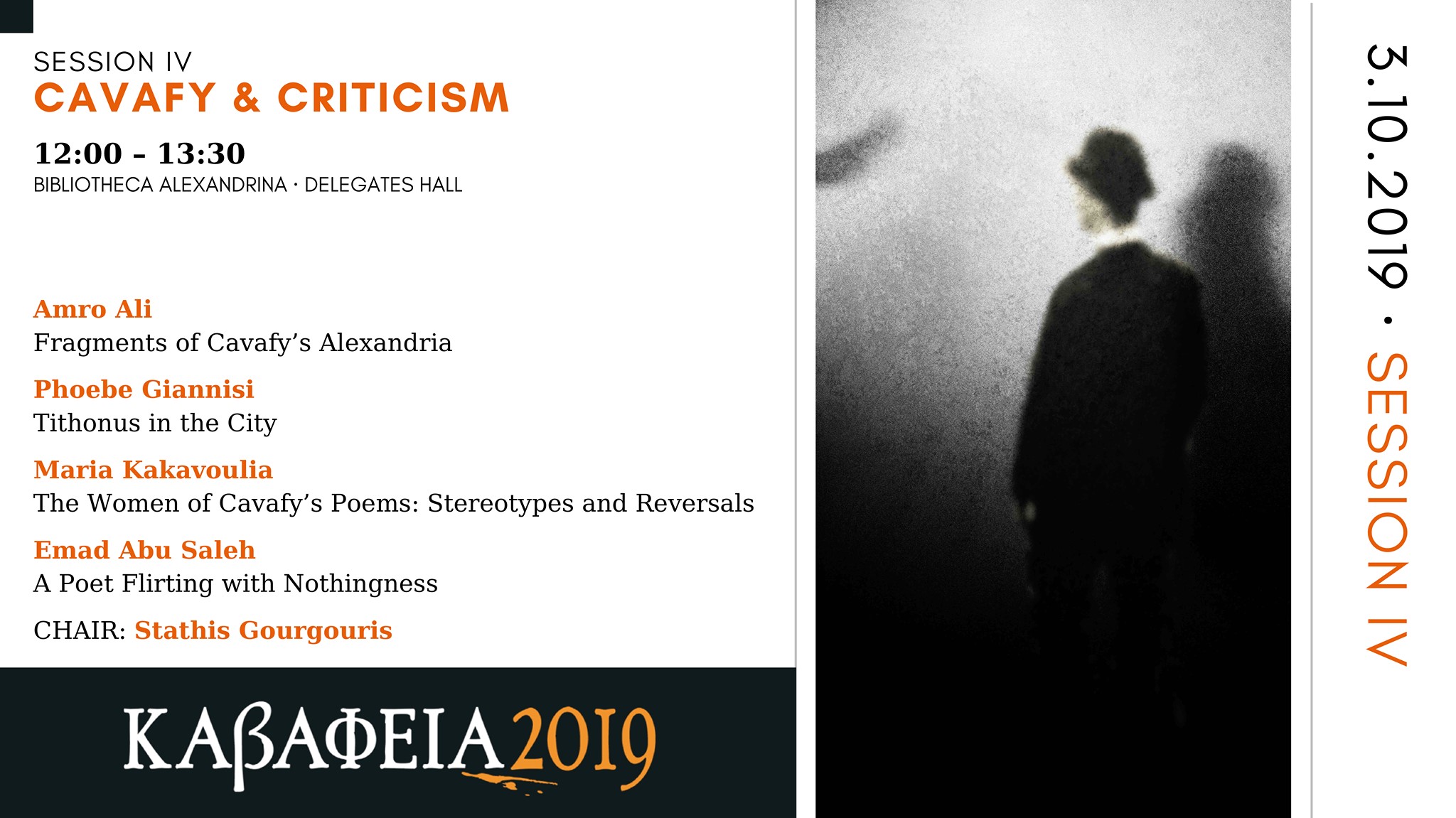
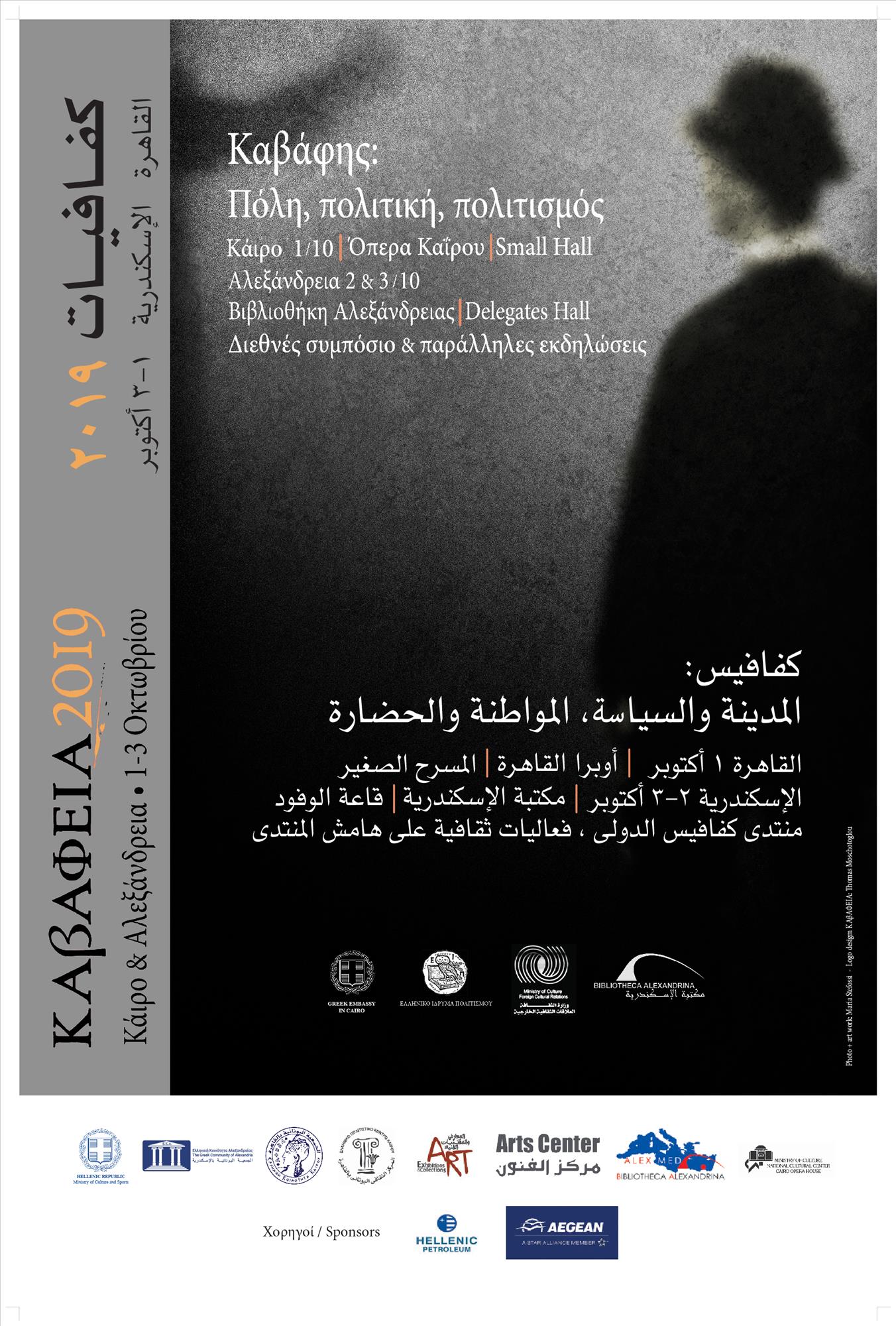
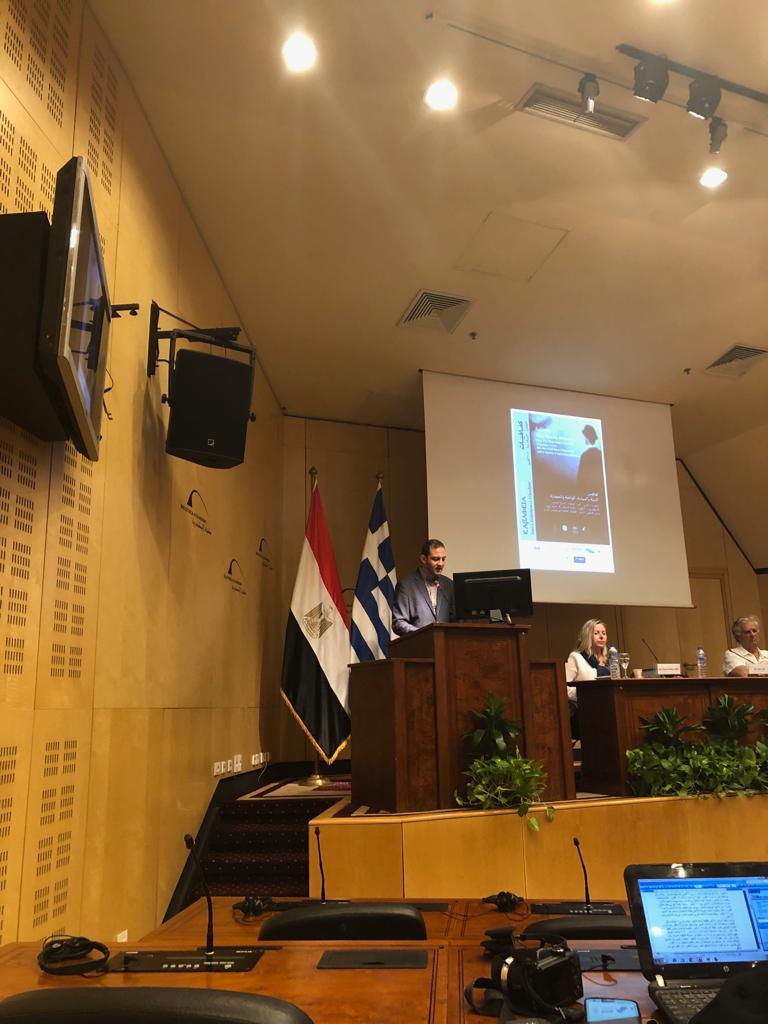
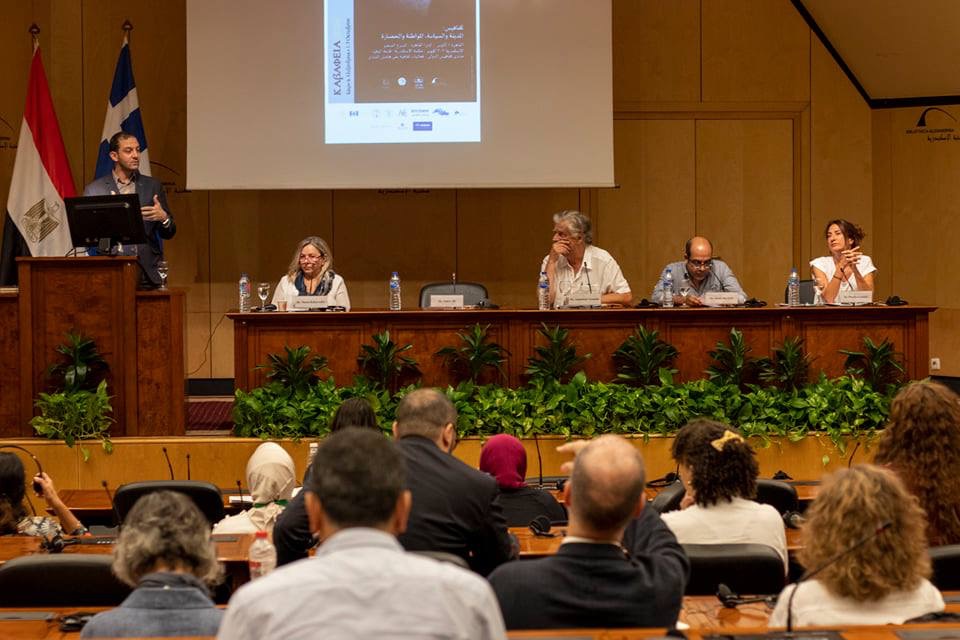
It was an honour to be invited to speak at the Cavafy International Symposium which was held at the Bibliotheca Alexandrina. The symposium, Cavafy: Polis & Politics; Civitas & Civilization, brought together scholars, intellectuals, writers and poets from Egypt, Greece, the Greek diaspora, and elsewhere to discuss the many ways C. P. Cavafy’s work lives on in the city in which he lived and wrote. “Fragments of Cavafy’s Alexandria,” was my contribution for the Cavafy and Criticism session.
There are two words that I chose to focus on: “implication” and “real” to understand Cafavy’s relationship to Alexandria, and the Alexandria he imagined.
Cavafy came to represent a moment in the city’s life, while, at the same time, his poems brought Alexandria’s past into the present. Like the rare perfect marriage, Cavafy gave the city a new mythology, and Alexandria gave the poet a history and a setting in which he could ground his poems and hear his voice.
A visiting British critic Bonamy Dobree, speaks of Cavafy’s conversation in tones:
“I have met an Alexandrian—with all that implies. Implication, that word is important when thinking of Mr. Cavafy, for his poems are like his conversation, his conversation like Alexandria, and Alexandria is all implication. . . . He may talk of the Alexandrian tram-service, of the Ptolemies, of the use of a certain word in seventeenth-century English: one scarcely knows what it is that one has talked to Mr. Cavafy about . . . both his talk and his poems leave you with a flavour, something you have never quite met before, a sound that remains in the ear. . . .”
“Only the city is real,” said Durrel, “Real,” the only word, as Nabokov has said, that requires quotation marks. While Cavafy’s Alexandria is a mythical land, but it is Alexandria; her landscape and her peoples, the spirit of place, had, perhaps more than any other city of the 20th century, the power to excite mythic visions, and in order to know those visions fully we must examine the spot on which they grew.
One of Cavafy’s achievements went beyond his beautiful poetry. I would dare to say that his unintended achievement was to show how a city can continue to exist, even after so much has disappeared, through what remains implied. He turned his face to the streets and half-forgotten conversations rather than the monuments and cliched grandeur of the city.
That is what interested me in thinking about Cavafy and Alexandria, imagining the city in fragments in a place that unfortunately does not generously yield its archives and records.
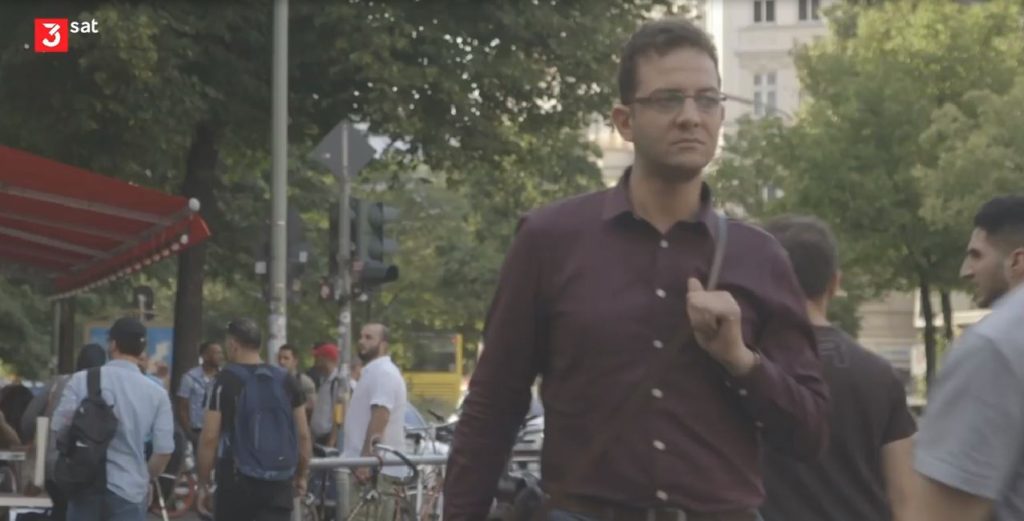
A feature report on the Arab Berlin exile essay was aired on the Kulturzeit program on the German 3sat channel. Click here to watch the video.
“Berlin wird immer mehr zu einem Ort, an dem sich Künstler und Intellektuelle aus den arabischen Ländern zusammenfinden, um das Erbe ihrer Revolution zu retten.”
A feature TV report Berlin als Zentrum des arabischen Exils (in German) on the Arab Berlin exile essay was aired on the Kulturzeit program on the German 3sat channel (17 September 2019). The video can be watched below.
“Berlin wird immer mehr zu einem Ort, an dem sich Künstler und Intellektuelle aus den arabischen Ländern zusammenfinden, um das Erbe ihrer Revolution zu retten.”