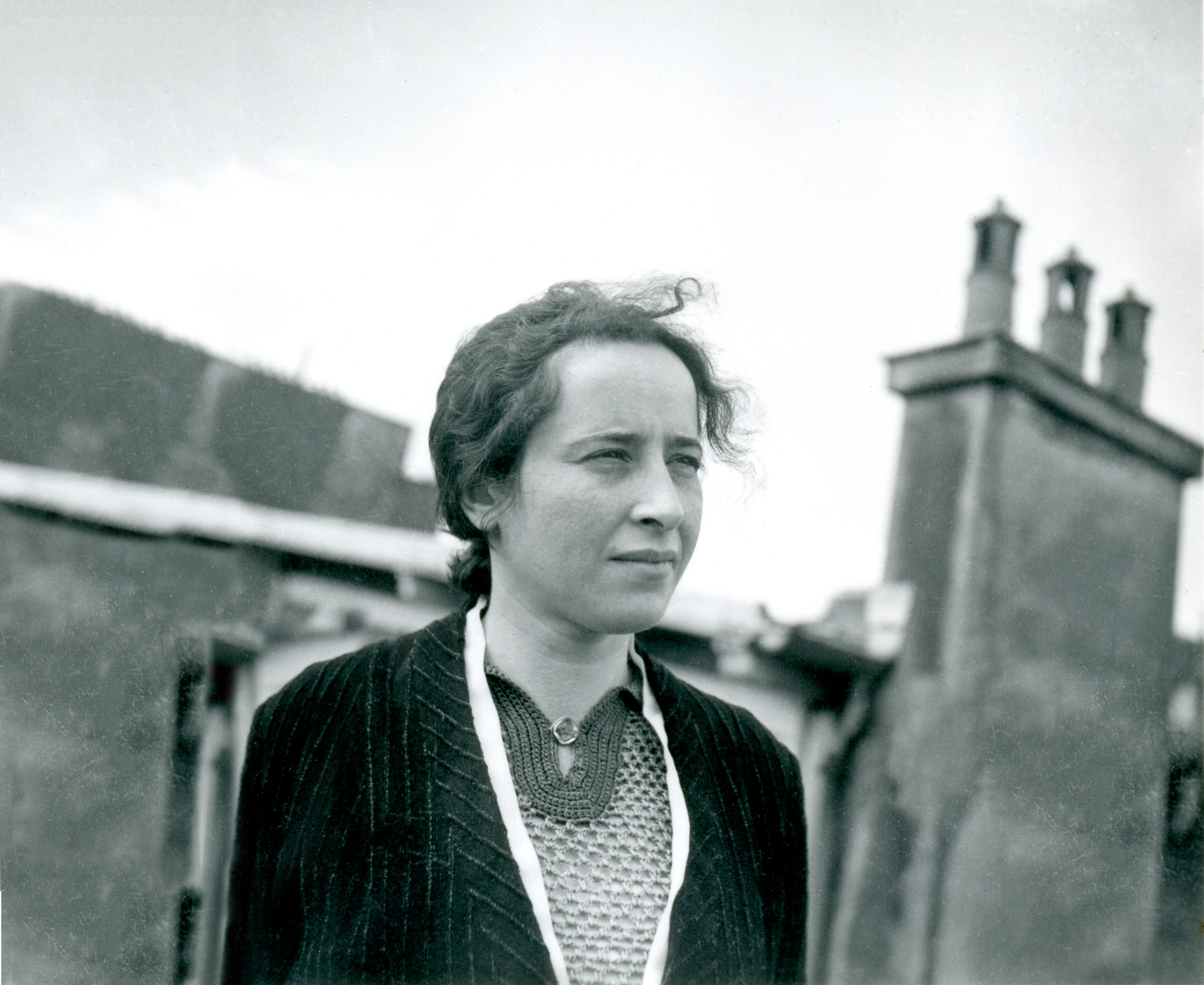
There is something powerfully raw and vivid about Hannah Arendt’s essay that came out in the midst of Europe’s darkness in the Second World War, before the worst horrors inflicted upon the Jews were fully unveiled. Originally published in January 1943 as “We Refugees” in a small Jewish journal called Menorah (shut down in 1961), the piece captures what it really means to be a refugee – the endless anxiety, ravaging despair, deluded optimism, jolting absurdity and even the humour of the “refugee.” What it is to be a wandering individual in search for dignity within a larger collective that “fight like madmen for private existences with individual destinies.” Arendt’s larger lesson is poignant: “The comity of European peoples went to pieces when, and because, it allowed its weakest member to be excluded and persecuted.” A message that projects a long arm into the present and can be read in the current global context that sees indifference and outright hostility to refugees, a political and social attitude that can only come at the price of exacerbating tensions and rupturing the moral fabric of the perpetrators of such indifference and hostility.
“We Refugees”
In the first place, we don’t like to be called “refugees.” We ourselves call each other “newcomers” or “immigrants.” Our newspapers are papers for “Americans of German language”; and, as far as I know, there is not and never was any club founded by Hitler-persecuted people whose name indicated that its members were refugees.
A refugee used to be a person driven to seek refuge because of some act committed or some political opinion held. Well, it is true we have had to seek refuge; but we committed no acts and most of us never dreamt of having any radical opinion. With us the meaning of the term “refugee” has changed. Now “refugees” are those of us who have been so unfortunate as to arrive in a new country without means and have to be helped by Refugee Committees.
Before this war broke out we were even more sensitive about being called refugees. We did our best to prove to other people that we were just ordinary immigrants. We declared that we had departed of our own free will to countries of our choice, and we denied that our situation had anything to do with “so-called Jewish problems.” Yes, we were “immigrants” or “newcomers” who had left our country because, one fine day, it no longer suited us to stay, or for purely economic reasons. We wanted to rebuild our lives, that was all. In order to rebuild one’s life one has to be strong and an optimist. So we are very optimistic.
Our optimism, indeed, is admirable, even if we say so ourselves. The story of our struggle has finally become known. We lost our home, which means the familiarity of daily life. We lost our occupation, which means the confidence that we are of some use in this world. We lost our language, which means the naturalness of reactions, the simplicity of gestures, the unaffected expression of feelings. We left our relatives in the Polish ghettos and our best friends have been killed in concentration camps, and that means the rupture of our private lives.
Nevertheless, as soon as we were saved—and most of us had to be saved several times—we started our new lives and tried to follow as closely as possible all the good advice our saviors passed on to us. We were told to forget; and we forgot quicker than anybody ever could imagine. In a friendly way we were reminded that the new country would become a new home; and after four weeks in France or six weeks in America, we pretended to be Frenchmen or Americans. The most optimistic among us would even add that their whole former life had been passed in a kind of unconscious exile and only their new country now taught them what a home really looks like. It is true we sometimes raise objections when we are told to forget about our former work; and our former ideals are usually hard to throw over if our social standard is at stake. With the language, however, we find no difficulties: after a single year optimists are convinced they speak English as well as their mother tongue; and after two years they swear solemnly that they speak English better than any other language—their German is a language they hardly remember.
In order to forget more efficiently we rather avoid any allusion to concentration or internment camps we experienced in nearly all European countries—it might be interpreted as pessimism or lack of confidence in the new homeland. Besides, how often have we been told that nobody likes to listen to all that; hell is no longer a religious belief or a fantasy, but something as real as houses and stones and trees. Apparently nobody wants to know that contemporary history has created a new kind of human beings—the kind that are put in concentration camps by their foes and in internment camps by their friends.
Even among ourselves we don’t speak about this past. Instead, we have found our own way of mastering an uncertain future. Since everybody plans and wishes and hopes, so do we. Apart from the general human attitudes, however, we try to clear up the future more scientifically. After so much bad luck we want a course as sure as a gun. Therefore, we leave the earth with all its uncertainties behind and we cast our eyes up to the sky. The stars tell us—rather than the newspapers—when Hitler will be defeated and when we shall become American citizens. We think the stars more reliable advisers than all our friends; we learn from the stars when we should have lunch with our benefactors and on what day we have the best chances of filling out one of these countless questionnaires which accompany our present lives. Sometimes we don’t rely even on the stars but rather on the lines of our hand or the signs of our handwriting. Thus we learn less about political events but more about our own dear selves, even though somehow psychoanalysis has gone out of fashion. Those happier times are past when bored ladies and gentlemen of high society conversed about the genial misdemeanors of their early childhood. They don’t want ghost-stories any more; it is real experiences that make their flesh creep. There is no longer any need of bewitching the past; it is spellbound enough in reality. Thus, in spite of our outspoken optimism, we use all sorts of magical tricks to conjure up the spirits of the future.
I don’t know which memories and which thoughts nightly dwell in our dreams. I dare not ask for information, since I, too, had rather be an optimist. But sometimes I imagine that at least nightly we think of our dead or we remember the poems we once loved. I could even understand how our friends of the West coast, during the curfew, should have had such curious notions as to believe that we are not only “prospective citizens” but present “enemy aliens.” In daylight, of course, we become only “technically” enemy aliens—all refugees know this. But when technical reasons prevented you from leaving your home during the dark house, it certainly was not easy to avoid some dark speculations about the relation between technicality and reality.
No, there is something wrong with our optimism. There are those odd optimists among us who, having made a lot of optimistic speeches, go home and turn on the gas or make use of a skyscraper in quite an unexpected way. They seem to prove that our proclaimed cheerfulness is based on a dangerous readiness for death. Brought up in the conviction that life is the highest good and death the greatest dismay, we became witnesses and victims of worse terrors than death—without having been able to discover a higher ideal than life. Thus, although death lost its horror for us, we became neither willing nor capable to risk our lives for a cause. Instead of fighting—or thinking about how to become able to fight back—refugees have got used to wishing death to friends or relatives; if somebody dies, we cheerfully imagine all the trouble he has been saved. Finally many of us end by wishing that we, too, could be saved some trouble, and act accordingly.
Since 1938—since Hitler’s invasion of Austria—we have seen how quickly eloquent optimism could change to speechless pessimism. As time went on, we got worse—even more optimistic and even more inclined to suicide. Austrian Jews under Schuschnigg were such a cheerful people—all impartial observers admired them. It was quite wonderful how deeply convinced they were that nothing could happen to them. But when German troops invaded the country and Gentile neighbours started riots at Jewish homes, Austrian Jews began to commit suicide.
Unlike other suicides, our friends leave no explanation of their deed, no indictment, no charge against a world that had forced a desperate man to talk and to behave cheerfully to his very last day. Letters left by them are conventional, meaningless documents. Thus, funeral orations we make at their open graves are brief, embarrassed and very hopeful. Nobody cares about motives, they seem to be clear to all of us.
I speak of unpopular facts; and it makes things worse that in order to prove my point I do not even dispose of the sole arguments which impress modern people—figures. Even those Jews who furiously deny the existence of the Jewish people give us a fair chance of survival as far as figures are concerned—how else could they prove that only a few Jews are criminals and that many Jews are being killed as good patriots in wartime? Through their effort to save the statistical life of the Jewish people we know that Jews had the lowest suicide rate among all civilized nations. I am quite sure those figures are no longer correct, but I cannot prove it with new figures, though I can certainly with new experiences. This might be sufficient for those skeptical souls who never were quite convinced that the measure of one’s skull gives the exact idea of its content, or that statistics of crime show the exact level of national ethics. Anyhow, wherever European Jews are living today, they no longer behave according to statistical laws. Suicides occur not only among the panic-stricken people in Berlin and Vienna, in Bucharest or Paris, but in New York and Los Angeles, in Buenos Aires and Montevideo.
On the other hand, there has been little reported about suicides in the ghettoes and concentration camps themselves. True, we had very few reports at all from Poland, but we have been fairly well informed about German and French concentration camps.
At the camp of Gurs, for instance, where I had the opportunity of spending some time, I heard only once about suicide, and that was the suggestion of a collective action, apparently a kind of protest in order to vex the French. When some of us remarked that we had been shipped there “pour crever” in any case, the general mood turned suddenly into a violent courage of life. The general opinion held that one had to be abnormally asocial and unconcerned about general events if one was still able to interpret the whole accident as personal and individual bad luck and, accordingly, ended one’s life personally and individually. But the same people, as soon as they returned to their own individual lives, being faced with seemingly individual problems, changed once more to this insane optimism which is next door to despair.
We are the first non-religious Jews persecuted—and we are the first ones who, not only in extremis, answer with suicide. Perhaps the philosophers are right who teach that suicide is the last and supreme guarantee of human freedom; not being free to create our lives or the world in which we live, we nevertheless are free to throw life away and to leave the world. Pious Jews, certainly, cannot realize this negative liberty: they perceive murder in suicide, that is, destruction of what man never is able to make, interference with the rights of the Creator. Adonai nathan veadonai lakach (“The Lord hath given and the Lord hath taken away”); and they would add: baruch shem adonai (“blessed be the name of the Lord”). For them suicide, like murder, means a blasphemous attack on creation as a whole. The man who kills himself asserts that life is not worth living and the world not worth sheltering him.
Yet our suicides are no mad rebels who hurl defiance at life and the world, who try to kill in themselves the whole universe. Theirs is a quiet and modest way of vanishing; they seem to apologize for the violent solution they have found for their personal problems. In their opinion, generally, political events had nothing to do with their individual fate; in good or bad times they would believe solely in their personality. Now they find some mysterious shortcomings in themselves which prevent them from getting along. Having felt entitled from their earliest childhood to a certain social standard, they are failures in their own eyes if this standard cannot be kept any longer. Their optimism is the vain attempt to keep head above water. Behind this front of cheerfulness, they constantly struggle with despair of themselves. Finally, they die of a kind of selfishness.
If we are saved we feel humiliated, and if we are helped we feel degraded. We fight like madmen for private existences with individual destinies, since we are afraid of becoming part of that miserable lot of schnorrers whom we, many of us former philanthropists, remember only too well. Just as once we failed to understand that the so-called schnorrer was a symbol of Jewish destiny and not a shlemihl, so today we don’t feel entitled to Jewish solidarity; we cannot realize that we by ourselves are not so much concerned as the whole Jewish people. Sometimes this lack of comprehension has been strongly supported by our protectors. Thus, I remember a director of a great charity concern in Paris who, whenever he received the card of a German-Jewish intellectual with the inevitable “Dr.” on it, used to exclaim at the top of his voice, “Herr Doktor, Herr Doktor, Herr Schnorrer, Herr Schnorrer!”
The conclusion we drew from such unpleasant experiences was simple enough. To be a doctor of philosophy no longer satisfied us; and we learnt that in order to build a new life, one has first to improve on the old one. A nice little fairy-tale has been invented to describe our behaviour; a forlorn émigré dachshund, in his grief, begins to speak: “Once, when I was a St. Bernard …”
Our new friends, rather overwhelmed by so many stars and famous men, hardly understand that at the basis of all our descriptions of past splendors lies one human truth: once we were somebodies about whom people cared, we were loved by friends, and even known by landlords as paying our rent regularly. Once we could buy our food and ride in the subway without being told we were undesirable. We have become a little hysterical since newspapermen started detecting us and telling us publicly to stop being disagreeable when shopping for milk and bread. We wonder how it can be done; we already are so damnably careful in every moment of our daily lives to avoid anybody guessing who we are, what kind of passport we have, where our birth certificates were filled out—and that Hitler didn’t like us. We try the best we can to fit into a world where you have to be sort of politically minded when you buy your food.
Under such circumstances, St. Bernard grows bigger and bigger. I never can forget that young man who, when expected to accept a certain kind of work, sighed out, “You don’t know to whom you speak; I was Section-manager in Karstadt’s [A great department store in Berlin].” But there is also the deep despair of that middle-aged man who, going through countless shifts of different committees in order to be saved, finally exclaimed, “And nobody here knows who I am!” Since nobody would treat him as a dignified human being, he began sending cables to great personalities and his big relations. He learnt quickly that in this mad world it is much easier to be accepted as a “great man” than as a human being.
The less we are free to decide who we are or to live as we like, the more we try to put up a front, to hide the facts, and to play roles. We were expelled from Germany because we were Jews. But having hardly crossed the French borderline, we were changed into “boches.” We were even told that we had to accept this designation if we really were against Hitler’s racial theories. During seven years we played the ridiculous role of trying to be Frenchmen—at least, prospective citizens; but at the beginning of the war we were interned as “boches” all the same. In the meantime, however, most of us had indeed become such loyal Frenchmen that we could not even criticise a French governmental order; thus we declared it as all right to be interned. We were the first “prisonniers volontaires” history has ever seen. After the Germans invaded the country, the French Government had only to change the name of the firm; having been jailed because we were Germans, we were not freed because we were Jews.
It is the same story all over the world, repeated again and again. In Europe the Nazis confiscated our property; but in Brazil we have to pay 30% of our wealth, like the most loyal member of the Bund der Auslandsdeutschen. In Paris we could not leave our homes after eight o’clock because we were Jews; but in Los Angeles we are restricted because we are “enemy aliens.” Our identity is changed so frequently that nobody can find out who we actually are.
Unfortunately, things don’t look any better when we meet with Jews. French Jewry was absolutely convinced that all Jews coming from beyond the Rhine were what they called Polaks—what German Jewry called Ostjuden. But those Jews who really came from eastern Europe could not agree with their French brethren and called us Jaeckes. The sons of these Jaecke-haters—the second generation born in France and already duly assimilated—shared the opinion of the French Jewish upper class. Thus, in the very same family, you could be called a Jaecke by the father and a Polak by the son.
Since the outbreak of the war and the catastrophe that has befallen European Jewry, the mere fact of being a refugee has prevented our mingling with native Jewish society, some exceptions only proving the rule. These unwritten social laws, though never publicly admitted, have the great force of public opinion. And such a silent opinion and practice is more important for our daily lives than all official proclamations of hospitality and good will.
Man is a social animal and life is not easy for him when social ties are cut off. Moral standards are much easier kept in the texture of a society. Very few individuals have the strength to conserve their own integrity if their social, political and legal status is completely confused. Lacking the courage to fight for a change of our social and legal status, we have decided instead, so many of us, to try a change of identity. And this curious behavior makes matters much worse. The confusion in which we live is partly our own work.
Some day somebody will write the true story of this Jewish emigration from Germany; and he will have to start with a description of that Mr. Cohn from Berlin who had always been a 150% German, a German super-patriot. In 1933 that Mr. Cohn found refuge in Prague and very quickly became a convinced Czech patriot—as true and loyal a Czech patriot as he had been a German one. Time went on and about 1937 the Czech Government, already under some Nazi pressure, began to expel its Jewish refugees, disregarding the fact that they felt so strongly as prospective Czech citizens. Our Mr. Cohn then went to Vienna; to adjust oneself there a definite Austrian patriotism was required. The German invasion forced Mr. Cohn out of that country. He arrived in Paris at a bad moment and he never did receive a regular residence-permit. Having already acquired a great skill in wishful thinking, he refused to take mere administrative measures seriously, convinced that he would spend his future life in France. Therefore, he prepared his adjustment to the French nation by identifying himself with “our” ancestor Vercingetorix. I think I had better not dilate on the further adventures of Mr. Cohn. As long as Mr. Cohn can’t make up his mind to be what he actually is, a Jew, nobody can foretell all the mad changes he will have to go through.
A man who wants to lose his self discovers, indeed, the possibilities of human existence, which are infinite, as infinite as is creation. But the recovering of a new personality is as difficult—and as hopeless—as a new creation fo the world. Whatever we do, whatever we pretend to be, we reveal nothing but our insane desire to be changed, not to be Jews. All our activities are directed to attain this aim: we don’t want to be refugees, since we don’t want to be Jews; we pretend to be English-speaking people, since German-speaking immigrants of recent years are marked as Jews; we don’t call ourselves stateless, since the majority of stateless people in the world are Jews; we are willing to become loyal Hottentots, only to hide the fact that we are Jews. We don’t succeed and we can’t succeed; under the cover of our “optimism” you can easily detect the hopeless sadness of assimilationists.
With us from Germany the word assimilation received a “deep” philosophical meaning. You can hardly realize how serious we were about it. Assimilation did not mean the necessary adjustment to the country where we happened to be born and to the people whose language we happened to speak. We adjust in principle to everything and everybody. This attitude became quite clear to me once by the words of one of my compatriots who, apparently, knew how to express his feelings. Having just arrived in France, he founded one of these societies of adjustment in which German Jews asserted to each other that they were already Frenchmen. In his first speech he said: “We have been good Germans in Germany and therefore we shall be good Frenchmen in France.” The public applauded enthusiastically and nobody laughed; we were happy to have learnt how to prove our loyalty.
If patriotism were a matter of routine or practice, we should be the most patriotic people in the world. Let us go back to our Mr. Cohn; he certainly has beaten all records. He is that ideal immigrant who always, and in every country into which a terrible fate has driven him, promptly sees and loves the native mountains. But since patriotism is not yet believed to be a matter of practice, it is hard to convince people of the sincerity of our repeated transformations. This struggle makes our own society so intolerant; we demand full affirmation without our own group because we are not in the position to obtain it from the natives. The natives, confronted with such strange beings as we are, become suspicious; from their point of view, as a rule, only a loyalty to our old countries is understandable. That makes life very bitter for us. We might overcome this suspicion if we could explain that, being Jews, our patriotism in our original countries had rather a peculiar aspect. Though it was indeed sincere and deep-rooted. We wrote big volumes to prove it; paid an entire bureaucracy to explore its antiquity and to explain it statistically. We had scholars write philosophical dissertations on the predestined harmony between Jews and Frenchmen, Jews and Germans, Jews and Hungarians, Jews and … Our so frequently suspected loyalty of today has a long history. It is the history of a hundred and fifty years of assimilated Jewry who performed an unprecedented feat: though proving all the time their non-Jewishness, they succeeded in remaining Jews all the same.
The desperate confusion of these Ulysses-wanderers who, unlike their great prototype, don’t know who they are is easily explained by their perfect mania for refusing to keep their identity. This mania is much older than the last ten years which revealed the profound absurdity of our existence. We are like people with a fixed idea who can’t help trying continually to disguise an imaginary stigma. Thus we are enthusiastically fond of every new possibility which, being new, seems able to work miracles. We are fascinated by every new nationality in the same way as a woman of tidy size is delighted with every new dress which promises to give her the desired waistline. But she likes the new dress only as long as she believes in its miraculous qualities, and she discovers that it does not change her stature—or, for that matter, her status.
One may be surprised that the apparent uselessness of all our odd disguises has not yet been able to discourage us. If it is true that men seldom learn from history, it is also true that they may learn from personal experiences which, as in our case, are repeated time and again. But before you cast the first stone at us, remember that being a Jew does not give any legal status in the world. If we should start telling the truth that we are nothing but Jews, it would mean that we expose ourselves to the fate of human beings who, unprotected by any specific law or political convention, are nothing but human beings. I can hardly imagine an attitude more dangerous, since we actually live in a world in which human beings as such have ceased to exist for quite a while, since society has discovered discrimination as the great social weapon by which one may kill men without any bloodshed; since passports or birth certificates, and sometimes even income tax receipts, are no longer formal papers but matters of social distinction. It is true that most of us depend entirely upon social standards, we lose confidence in ourselves if society does not approve us; we are—and always were—ready to pay any price in order to be accepted by society. But it is equally true that the very few among us who have tried to get along without all these tricks and jokes of adjustment and assimilation have paid a much higher price than they could afford: they jeopardized the few chances even our laws are given in a topsy-turvy world.
The attitude of these few whom, following Bernard Lazare, one may call “conscious pariahs,” can as little be explained by recent events alone as the attitude of our Mr. Cohn who tried by every means to become an upstart. Both are sons of the nineteenth century which, not knowing legal or political outlaws, knew only too well social pariahs and their counterpart, social parvenus. Modern Jewish history, having started with court Jews and continuing with Jewish millionaires and philanthropists, is apt to forget about this other trend of Jewish tradition—the tradition of Heine, Rahel Varnhagen, Sholom Aleichemn, of Bernard Lazare, Franz Kafka or even Charlie Chaplin. It is the tradition of a minority of Jews who have not wanted to become upstarts, who preferred the status of “conscious paria.” All vaunted Jewish qualities—the “Jewish heart,” humanity, humor, disinterested intelligence—are pariah qualities. All Jewish shortcomings—tactlessness, political stupidity, inferiority complexes and money-grubbing—are characteristic of upstarts. There have always been Jews who did not think it worth while to change their humane attitude and their natural insight into reality for the narrowness of castle spirit or the essential unreality of financial transactions.
History has forced the status of outlaws upon both, upon pariahs and parvenus alike. The latter have not yet accepted the great wisdom of Balzac’s “On ne parvient pas deux fois”; thus they don’t understand the wild dreams of the former and feel humiliated in sharing their fate. Those few refugees who insist upon telling the truth, even to the point of “indecency,” get in exchange for their unpopularity one priceless advantage: history is no longer a closed book to them and politics is no longer the privilege of Gentiles. They know that the outlawing of the Jewish people in Europe has been followed closely by the outlawing of most European nations. Refugees driven from country to country represent the vanguard of their peoples—if they keep their identity. For the first time Jewish history is not separate but tied up with that of all other nations. The comity of European peoples went to pieces when, and because, it allowed its weakest member to be excluded and persecuted.
Hannah Arendt, “We Refugees,” Menorah Journal 31, no. 1 (January 1943): pp 69-77.