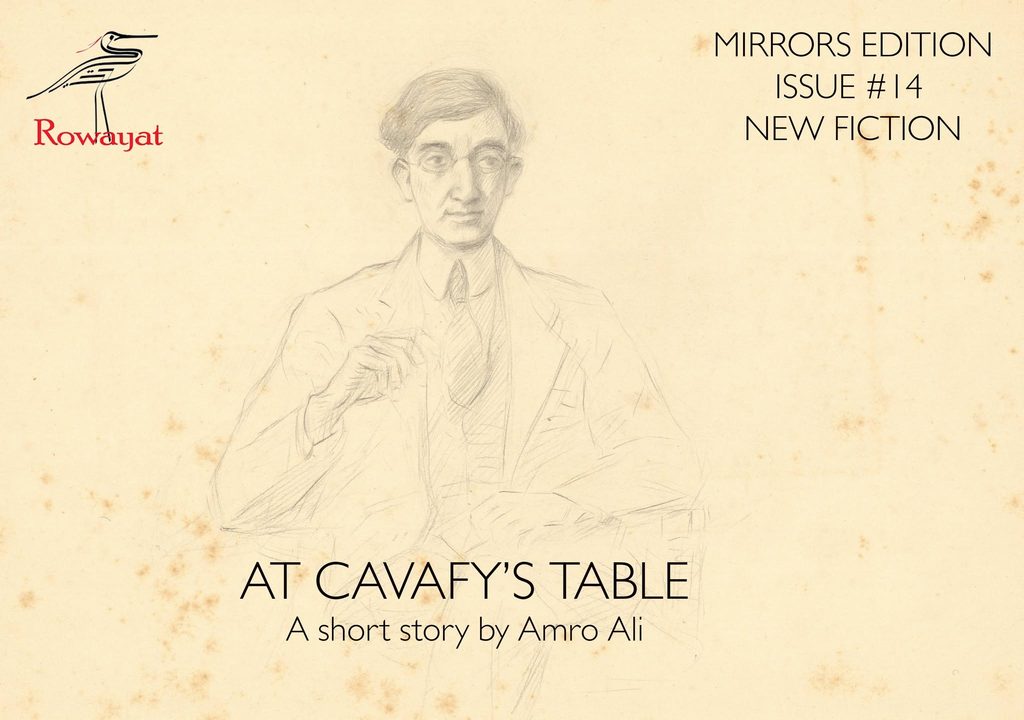
Cavafy and Ahmed Shawqi, the prince of poets, did meet more than once. Yet only a few lines of their conversations survive, most is lost to us.
So what happens in that silence? I tried to enter that silence. In At Cavafy’s Table, literature enters it.
In January 1929, during the Al-Karam winter storm, Cavafy and Shawqi meet at Baudrot Café in Alexandria in their final reunion. There is also a waiter named Mina.
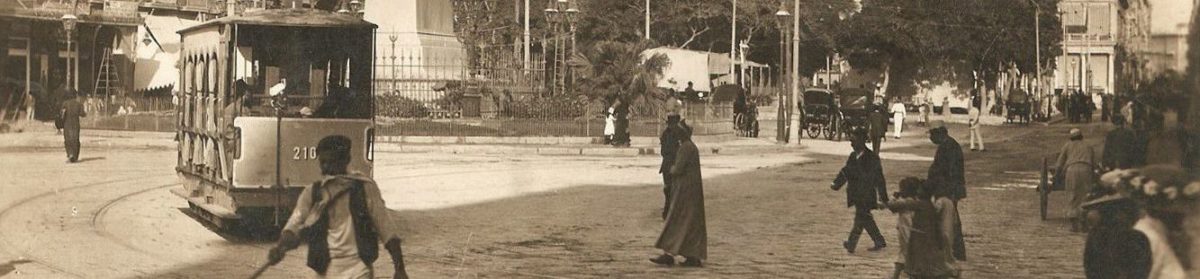
I spent quite some time reconstructing this world from Cavafy’s notebooks, Shawqi’s habits, correspondence, poems and the surviving literature of the city to give us fragments of the world around them in a year that saw Alexandria’s only recorded snowfall of the twentieth century.
At Cavafy’s Table is published in the Rowayat literary journal, Issue 14, Mirrors edition.
The Mediterranean sends storms and Alexandrians respond by naming them. Al-Karam, Generosity, is the January storm that drenches Alexandria and stays for days. It sends people indoors, street cats under the canopies, and birds to the balconies. The city finds itself alone with the sea that made it. When you live beside this sea long enough, you know that naming a thing is the closest you can get to someday taming it.
“Who takes twenty years to reply to a letter!” Cavafy shouted in the middle of Fouad Street.
After a bout of heavy coughing, he kept walking, passing under a fluttering white banner strung high between two lamp poles, hand-painted with Happy New Year, 1929! in Arabic, Greek, Italian, English, and French. It was, however, already a few weeks past the new year. The banner struggled but held, saved only by the torn holes that let the wind through. More thunder drew Cavafy’s face to the night sky as flashes lit the neoclassical and Belle Époque facades.
The rain resumed, but he kept the same pace as he turned the corner of Cherif Pasha Street toward Baudrot Café. He stood at the door that was ringed with frosted light bulbs. He hadn’t expected it to be packed on a winter Thursday. Cotton brokers, tobacco traders, artists, intellectuals (and self-proclaimed ones), playwrights, actors, and the odd one or two anarchists overfilled the art deco space. Men in tailored suits with fedoras and fezzes, women in silk coats with cloche hats. Many Egyptians fresh from a rehearsal of Ahmed Shawqi’s The Death of Cleopatra at the nearby Mohamed Ali Theater mingled – politely, if a little awkwardly – with Europeans from a French comedy at the Alhambra. They all sought refuge from the rain.
Cavafy lingered at the coat rack, slowly taking off his coat and hat, mapping the room. Some familiar faces approached. He was quick to mumble a Bonjour, Kalispéra or Buonasera with a forced smile, extending brief, stiff handshakes when he couldn’t avoid them. He made it through the crowd toward his usual corner table by the window. A waiter recognized him and rushed to remove two Cypriots from it, giving them the excuse that it was reserved. Cavafy took his seat while looking out the window. “Is he coming or not?”
He pulled out the telegram and checked it again.
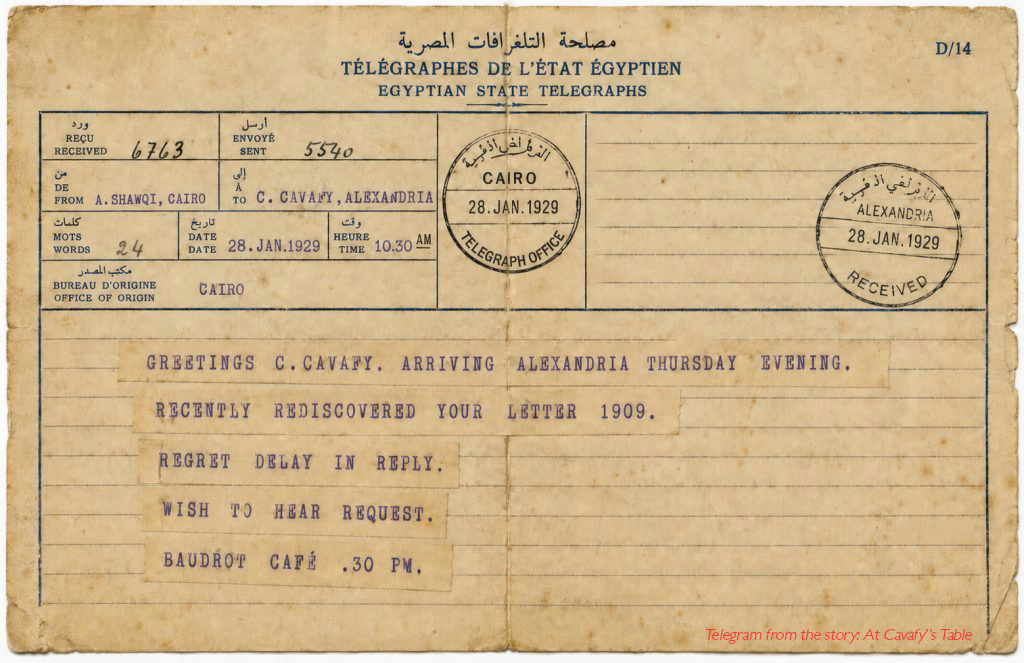
GREETINGS C.CAVAFY. ARRIVING ALEXANDRIA THURSDAY EVENING.
RECENTLY REDISCOVERED YOUR LETTER 1909.
REGRET DELAY IN REPLY.
WISH TO HEAR REQUEST.
BAUDROT CAFÉ .30 PM.
The hour was smudged. He could not tell if he was early or late.
“Good evening, Mr. Cavafy. It has been a while since I’ve seen you here, I’m sure”
The waiter gabbled, eager to show off his English skills before Cavafy cut him off.
“Get me a raki!”
The rain eased. The customers slowly left, until the cafe belonged to one man. Cavafy looked up at the empty tables a few times, his hand resting on the cane. He had wanted the quiet, at least he thought he did, but now that quiet felt different. He doodled circles on the back of the telegram. He then leaned the cane against the wall and took out an Irma cigarette, snapped it in half, lit one end, and returned the other to the packet.
The same waiter, Mina, approached him.
“No poem tonight, Mr. Cavafy?”
Cavafy waved him away. Mina remained.
“I never write properly outside my apartment,” Cavafy said, taking a deep puff of his cigarette, and exhaling toward the street. He took out scraps of paper from his pocket and continued the doodling, then screwed them up.
Mina paced about clearing the tables. When he moved closer to the entrance, he found the leg of a wobbling table that hadn’t been repaired in years. He steadied it and stood there for a moment. The singer Sayed Darwish had complained about this table in the final months of his life. Specifically, irritably. In the way that dying men sometimes fasten on to the smallest of things. Mina even thought of the table at the funeral. One of the other waiters placed his hand on Mina’s shoulder. “We were there when nobody else was,” he said.
Mina nodded. “Barely anyone saw him lowered into the ground,” he said. “The whole country was swept up in Saad Zaghloul’s return from exile.”
Mina took some folded papers from his pocket. Some poems he had written that morning – or last night, or last week. He couldn’t remember when. He read the first line, then crumpled them up. He brought Cavafy a couple of sablés. He took a few steps back as one of the waiters whispered, “Are we seriously going to stay open for this Greek crank?”
“Yes, it’s the rules,” Mina replied.
The streetlights flickered. Cavafy looked toward the door.
Mina returned to the other waiters huddled around the radio listening to the day’s news and making jests after each bulletin.
The imminent opening of the Alexandria stadium will be the first of its kind in Egypt and Africa, conceived by Angelo Boulanachi and designed by Russian architect Vladimir Nicohosov. It is said to be inspired by the city’s Greek, Roman, and Islamic heritage …
One waiter said, “Islamic heritage ya ragel, but they will charge us Italian prices just to see a rookie match.”
Despite the first American talkie, The Jazz Singer, coming out two years ago, there has been another setback for the Egyptian motion picture industry in its efforts to bring sound to local films. The Misr Company for Acting and Cinema warns that any further delay will hamper the industry at a critical moment when audiences are already drifting from the theater to the screen…
“Why the hurry for talkies?” another waiter said. “Egyptian audiences already play that part well enough.”
Mina laughed and added, “I saw The Gold Rush last week and could’ve sworn Charlie Chaplin was speaking Arabic thanks to the basha behind me explaining every scene!”
Cavafy nibbled the biscuits and shouted, “No one asked for me?” His voice pierced the room, scattering crumbs.
Mina returned to Cavafy’s table only to look around the empty café. “Umm, no, no, sir. This person, what time did he say he would meet you?” he asked.
“Twenty years without an answer.”
“I don’t understand.”
“And he kept me guessing by the half hour.”
“I still don’t understand.”
“The postal office didn’t issue the telegram in full…” but Cavafy got bored with the explanation. Mina just nodded.
“I should be writing or reading,” Cavafy said. “This is a waste of time – all you Egyptians need pocket watches.”
Mina apologized, although he didn’t know what for, and returned to his workmates. One of the waiters increased the volume to drown out Cavafy’s brooding mumbles.
Archaeologists in Mansheya have reported the discovery of a mummified female servant believed to date to the reign of Ptolemy VI Philometor…
“Mabrouk! Congratulations to her! Now she’s finally eligible to claim her pension,” one waiter said. The laughter was cut short by Cavafy slamming his hand on the table so that it resounded like a tabla. A worried Mina moved to turn the radio’s volume down until the classical Arabic was a low hum. The last snippets made it out:
In Cairo, debate continues in parliament over the intrusion of British advisors in key ministries, seven years after the declaration of independence…
Reports of Al-Karam have reached Alexandria, which will set back corniche construction works. Residents are urged to take the necessary precautions. The storm is reported to be heading eastward, and our neighbors in Palestine should expect the same deluge by morning.
“Seems the British are now advising the weather, too.” A waiter threw in the last quip before a “Shhhhhh” from Mina, who placed a record on the nearby gramophone and raised the volume of a slow French jazz song. Cavafy felt less alone.
Thunder struck and the heavy rain returned. This time, the power cut caused the lights to go out and the radio to fall mute, but the gramophone played on, kept alive by its hand-crank. Outside, the Route 15 yellow tram screeched to a halt; its windows went dark.
Mina hurried to bring a candle over to Cavafy’s table; he then lit a gas lantern and placed it on the half-empty bookshelf above. He took out a napkin with a short poem he’d written earlier that evening. He wanted to hand it over to the Greek poet, but then folded it away.
* * *
Some minutes later, a man entered the café, his fez futilely covered with the day’s Al-Ahram newspaper. All the waiters immediately recognized him, rushing forward to shake his hand and take his coat.
“Mr. Cavafy, I’m terribly sorry for keeping you waiting this long, as my driver was sick and the train from Cairo arrived late.”
“My whole life is about waiting, Mr. Shawqi,” Cavafy said as he stood up. “One learns what is worth waiting for, and seeing Egypt’s national poet again makes it worthwhile.” They shook hands, then after a moment’s hesitation, embraced.
Mina smiled politely. They were speaking French.
Shawqi loosened his bow tie and then placed his damp fez on the bookshelf next to the lantern’s warmth to dry it. Cavafy passed Shawqi a cigarette. Shawqi asked for black tea.
“Had you not sent me this telegram, I might have thought our meeting last year was the end of it,” said Cavafy.
“It was only last week that I came across the letter in my files,” said Shawqi. “You never mentioned the letter’s request again, and I assumed it no longer mattered to you.”
“I took silence as your answer,” Cavafy said. “Anyway, it was another era. I remember sending it following our first meeting; it was after Denshawai but before the Great War. The fact that I can recall Edward was still king means we are talking a very long time ago.”
“It feels like a century since we first met at Athineos on that sunny afternoon when we spoke for half an hour, mostly about Molière,” Shawqi said. “Alexandria was a beautiful city back then; it was simpler, the people had manners and were less hurried. No Ford Model T menacing to flatten you at every corner.”
Their voices rose over the gramophone and the rain. Two aging poets with their faces illuminated by the cigarette glow, blurred by the haze of smoke between them.
“It was,” Shawqi paused to remember the name, “Mahmoud Sami of the Third Circle of Irrigation, who set up that meeting.”
“A circle I was glad to leave,” Cavafy said. “But yes, indeed, it was Mahmoud.”
“But I guess we are not here to talk about Molière or Mahmoud?” Shawqi said.
“I would hope not.”
Shawqi paused. “The last line of your letter read: Our meeting was brief but joyful. I have a request to ask you. Please let me know when you are next in Alexandria.”
“Well,” Shawqi said, looking up, “here I am.”
“At last,” Cavafy said.
“Is the question still worth asking?”
Cavafy nodded.
“I wanted to ask if you could introduce me to your world – bring my work into Arab literary circles. Before it fossilizes in Greek cafés.”
“It is strange that at the end of our lives, you would care for that.”
“It was the younger me that asked it.”
“And now?”
“The same. Though I would say for different reasons now.”
“So,” Shawqi paused, “this request survived twenty years?”
“I’m not one to be prompt in replying to letters,” Cavafy said, “but I don’t usually wait twenty years either.”
“It is a coincidence,” Cavafy continued, “that you just decided to answer the letter, as the other day, an old Greek lady on my street called me the poet of a dying city. It struck me. It made me wonder if there was life for me beyond its death.”
“When we first met and even when I sent that letter,” Cavafy went on, “in no way was I seeking patronage. The ministry paid tolerably enough. Well, perhaps a little fame would not hurt. My poems are largely trapped in a language that only three million people read. That’s why I was hoping that my writing would become better known among your peers through Arabic translations.”
“We spent a whole two hours at your place last spring,” Shawqi said. “You said nothing of this then.”
“We spent two hours discussing your poetry,” said Cavafy.
Shawqi circled his finger around the saucer and brushed some ash off his sleeve before lifting his face to speak.
“Some time ago, I did read some of your poems in English that were translated by that British author who wrote a guide on this city. Forster, I believe.”
“Forster, yes,” said Cavafy.
“The lines were all about ruins, humiliated kings here and perished dreams there. Does nothing survive after you’ve lifted pen from paper?”
“What survives? What outlasts the century?” Cavafy replied. “Surely not the speeches and victory parades. Either that or ruins. The government itself put ruins on every Egyptian pound note.”
“What era do you live in? Have you forgotten you are in the century of building nations? And behind building nations is a movement, and behind the movement is a poet that should give it a moral voice. How else is greatness built? So, I ask, how can a poet answer this higher calling with this fatalism of yours? – or of those who write of wastelands and broken men?”
“Whenever Egypt digs up a broken statue, it makes the front-page headline,” replied Cavafy, lighting another cigarette. “A poem I write will speak of the statue’s crack, not the statue and surely not the headline.”
“I would like to say that’s profound, but why align yourself with this cult of defeat? Even a dead Victor Hugo gives more life than the moderns of today.”
“Hugo had the luxury of certainty, and that, my friend, is what separates Paris from Alexandria,” Cavafy said.
“The ambiguity in your verses is why you Alexandrian poets have a loyalty problem,” Shawqi replied, half smiling.
“Alexandria itself has a loyalty problem,” Cavafy said, facing him more fully. “It was never loyal to permanence. That’s our loyalty problem.”
“Where is Marinetti now? Where is Enrico Pea? Where is Ungaretti?” said Shawqi.
“Well, I am still here. And do poets really leave the city they write on? The other day I came across one of Ungaretti’s poems.”
There is the mist that blots us out / Maybe a river is born up here / I listen to the Sirens’ song / from the lake where the city was.
Shawqi leaned back. “Some of us are too deep in the river to see the mist.”
“He was referring to Lake Mariout. The mist of a new creation. Or all that’s left of the old one.”
A silence.
Mina noticed the candle flame dying out, its wick nearly spent. He fetched two fresh candles. He lit both from the dying one; the old and the new flames touched before the first went out. “Tamam,” he whispered. Done. He took the saucer of the old candle away, now a hardened wax of white veins. Just then, the gramophone clicked at the end of its record. Mina replaced it with the American song Blue Skies.
Skies were gray but they’re not gray anymore.
Blue skies smiling at me, nothing but blue skies do I see.
Blue days, all of them gone, nothing but blue skies from now on.
I should care if the wind blows east or west,
I should fret if the worst looks like the best…
The thunder drowned out the rest, and the rain fell relentlessly.
* * *
Cavafy drew closer.
“I attended the Death of Cleopatra play two weeks ago. I have been thinking about it ever since.”
Shawqi’s face lit up.
“I went with a Syrian friend for the invited rehearsals; it was the first Arabic play I had been to in many years. I couldn’t understand it all, but I made out the scenes well enough,” Cavafy said. “It greatly helped that my friend filled me in on what I missed.”
“If you like it now, then you will be captivated by the premiere, hopefully by autumn,” Shawqi said.
“I just have one question,” Cavafy said.
“A question about?”
“I found it a peculiar detail in the final scene when the asp bites Cleopatra, killing her, then bites her assistant Helena, who is then rescued with an antidote by her Egyptian lover Habi. The high priest Anubis blesses them, and they are both carried away to Thebes. Why Thebes and not Alexandria?”
“I’m quite impressed; you’re the first person to ask that, but it surprises me that you did not see why.”
Cavafy simply nodded.
“Well, Alexandria dishonored Cleopatra and her inner circle with its vices. The least I could do was to bring her third lady-in-waiting to the spiritual heart of Egypt, to purify her, and permit her to start a new life with her lover in the paradise of the Nile Valley. Alexandria was too alien and corrupt to leave all of them buried there, or here, should I say.”
“Yet it was Alexandria that made the queen that you celebrate,” said Cavafy.
“I thought Alexandria was a dying city,” Shawqi said. “Your words, not mine.”
“Not all deaths are the same,” Cavafy said.
“So I ask again,” Cavafy continued, “why Thebes?”
“Why does history keep you awake at night, Mr. Cavafy? Was Cleopatra yours to keep?” said Shawqi.
“Was she yours to redeem?” Cavafy replied.
“I can say with certainty,” Shawqi said, “that we’ll never really know who will resurrect her – or how.”
“You just did,” said Cavafy.
They both laughed – the first real laughter of the evening. The waiters in the distance smiled.
* * *
Shawqi set down his glass. “If you’ve written so much about this city – how much of it do you hear in its own tongue?”
“Which tongue, Mr. Shawqi? The city I write of babbled in Koine Greek.”
“Well, you want to enter our circles. You Greeks of this city can speak perfect French, passable English, a little Italian, and tragic Arabic. How is yours?”
“Enough to buy milk, bread, and the occasional koshary,” Cavafy said, before adding, “and enough to misunderstand a tragic play.”
Shawqi grinned. “Well then, you’re already one of us. You’ve lived here since the last century.”
“Yes, and I was also born here,” said Cavafy. “And perhaps, unlike Ungaretti, I’ll die here.”
“You do know we are a few weeks away from the tenth anniversary of the revolution.”
“How I remember those days when I stayed mostly home,” Cavafy said.
Just then, two off-duty British soldiers entered dripping wet and laughing. All the waiters rushed to block their path at the door.
“We just want a pint, matey!” one said.
“We have no alcohol,” said Mina, “please go to a bar or somewhere else. You can go to Pastroudis, Trianon, Cabaret El-Dorado, Santa Lucia, Metropole.”
“Then what are those two fellows drinking?” one soldier said, pointing to Cavafy and Shawqi.
“No alcohol, no. Coffee only,” Mina said.
One of the waiters fetched a plate of sablés to placate them. The soldiers took a few and staggered back into the rain, satisfied.
“I will never know how that empire, of all empires mind you, became the one the sun never sets on,” said Shawqi, shaking his head.
“I can tell you after having lived several years in Liverpool,” Cavafy added, “one understands why this empire would chase the sun.”
Shawqi smiled.
“It also doesn’t help that we Mediterraneans are very polite,” Cavafy continued, “as we rarely tell the guests when it’s time to leave.”
They both chuckled briefly, and Shawqi repeated the line in Arabic to the waiters who joined in the laughter from afar.
The laughter gave in to a moment of quiet when Shawqi turned back to him.
“How is it that you’ve lived among us all your life,” said Shawqi, “and yet never entered our homes? What is Alexandria to you? Background furniture?”
Cavafy did not answer immediately. He lifted his cigarette, then, as though he’d forgotten what he was supposed to do with it, lowered it again. “I’ve entered more than you think,” he said.
It sounded as if he were not convinced himself.
He turned toward the window. In the distance was a large sign that read: The Brazilian Coffee Stores, Opening Soon.
“Let me guess,” Shawqi said, following his gaze, “a Brazilian friend of yours is behind the venture?”
“No, the Sideris family. Greeks.”
“Of course”
“Your stare leads me to believe you need coffee or prophecy,” Shawqi continued.
“Well, I just wonder about its fate,” Cavafy said. “It will either survive, thrive, die out or, worse, be orphaned.”
Outside, the drain clogged, and water reached the café floor. The waiters argued among themselves before grabbing brooms to push the water back toward the door.
Just then, Mina brought over a chess set, perhaps to make himself known to these poets. Cavafy scolded him, “Ma talabtesh shatarang!”
Mina apologized for bringing it unasked and picked the chessboard up, but then Shawqi asked him to leave it on the table. Mina set it down again and took a step back, his eyes lowered.
Shawqi watched him.
“Now you know why we had a revolution,” Shawqi said.
Cavafy remained silent.
Shawqi started placing the chess pieces one by one on the board.
“I am not in the mood for chess,” said Cavafy.
“Neither am I. Who said we need to play chess? I’m just setting it up.”
Cavafy watched in dumbfounded silence as Shawqi placed each piece on the board except for the last pawn, which he twirled in his fingers.
“Let’s say you are not Cavafy, and just another regular Greek baker or grocer, and let’s say I’m not Shawqi, just another Egyptian desk clerk or train conductor. We have no ties to consulates or ministers to bail us out. If we fell into a dispute, whose side do you think the courts would favor?”
“If it were a Frenchman and me, the Greek me,” Cavafy replied, “who do you think they’d favor?”
“So, you admit,” said Shawqi, “that the Egyptian is still at the bottom of the hierarchy, on his own land.”
Lightning struck again, the hardest so far. The leftover party streamers blew loose. A black-and-white portrait of the heavily-mustached King Fouad jolted from the wall, shattering on the floor.
Mina hurried to gather the photograph from the shards, while nervously glancing over his shoulder for passing police or informants.
The poets barely looked up.
“You Egyptian aristocrats are a curious lot,” Cavafy said. “You accuse us of hubris, but are you sure that once we are gone, you blue bloods won’t be next to peddle your own?”
Mina, after having averted potential trouble, busied himself polishing the silverware, occasionally glancing at the two poets from afar. His unfinished poems occupied his mind; some of which touched on the everyday lives in his district of Kom el-Dikka.
“Are you sure you are not already repeating English attitudes that one already encounters at the Sporting Club?” Cavafy said.
“Today’s sin cannot be excused by tomorrow’s speculation,” Shawqi said.
The cough came without warning, hard, harder than the one on the street. Cavafy covered his mouth with his hand, then reached into his pocket and pulled out a white linen handkerchief, pressing it to his mouth as he turned away from the table.
Shawqi set down the pawn. He rose slightly from his chair, then caught himself.
It lasted longer than either of them expected. When it stopped, Cavafy leaned back. He folded the handkerchief to hide the soiled part and returned it to his pocket. He reached for his cigarette wedged in the ashtray, then didn’t.
“Forgive me, Mr. Shawqi,” he said.
“There is nothing to forgive,” said Shawqi.
They sat for a moment. Outside, the rain continued.
Cavafy straightened. “I don’t doubt your integrity, Mr. Shawqi; your heart truly lies with the people. That I know. My concern, you could say, is the national movement behind you and the poetry that fuels their rage.”
Shawqi overheard one of the waiters mutter to Mina, “What has our revolution brought us, man?” Shawqi said nothing.
“The embers of Smyrna have yet to be put out,” Cavafy continued, “yet still, there are those who wish to turn Alexandria into the same disaster that befell the shores across the sea just a few years ago.”
“So, you lost a city,” said Shawqi. “We, however, nearly lost a country.”
“Revolutions, coups, empires, wars…it’s always the poets who are left to sweep the ashes,” he added, “in some cases, to serve those forces. Your poems have found their circles of admirers, even by fascists in Greece. So much for fossilization in cafés.”
Cavafy cut in. “Why should I be blamed for those who want to read what they wish into a poem or two of mine?”
Shawqi shook his head slightly and tried to hide a grin by turning around and touching his fez to see if it had dried. It hadn’t. He was about to speak when Mina approached to replace the ashtray. He tried to speak again, but Mina returned to adjust the lantern and replenish the candles. Both men ignored him. Two of the waiters quibbled over which record to play. The gramophone spun an Italian song neither poet heard.
Shawqi picked up his tea and stared at the mint leaves. He set it back down.
“It’s a bittersweet honor,” said Cavafy, “to devote your life to what every Mustafa, Mina, Markos, and Matteo on the street would care little about.”
“If public opinion were a barometer, we would have quit long ago,” Shawqi replied.
“I’ve read Hafiz Ibrahim,” Cavafy said. “And the Lebanese Khalil Mutran.”
Shawqi looked at him for a moment.
“Mutran above Ibrahim?” he said.
“Mutran above Ibrahim,” Cavafy replied.
* * *
“I have to admit,” said Shawqi, “there’s much to appreciate about a poet who can give form to the scourge of loneliness, the terror of life, and the specter of death. I only wish that gift was sometimes… turned toward… daylight.”
Cavafy stopped halfway pouring the raki into the glass and set the bottle down. Neither of them looked at the other.
“Have you ever thought of publishing your poems as a single volume? A nice book collection? I cannot go to my fellow poets with pamphlets and broadsheets and expect them to take you seriously.”
“You know what is my greatest fear, Mr. Shawqi? That my poetry books end up on a bookstore’s discount table.”
Shawqi laughed, saying it was not an unfounded fear. “Even Tolstoy will be found on the discount table, but that doesn’t make him any less Tolstoy.”
“Tolstoy has been dead since around our first meeting; he no longer needs to worry,” Cavafy said.
“We are both old; what do you have left to lose?”
“You’ll probably hear me mentioned in a few Greek salons or in a French journal. At times I’ll get a nice acknowledgment in a preface by a friend in Cambridge, only to be countered by a critic in London. You? Your name is sung from Baghdad to Tangiers, the prince of poets as they call you,” said Cavafy.
“Maybe because princes have better publicists,” Shawqi said with a shrug.
“Still, I am merely Cavafy.”
“And yet, I wouldn’t have taken the train from Cairo through this storm for anyone merely ordinary.”
“Do you know the struggles of being a poet in a city like Alexandria?” Cavafy said. “Alexandria burdens me. It bores me. It terrifies me that I will disappear in its ashes. I knew this fact long ago. Visibility is a means of survival.”
The newsboy dropped off a few newspapers. Mina filed them in the paper rack, pulled out two copies, and approached the table. “Tomorrow’s Al-Ahram, Mr. Shawqi.” Shawqi did not look up. Mina waited a moment, then placed it by his tea and set the Greek Tachydromos beside Cavafy without a word.
The smudged ink provoked a frown in Shawqi. “News fades fast, faster than our poems.”
“Ink is ink,” said Cavafy. “I doubt the rain knows the difference.”
“At times, I miss Constantinople, Athens, and London,” continued Cavafy, “but this city, this wretchedly melancholic city called Alexandria, has a peculiar suffering that enables me to write. Also, a black chocolate pastry in the evening helps too.”
Cavafy removed his glasses and rubbed his eyes.
“In my younger years, I would make paper aeroplanes out of my poems and take them to the theater steps, waiting for the crowd to come out. When they did, oh heaven have mercy. I would throw them at women’s hats, hoping they would latch on.”
“Surely, surely not?” said Shawqi.
“My favorites were the three-story and flowerpot hats,” Cavafy continued. “I would succeed three times out of ten, and seven times out of ten I was chased away.”
Cavafy’s restrained, brittle laughter mixed with Shawqi’s booming, infectious guffaw before Shawqi added, “the things we do for recognition!”
“Fame, I have enough of, but it’s never enough to postpone death,” continued Shawqi. “I have an unusual fear of death even though my faith tells me that every soul shall taste it. I will never wear a tie as it reminds me of the gallows. I will never fly in an aeroplane as it brings to mind a mosquito that can easily be swatted to its doom.”
He took out rosary beads from his pocket and began whispering supplications under his breath for a minute before continuing.
“When I was exiled in Andalusia many years ago, I dreamt that my spirit lay asleep in its grave. An ancient Egyptian deity appeared; I think it was Ammit or perhaps Anubis, and stood over me, holding a sledgehammer. Just as he swung it toward my tombstone, the Muezzin call for Fajr prayer woke me. I knew then I would return home.”
“I thought Spain got rid of the call to prayer centuries ago?” said Cavafy.
“The call was part of the dream,” Shawqi said serenely. “And it was in the Egyptian Sa’idi dialect. That’s how I knew it was time. As I once wrote,
My homeland is always in my mind, even if I were in paradise.”
* * *
It was around 11.20 pm when the rain slowed down. Shawqi pulled a creased train timetable from the inside pocket of his jacket, hoping to find a much later train. He ran his index finger down the departure times to the last one.
“A pity,” he said. “I have to catch the midnight train to Cairo. If you wish, we can take a short stroll to the Greco-Roman Museum. It has been many years since I’ve been there.”
“But it’s closed at this hour,” said Cavafy.
“Who said we need to enter? The steps alone are worth it.”
Shawqi got up, retrieved his dried fez from the shelf and headed for the restroom. Cavafy took out the telegram, smoothed it on the table, folded it and placed it back into his pocket. When Shawqi returned, he said, “Yalla bina, let’s go,” went to pay the bill and made for the door.
Cavafy followed, then stopped.
“What is your name?” Cavafy asked.
“Mina.”
“This is the first time in seven years working here that you ask my name,” Mina said in broken English.
“Then I’ll remember it,” said Cavafy as he put on his coat and hat.
“Mafeesh moshkela ya ustaz Cavafy,” said Mina with a faint smile. “No problem.”
Mina wanted to tell him he was something more, but the words stuck in his throat.
Cavafy offered a slight bow before stepping into the cold, where Shawqi waited.
They walked along Fouad Street as the cats emerged from their hiding places after the storm, dashing in different directions. They stepped around the puddles and turned onto Rue du Musée toward the museum.
As they climbed the steps, Shawqi gazed at the six imposing neoclassical columns. “They are larger than what I last remember,” he said as his eyes moved to the pediment bearing the Greek inscription Mouseion. “Where it all began,” he murmured to himself.
“Is there no way we can look inside?” he asked, turning to Cavafy.
“All the window glass is covered,” said Cavafy.
But the disappointed Shawqi was determined; he searched until he found the keyhole on the main door, bent down and peered through.
“I see one statue at the forefront, but I can’t make out who it is.”
Cavafy leaned down to look as Shawqi straightened up. “Marc Antony, I think. Yes, Marc Antony, sporting a pharaonic headdress.”
“What’s he still doing here? I thought the gods abandoned him,” Shawqi said.
Cavafy laughed, then coughed.
“I must go,” Shawqi said.
They bid each other farewell, but Cavafy remained in the same spot. Barely ten meters away, Shawqi turned back.
“There is something you should know,” he said after a long pause. “I’m of Arab, Turkish, Kurdish, Circassian and,” he paused for a few seconds, “Greek descent.”
Cavafy lowered the cigarette he was about to light. “Somehow, that doesn’t surprise me.”
“How so?” Shawqi asked, puzzled by his calmness.
“In the opening of your play that unfolds in the Royal Library, Cleopatra spends a part of her day studying and conversing with Zenon the librarian. Then, in that same scene, a secret society is formed among young men to free Egypt from Roman domination. What I found quite peculiar was that many of them were of mixed blood. It was unusual in this age to see a scene with Egyptians, Athenians, and Macedonians standing shoulder to shoulder claiming ancestral burial ties to the soil of the Nile. It was a rather fine egalitarian coup on your part.”
“Yes, but they all sacrificed loyalty to their origins for the Egyptian nation,” Shawqi said.
Cavafy nodded. He thought of his tomb in Alexandria.
“I’m as Egyptian as any other,” said Shawqi.
“That was never in question,” Cavafy said while finally lighting up the cigarette.
After a moment, he said, “Did the national movement ever know?”
Shawqi simply looked on.
The wind picked up. Shawqi put a hand to his fez.
The cough returned, as it had been doing all evening. The still-burning cigarette slipped from Cavafy’s fingers onto the wet steps.
“I need to get back to Cairo,” Shawqi said. “You don’t need my help, Constantine. You never did.”
* * *
Three years later, Shawqi died a few days before his birthday; Cavafy, six months later, on his. Mina worked in Baudrot café until its closure in 1962. Some say he passed away soon after; others say they arrived late or attended the wrong funeral altogether.
The rainy nights would send street vendors to take cover beneath the building’s canopy. They would lean their backs to the wall, watching the downpour, drying their wares, until some of them pressed their ears against the café’s shuttered doors. “Isma’, isma’,” they would say to one another – listen, listen – as if something were there. They couldn’t make out the tune, only hum it to one another.
Something like Blue Skies.
The sea is closer than it was.
Unknown artist, Sketch, n.d. Pencil on paper, 20.5 × 28 cm. Depicting C. P. Cavafy seated in frontal view, wearing glasses, a suit, and a necktie, the delicate pencil sketch appears almost ghosted into the worn paper, its oxidations and small holes deepening the sense of archival presence, fragility, and afterlife. Onassis Foundation C. P. Cavafy Fonds, The Digital Collection of the Cavafy Archive. CC BY-SA 4.0.