Political Sociologist · Public Scholar · UNESCO Advisor
Category: Arab World
“If the sun sinks in a sea of troubles. And a wave of darkness sweeps the world. And we can no longer see or understand and the way is lost in lines and circles. Then, all you wise and experienced ones, your only guide is the eyes of words.” – Ahmed Fouad Negm, Uyoun al-Kalamaz, “Eyes of Words,”(written in Egypt’s Qanatir prison, 1970).
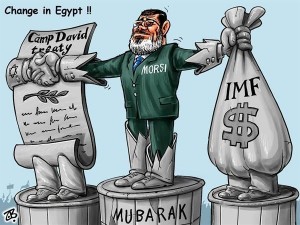
In 2007, Mohammed Morsi, then chairman of the Brotherhood’s political department and member of the Executive Bureau, complained of the inability of Washington to match its rhetoric on promoting democracy in Egypt. He said that Israel had no interest in a democratic Egypt as it, “would do more to support the Palestinians.” Now Morsi, having brokered a Gaza ceasefire has shown that his policy on the Palestinians is no more imaginative than Mubarak-era policies and, partly as a result of US approval, has undertaken a democratic rollback that has ignited Egypt’s streets.
orsi has inadvertently, and in part, fallen victim to the trilateral logic of Egypt’s bilateral relationship with the United States vis-à-vis the 1979 Camp David treaty. This was defined by Steven A. Cook in his book, The Struggle for Such a premise, not surprisingly in its close proximity to the Gaza saga, has a strong tendency to foment illiberal domestic policies, as Morsi has done, with a nod from the US and IMF backing, by abrogating the role of the judiciary to render his decrees immune from appeal, simultaneously protecting his Islamist-dominated Constituent Assembly from dissolution by the judiciary or anyone else.Egypt: from Nasser to Tahrir Square, as the dubious strategic relationship between Egypt and the US that is accompanied with the informal requirement of good Egyptian-Israeli relations – a requirement which, “built into these ties from the very start meant that Washington would almost always view Cairo through the prism of Israel.”
Whoever would have imagined that one of the challenges of the post-Egyptian revolution period would be the elevation of pornographic websites into a political issue? Yet Egypt’s Islamists have an uncanny way of not only surprising the public, but shifting the goalposts and reframing the debate – so that you find yourself swept up in matters far-removed from the country’s more pressing problems.
Egypt’s ultra-conservative Salafis have called for a ban on pornographic websites based on a 2009 court order. The timing is suspect given the drafting of the constitution, and the wrangling over the word ‘Sharia’, which comes across as an attempt to make anti-censorship advocates (largely the civil society camp) look like pro-pornography pro-decadents, which is far from the case.
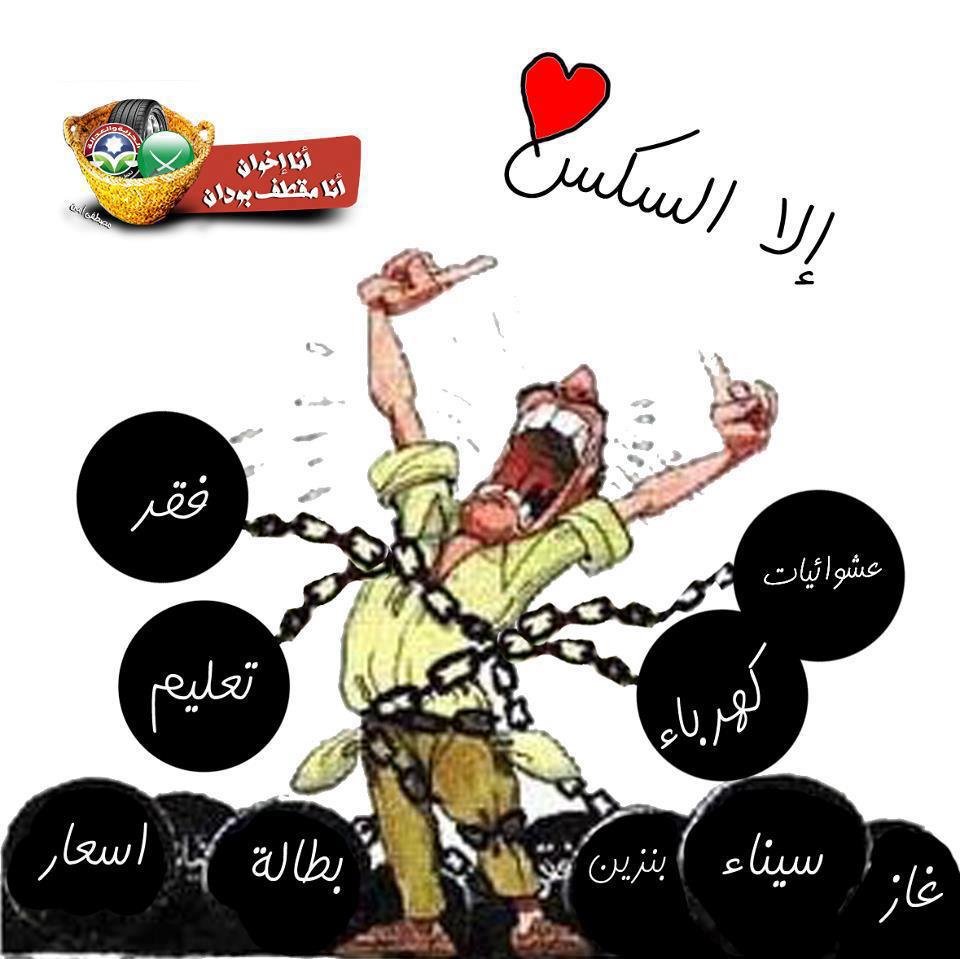
A cartoon of an Egyptian bound by countless political and socio-economic problems
This popular image that has been circulated around the social media shows an Egyptian bound by the ball and chain of poverty, lack of education, slums, haphazard electricity, Sinai insecurity, gas and fuel shortages, unemployment, rising food prices, etc and despite all that, he yells “Anything but sex [websites]!” Last winter, the very same anti-Islamist cartoon was circulating with similar problems on the chain and ball except the man was yelling about the red-herring of that moment, “Anything but the bikini!” This political “striptease” neatly sums up one element in the whole process.
This is not to downplay the social anxiety surrounding pornography. It has long been a concern of women groups, education boards, families, Muslim and Coptic groups. A Los Angeles Times report in March indicated the scale of the problem, “According to Google trends, Egypt ranked fifth in the world in searching for the term ‘sex’ in 2011. It was also reported that at least six pornographic websites rank among the top 100 sites in Egypt.”
Even many liberal Egyptians would not be opposed to a ban on pornographic sites if it just came down to that. Yet the concern must be that when Islamists take it up, the wheels of censorship are set in motion. Vaguely-worded legislation targeting porn sites risks enveloping the websites of activists, opposition groups, civil groups, independent news, and others as “violating Egyptian customs and values.” Continue reading “The Revolution will not be eroticised”
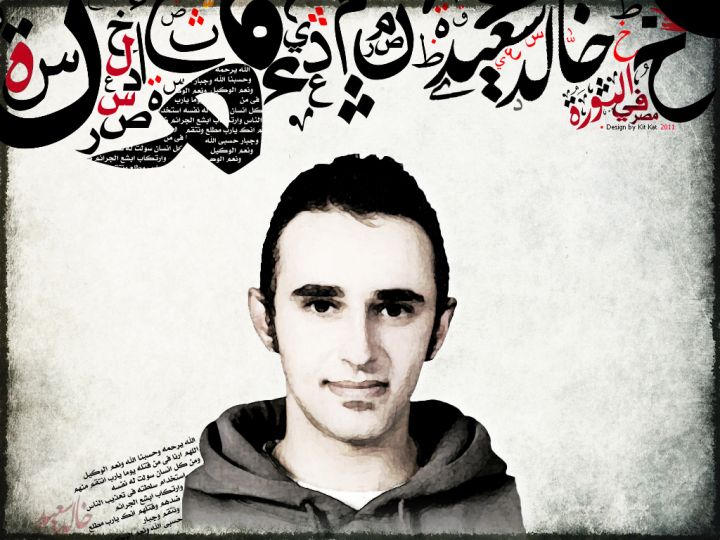
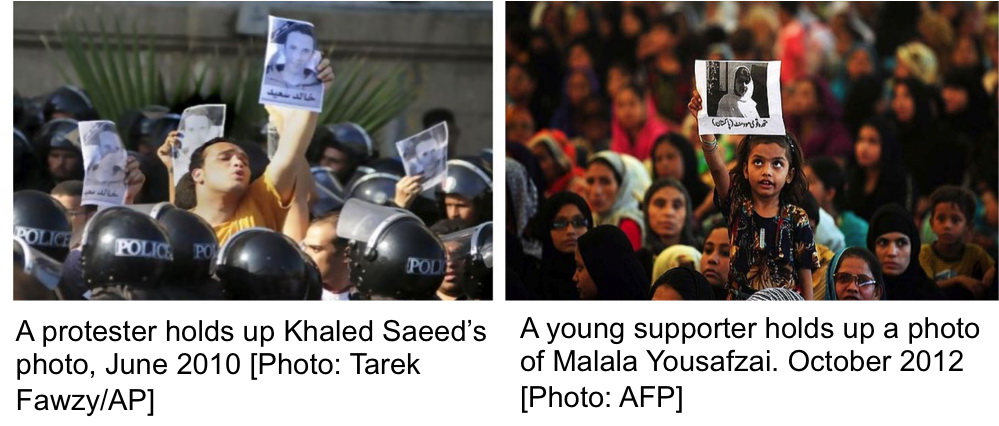
While reading the horrific case of Malala Yousafzai, the 14 year-old Pakistani girl who was shot in the face by the Talban for championing girls’ education, I came across a photo of a young supporter of Malala that triggered memories back to June 2010 of a similar image that has forever been engraved in my mind – an Egyptian youth protesting the tragic death of Khaled Saeed, the 28-year old Alexandrian who was beaten to death by policemen and would trigger the rapid countdown to the 2011 Egyptian revolution (See my detailed June piece Saeeds of Revolution: De-mythologizing Khaled Saeed).
The images provide a poignant and surreal expression of a protestor, in a repressive atmosphere, raising their hand held up high clenching a simple black and white A4 printout of their respective poster-child. It strikes deep at the heart of Arab regimes or fanatical organisations that have little appetite for dissent or any mere standing out from the crowd. Continue reading “Silent Commanders-in-Chief: From Khaled Saeed to Malala Yousafzai”
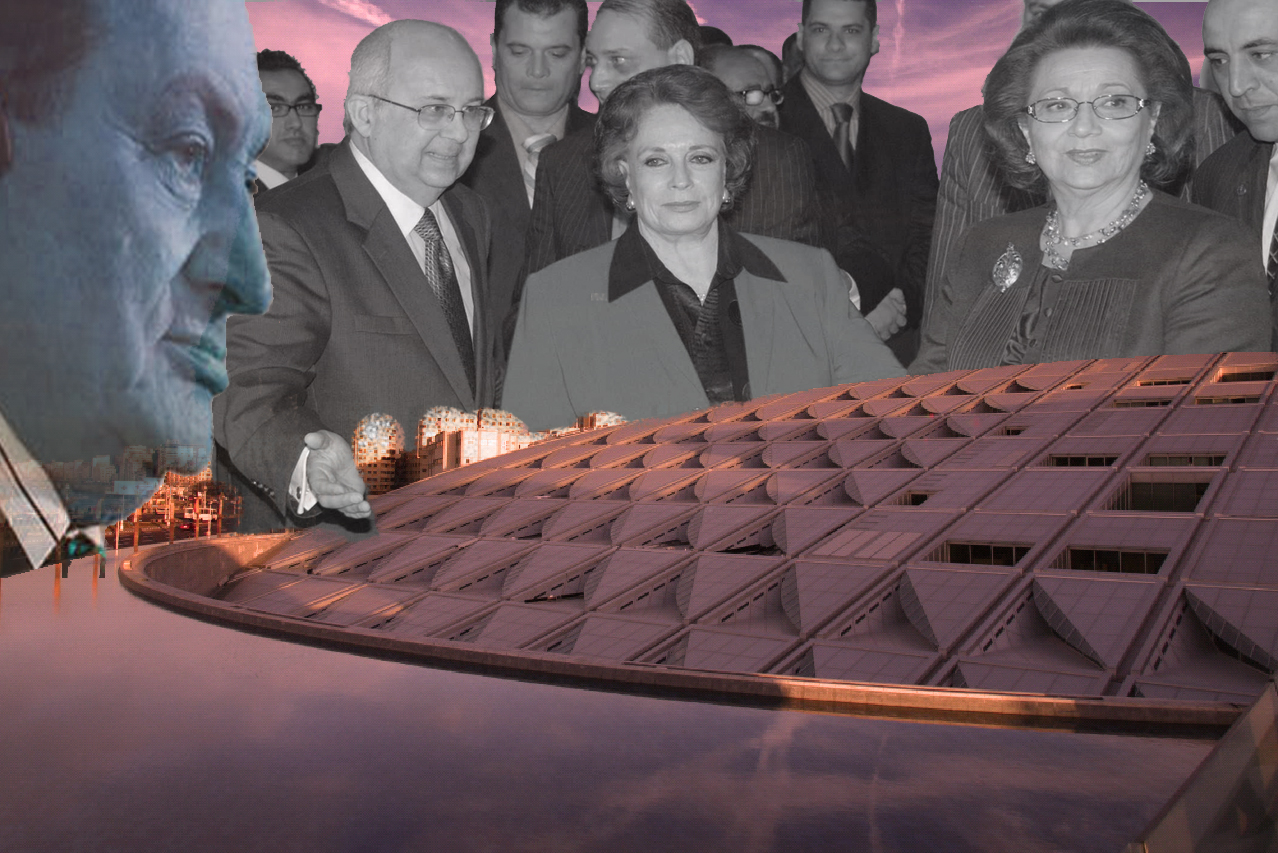
Deposed President Hosni Mubarak, Bibliotheca Alexandrina Director Ismail Serageldin, widow of the late President Anwar al-Sadat, Jehan, and former first lady Suzanne Mubarak; oversee the Library.
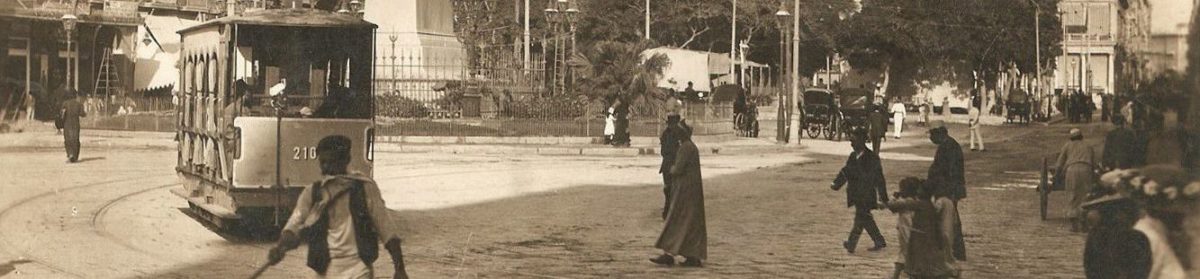
The piece examines the foundational politics and abuse of power behind the resurrected Library of Alexandria. “The library rests at the heart of international power plays seeking to carve out a stake in the ‘sacred drama’ of the Alexandria myth, Egypt’s political repositioning with the West, the Mubaraks’ unabashed narcissism, coupled with the self-styled “culture wars” of Alexandria’s elites. The foundational drama that midwifed the Bibliotheca would give way to a decade of corruption, abuse of power, while also positively shaping the socio-cultural landscape of the coastal city, even making it a vital player in the post-Mubarak environment.”
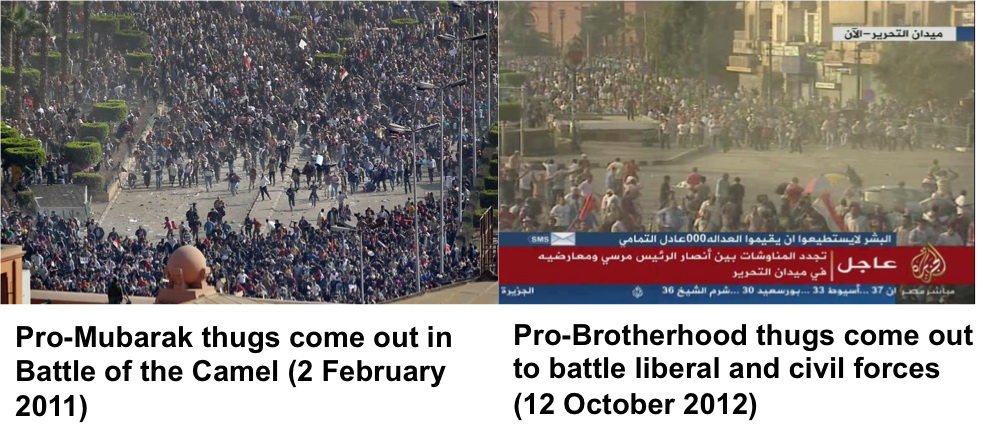
It’s hard to imagine the above photos are two different events. Yet one took place at the turning point of the 18 day revolution, when pro-Mubarak thugs came out on 2 February 2011 on horseback and camels to scare the protesters away, and the latter was on Friday, nowhere near the level of the Battle of the Camel, but disturbing enough. What they do have in common, besides the striking visual parallel, is citizen versus citizen, which has not happened at any time in between those two events
The backdrop to Friday’s case could not be any more tragic, the perpetrators of the notorious Battle of the Camel that resulted in dozens of deaths and hundreds of injured (Exhibit A) were acquitted on Wednesday. So what do pro-Morsi supporters do? They gave us a re-enactment of the Battle of the Camel, the very event they came out to protest against. Continue reading “Tahrir Square: rent-a-thug culture”
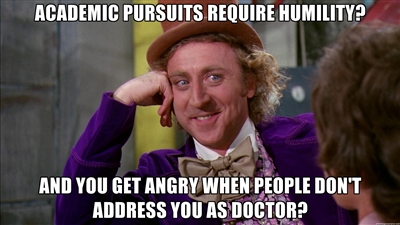
Once when a Saudi diplomat whom I knew greeted me as Ostaz(Mr) and I replied in kind with Ostaz, he shouted “Doctor!” I was taken aback at the response. Did I miss something here? The Arab world’s social fixation with ‘doctor’ titles can really be burdensome if at times comical.
When Egypt’s TV satirist Bassam Yousef opened the floor for questions following his opening peroration, a number of Egyptian audience members started off with, “I’m doctor so and so”. Yousef remarked, “we seem to have a lot of doctors in the house today” to the laughter of the audience. At a Cairo conference on the Arab uprisings earlier this year, a female Egyptian academic pleaded with the audience during question time in what was only a semi-joking manner: “I worked so hard for my PhD, so the least I can ask of people is to call me doctor.” This was cringe-worthy, given the number of overseas academics in the session who could not care less if you addressed them as doctor.Yes I can hear the cries already, “This happens all around the world, not just the Middle East!” Sure, the old guard of scholarly circles in Italy and Germany get irked if you fail to address them as such, but it is on the wane. I’m no blind egalitarian that believes titles should be done away with. There is a time and place for titles, such as first meetings, formal ceremonies, application forms and business cards. I’ll use it more out of respect for an elder than anything else.
But we are talking about the abuse of the title ‘doctor’ to the extent that it even makes it into people’s signature, caller ID’s. Merely registered PhD candidates get called doctor, and the expectation that the title confers upon someone is an all-knowing command of any subject. You hear statements like, “I have a PhD in veterinary science, but I do know a bit about the changing Middle East socio-political landscape”.
Saeeds of Revolution: Demythologizing Khaled Saeed has now been translated into Arabic
ارتفع اسم خالد سعيد بسرعة حتى أصبح يعادل اسم روزا بارك. وأصبحت صورته الفوتوغرافية السمة المميزة للحركة الثورية في مصر على الدوام. وأصبح ميدان كليوباترا، المجاور لمسرح الجريمة، “قبلة” ومحطة يسير عبرها المتظاهرون وهم يرددون بأشكال مختلفة “كلنا خالد سعيد”.
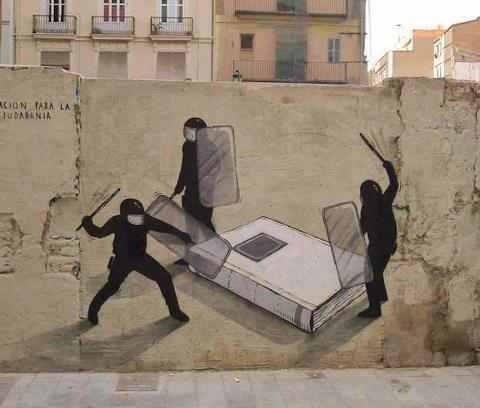
On a conference visit to Rome a few months ago, I was taken aback by what I saw upon my arrival at the main train station, Roma Termini – out on the street was a homeless man, in torn, dishevelled clothes, reading a book. The sight in some ways entranced me. Here was a man who had lost everything in life, but had not lost his dignity to live and re-live through the written word.
I found myself bleakly registering the contrast with Egyptian university graduates who will rarely pick up a book following their formal education. Forget leisure reading, they would no more think of taking out a book in a cafe as taking out a gun. Ask a young Egyptian why don’t you read, and the response is, “I only read if I have to.” In other words, if it is work-related or an obligatory part of some curriculum.
It is in this context of a defanged reading culture that police raided the book sellers on the historical Nabi Daniel Street in Alexandria – the city that spawned one of the wonders of the world, the ancient library of Alexandria. The street – where I could pick up a copy of a 1960s Time magazine or some other yellowing Egyptian periodical – strewing books all over the pavement and sending shockwaves throughout the literary world followed by accusations of Muslim Brotherhood-style censorship. Continue reading “Turning the tide on Egypt’s sinking book reading culture”