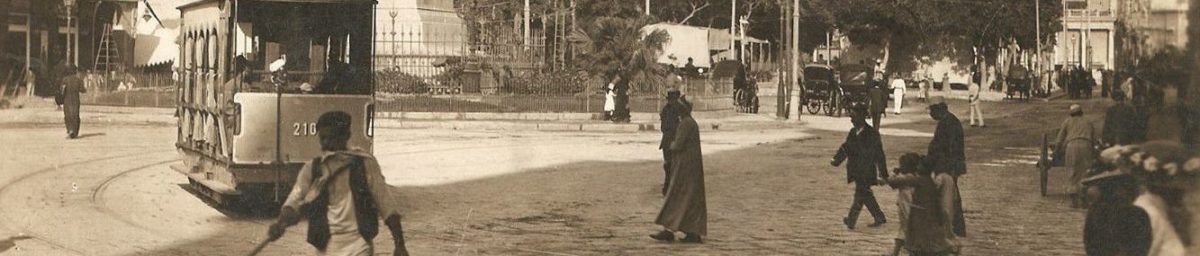
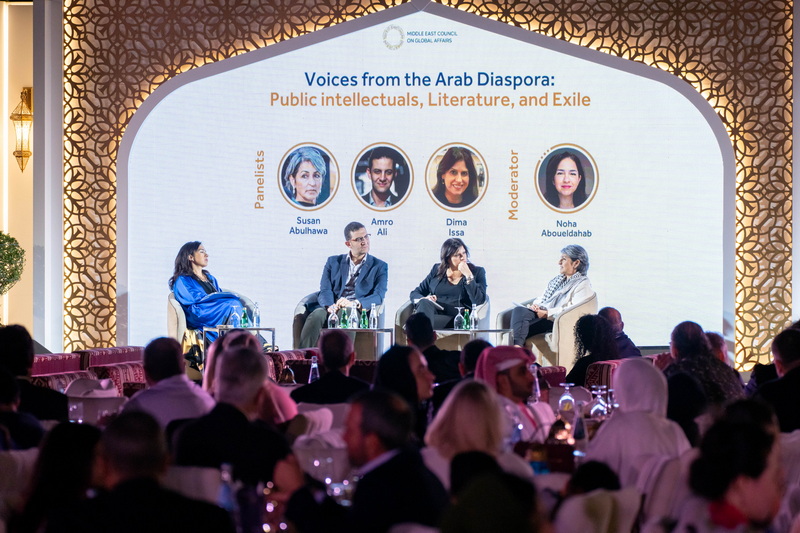
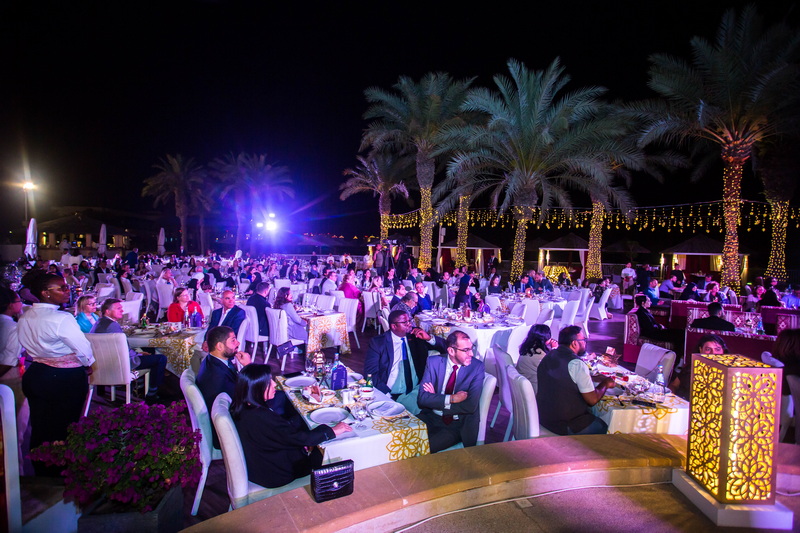
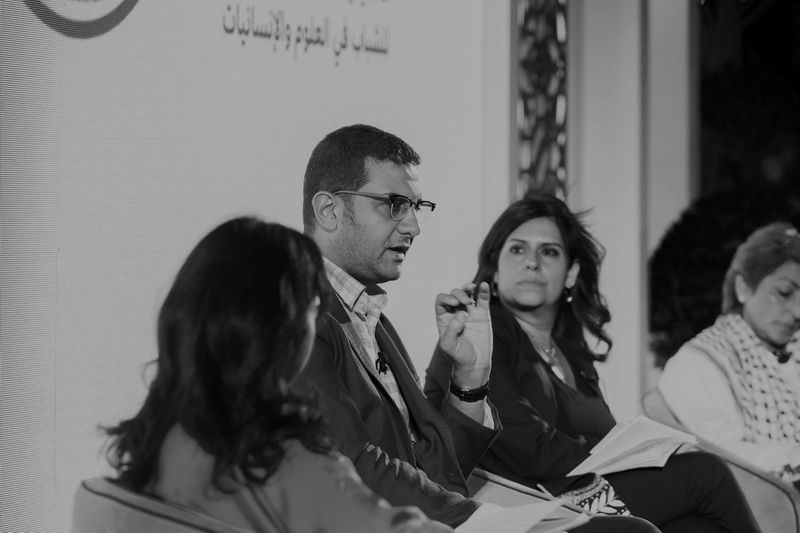
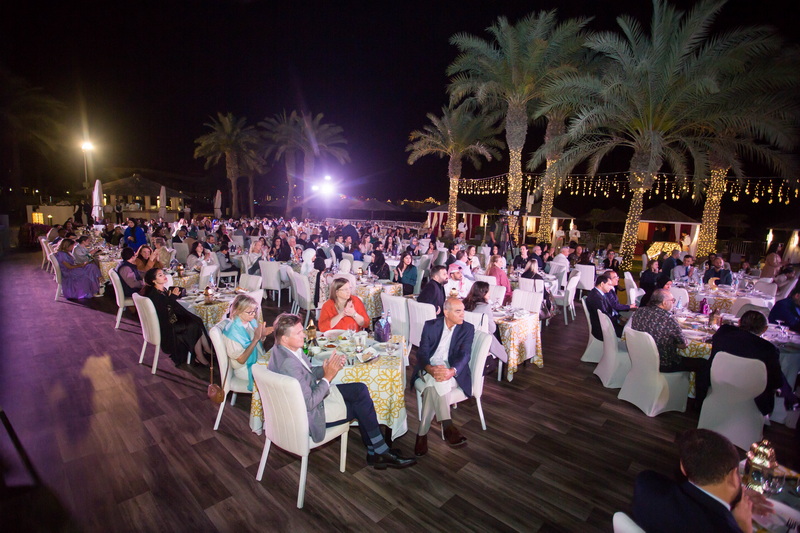
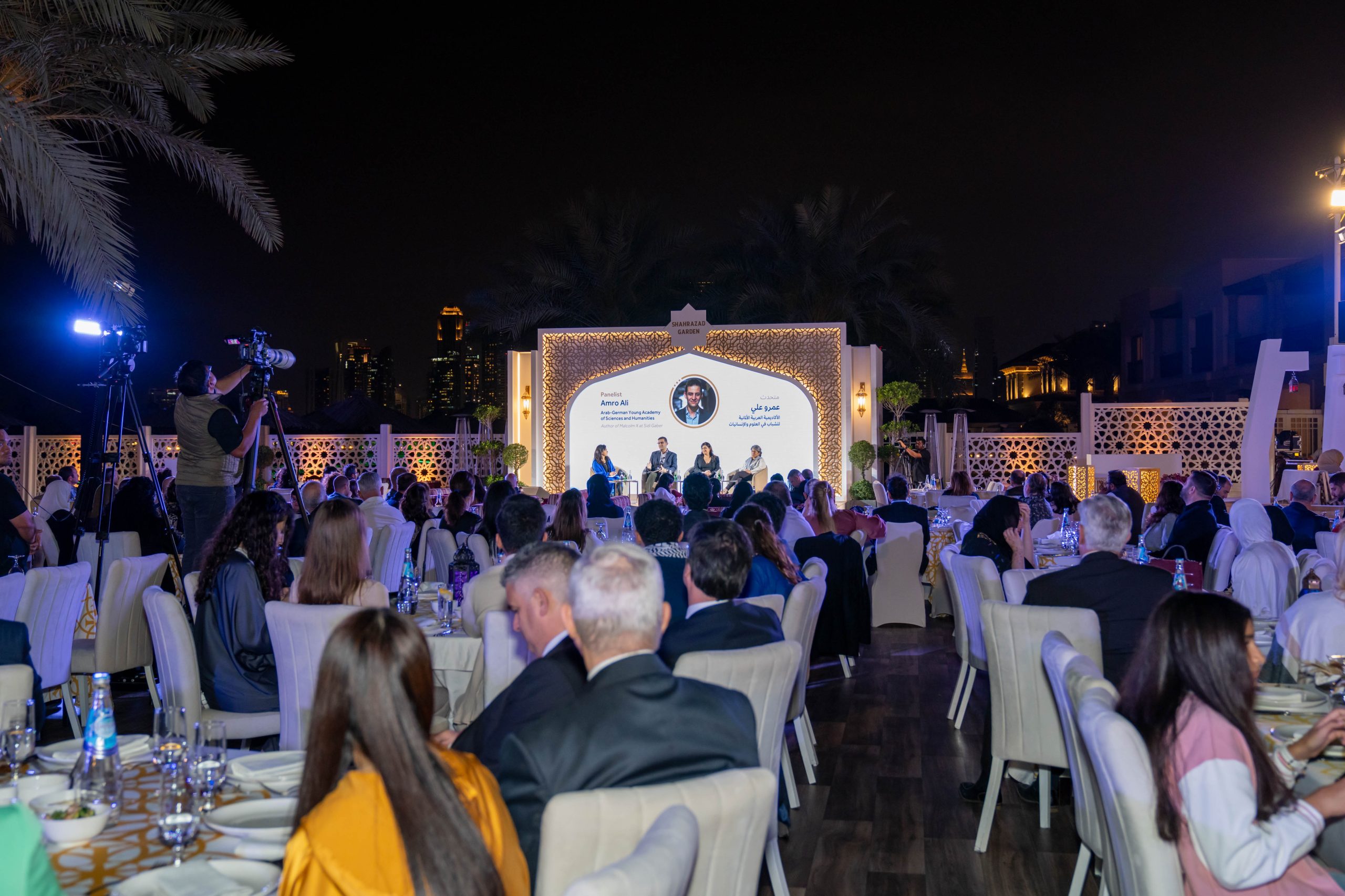
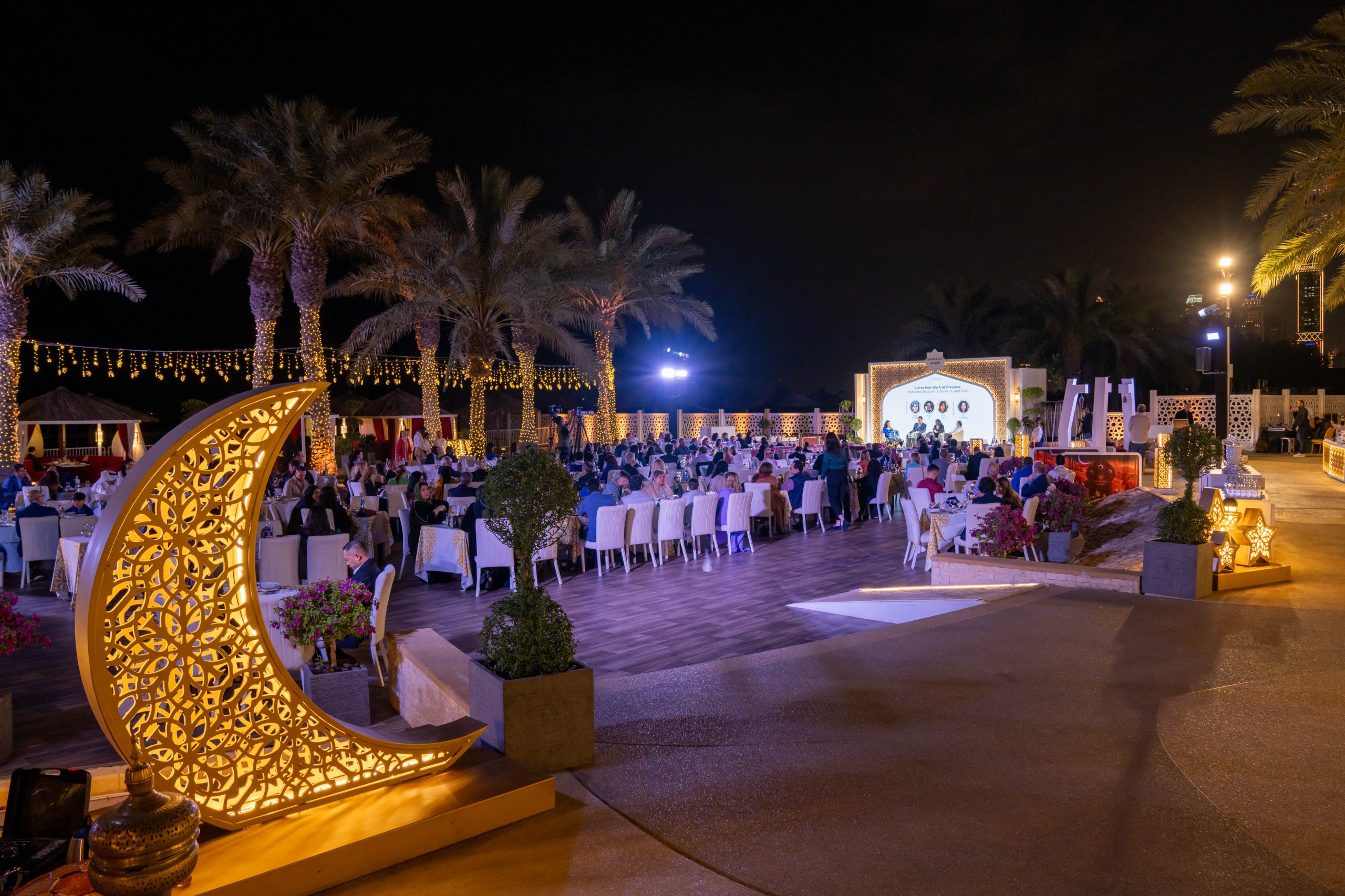
It was an honour to be invited to speak on a topic close to my heart and sharing the panel with stellar figures as Lebanese author Dima Issa and Palestinian novelist Susan Abulhawa, and moderated by legal scholar Noha Abouleldahab. It was an enriching discussion with a massive turnout in Doha, and it was refreshing to talk about Gaza without any attempted censorship. Thank you to the Middle East Council for the invitation and organising the “Voices from the Arab Diaspora: Public Intellectuals, Literature, and Exile” event.
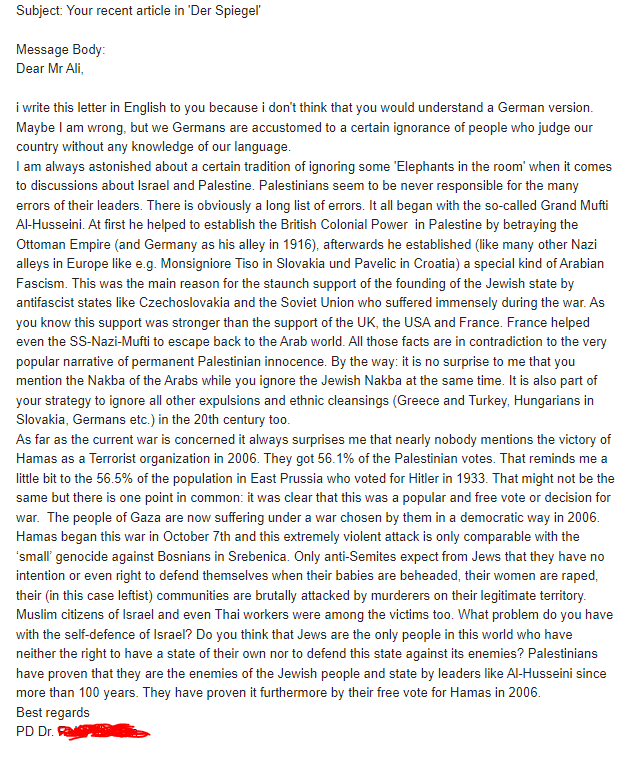
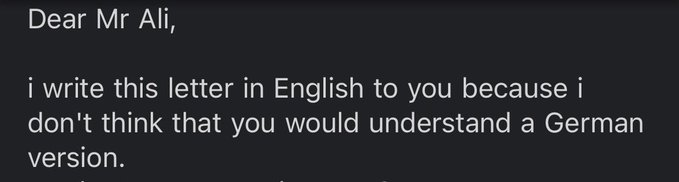
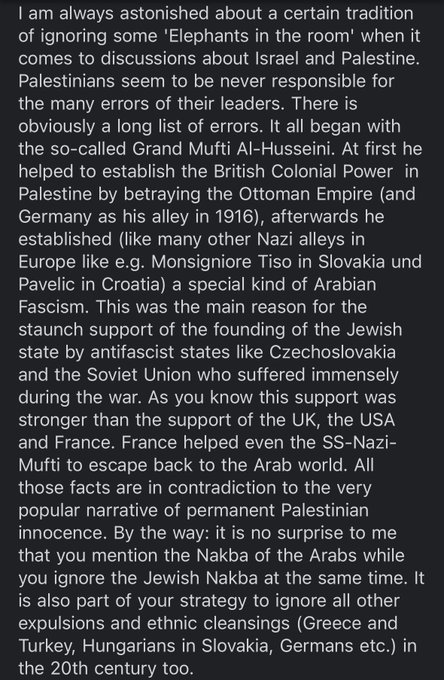
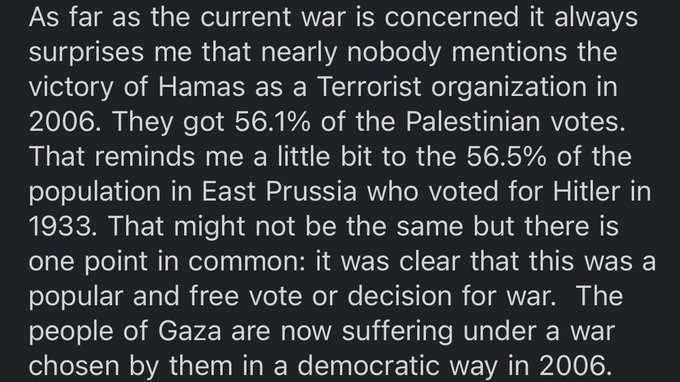
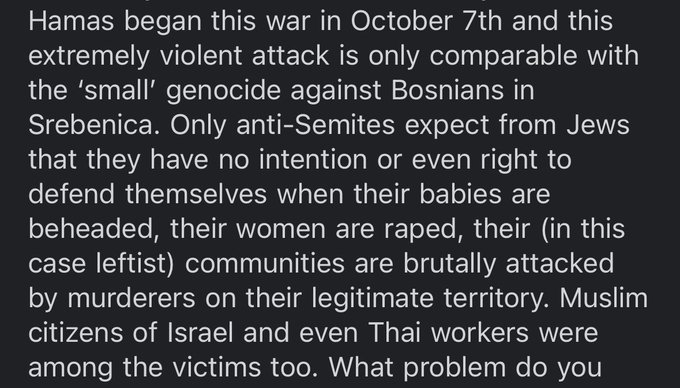
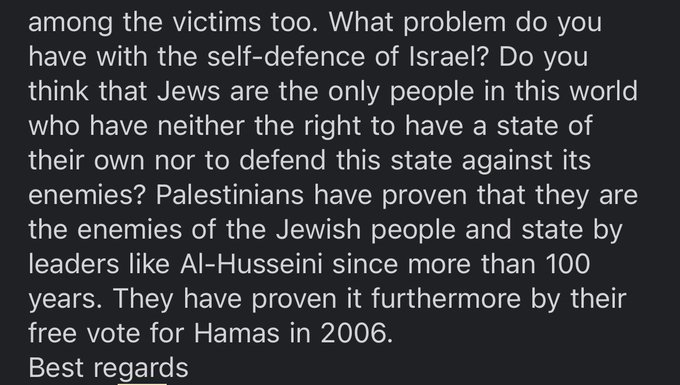
Since my article in Der Spiegel on Gaza, which can be read in the following languages, German, English, Arabic, and Italian, I’ve received countless messages from upset Germans. I want to show this angry email from a professor (or more technically, a Privatdozent) which is quintessential as it ticks almost all the boxes with the problematic German position. This started off as a thread on Twitter which garnered lots of insightful responses.
From the outset, I want to clarify that I understand there is a plurality of German views, but this one by far reflects the dominant worldview of the establishment that is impacting domestic and foreign policy.
I chose this email because it comes from a German academic and historian who has published books on German literature. He plays a role of consequence in society. And no, I won’t disclose his identity not just because privacy and ethics matter to me, but because he sent it privately as an email, not through a public medium like Twitter. Also, his views are not uncommon in Germany, it’s a socio-structural problem. Rather than the individual, we need to address the bigger picture that normalizes genocide.
Let’s dissect this.
Although titles don’t bother me, he addresses me as “Mr” while he signs off as doctor. Despite him knowing I’m a doctor. The hierarchy is established from the start. He also doesn’t know if I speak German, but has assumed I don’t in order to build up his following argument.
Putting aside that “We Germans” has a ring of the Volksgemeinschaft. The irony of saying “ignorance of people who judge our country without any knowledge of our language” when Germans who don’t know Arabic, Hebrew, Persian etc will write endlessly on the Middle East.
I’m a scholar of Middle Eastern studies, and if Germany is going to send hundreds of millions of euros in military equipment to Israel, then it should not be surprising that I will treat this as a political and moral problem in my domain.
Here is a classic form of offloading German historical guilt onto the Palestinians who are stripped of political, structural, and colonial factors while marginal individual phenomenons like the Mufti of Jerusalem are centered.
The Zionist narrative is pathologically obsessed with the Mufti. Netanyahu partly blames him rather than Hitler for causing the Holocaust. Here is an article that briefly unpacks the exaggerated role of the Mufti who “when all things considered, was a rather powerless politician in exile who couldn’t even muster his own people to fight at the outset of the 1948 war.”
Never mind the Balfour Decleration and British colonialism, or that Palestinian politics comprised of liberalism, socialism, Islamism, fascism etc. The Zionist narrative likes to go for the marginal one that can justify its legitimacy, with German officialdom cheering this on.
No one is claiming “permanent Palestinian innocence”, not even Palestinians themselves. They have made mistakes like all liberation movements. Yet his subtext is that there is a permanent Zionist innocence as the categories of occupier/occupied, aggressor/victim, etc are switched.
Lots of Tu quoque (you too) fallacies, but on the point of Jews leaving or being expelled is certainly one of the darkest stains committed in the Arab world, not to mention a tragic loss for Arab countries. But history shows it was never as simple, for example, in Iraq, “Zionists bombed sites to encourage migration to Israel”
Yep, he went there. Comparing Hamas with the Nazis. A tiny bit of detail he forgets, that since October 7, most of the murdered civilians in Gaza were born after 2006 or were too young to vote in 2006.
He uses genocide only for October 7th and belittles the Bosnian genocide. He brings up the rejected claims of beheaded babies. No mention of 25,000+ murdered Palestinians. His real point being: only an anti-Semite would deny Israel’s right to carry out a genocide.
No mention if Palestinians have a right to defend themselves or if they have a right to a state. He prefers to frame the entire Palestinian people through the lens of Al-Husseini and Hamas “enemies of the Jewish people…since more than 100 years”. So much German projection here!
Here are some of the many tweet replies that stood out and added value to the discussion:
“This German completely skips over Hitler and Nazi Germany !!” – @Busybee32433175
“Just a German scholar weaponising its historical guilt against anyone critical of ISR. This is peak selective and historical revisionism. These are easily debunked. It’s concerning that it’s coming from an academic.” – @Amarmustafa_
“Who on earth uses a quantifier like ‘small’ to describe the genocide in Srebrenica? Their constant need to offload their historical guilt is patently pathological. Please read this excellent thread.” – @theafroaussie
“Is nobody going to bring up the fact that he made up voting stats to help his point? Hamas NEVER won a majority of voters in Gaza. In 2006, they won a plurality with less than 50% of votes. I’m surprised an academic could get that wrong but then again he has a narrative to push.” – @DiasporaArab
“Worth reading it; as the author rightly suggests this angry email points to a structural / ideological problem rather than to an individual opinion.” – @VolkanCidam
“To such persons we (brown/blacks) will forever be spoken down to, no matter how many qualifications and eduction we successfully complete and receive from THEIR establishments. As the issue is not ignorance but arrogance. In this narrative we are the uncivilised ‘other’ no matter what.” – @imsarakay
“Telling that Palestinians are still responsible for the views of the grand Mufti who continues to be their ‘leader’ but Germans are not still responsible for Hitler. They have offloaded this responsibility by projecting their own demons onto the Palestinians.” – @akkhan81
“Good to detail also that history did not begin on October 7, and address the structural conditions of Palestinian subjugation by Israel for 75 years,(disposition, ethnic, cleansing, military occupation, apartheid), notwithstanding the extreme suffocation of Gaza for 17 years. This does not mean that anything goes against occupying non-combatants in response, but the complete elision of context by the German doctor is criminal and telling. If not outright racist.” – @4Bassam
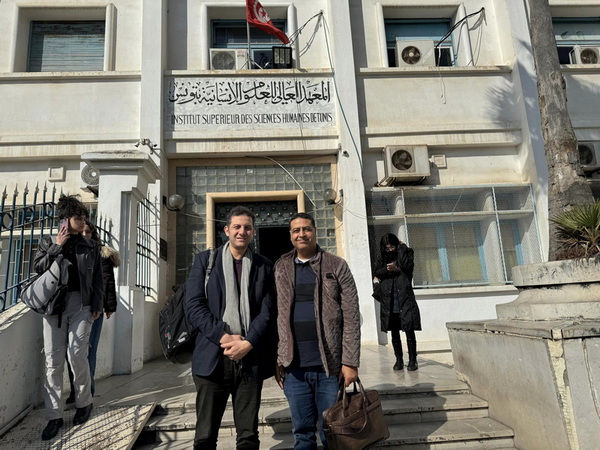
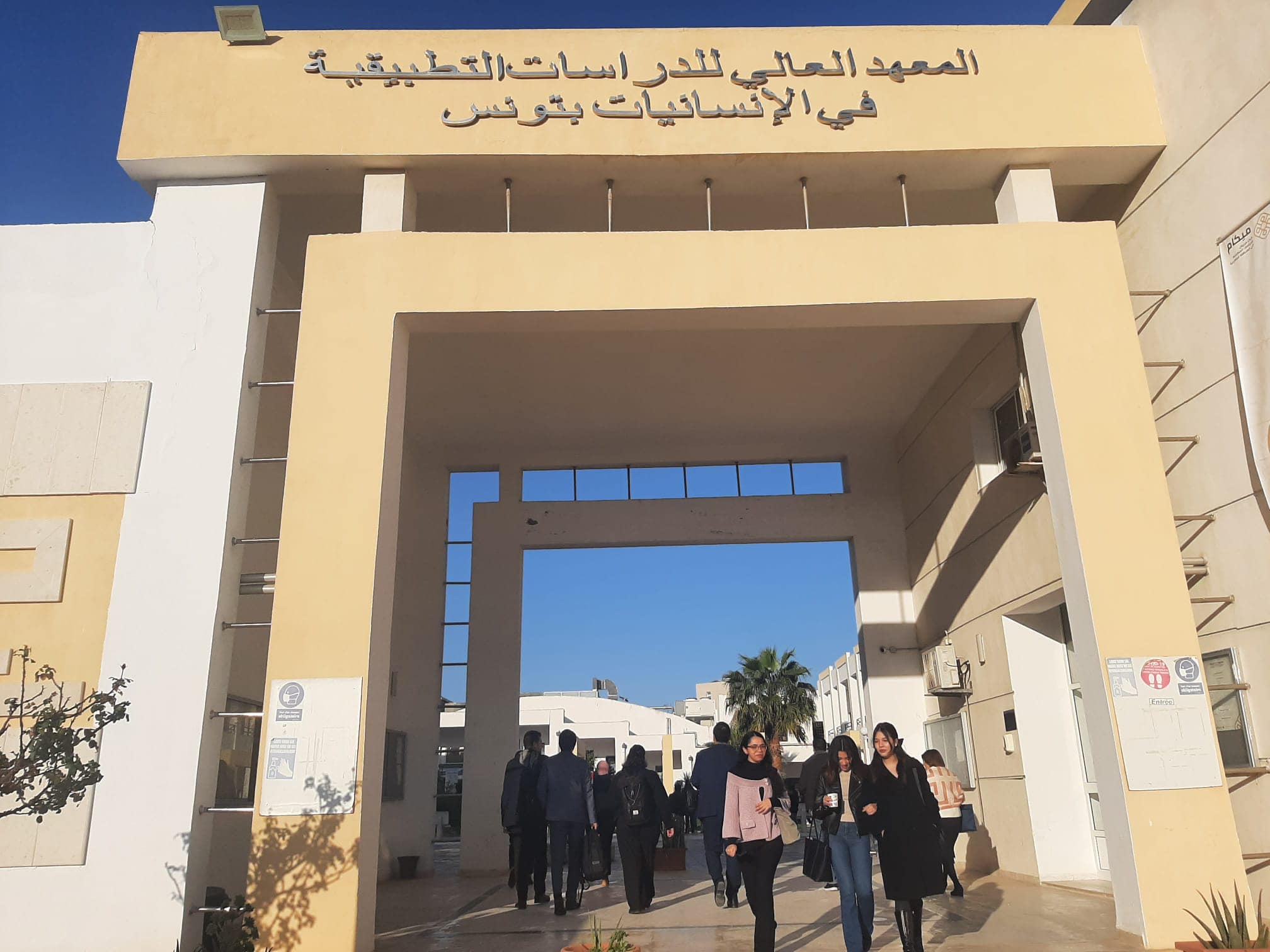
It was a great pleasure and honour to give a guest public lecture to the inspiring students at the University of Tunis, and thank you to Prof. Anis Ben Amor for the invitation. The topics touched on Gaza, alienation, and recalibrating the moral compass and preserving the ethical self in the era of genocide normalisation.
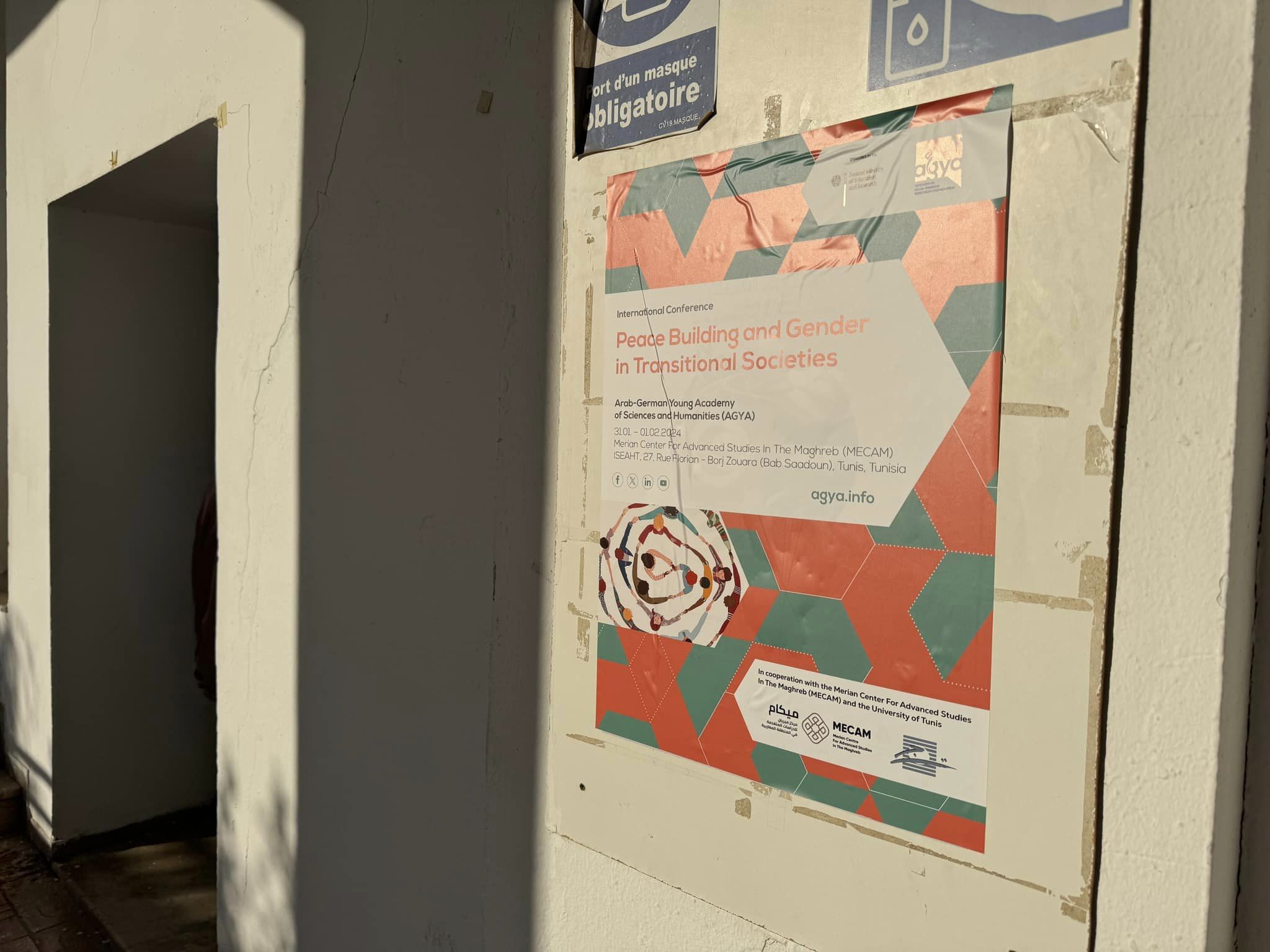
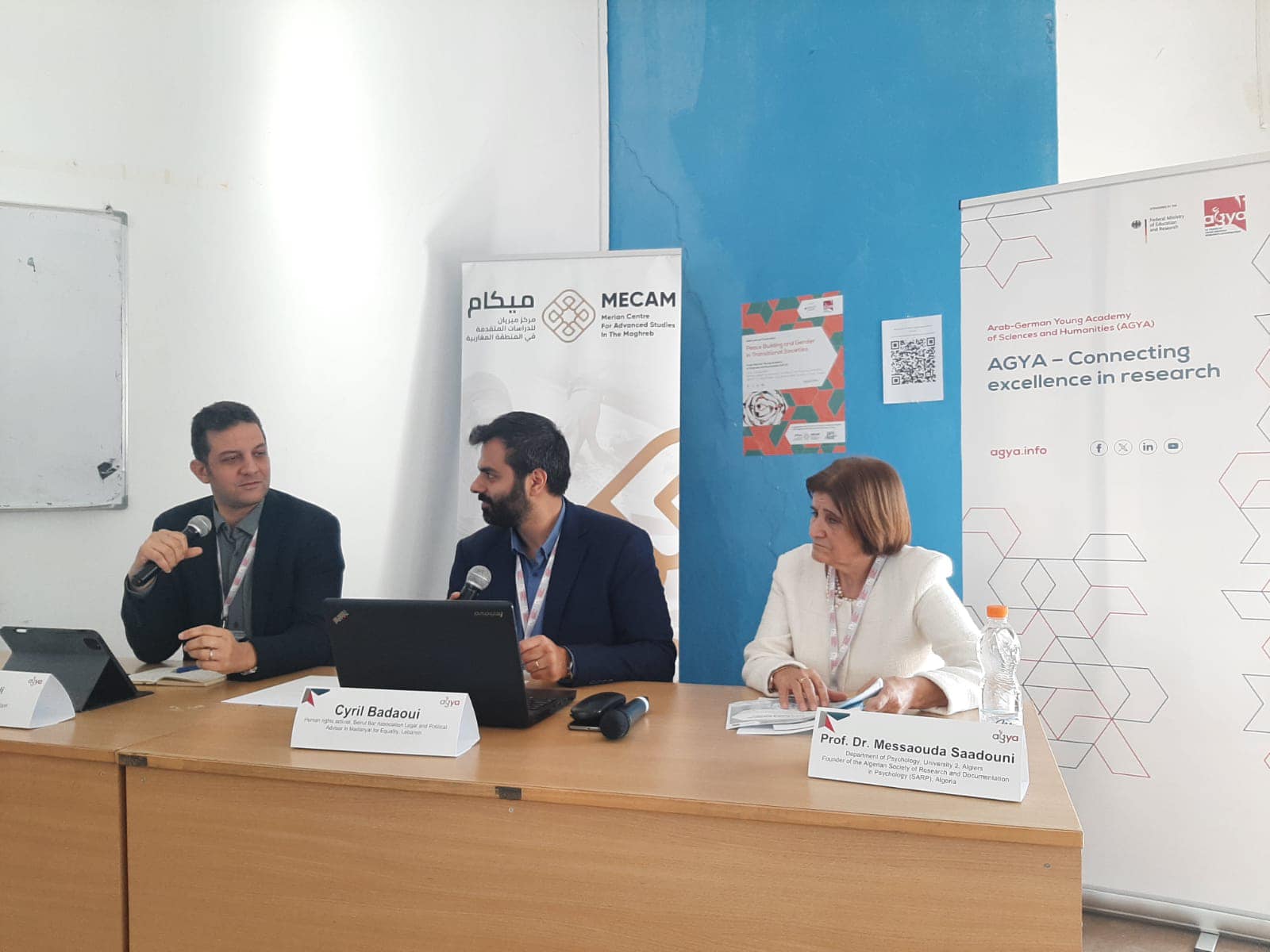
The Tunis conference ‘Peace Building and Gender in Transitional Societies’ was a tremendous success, and it was an honour to be the moderator for such a critical topic. The event was hosted by the Merian Center for Advanced Studies in the Maghreb.
Author: Amro Ali Click here to download the PDF file. A shortened version of this article was translated into German for Der Speigel on 1 January 2024.
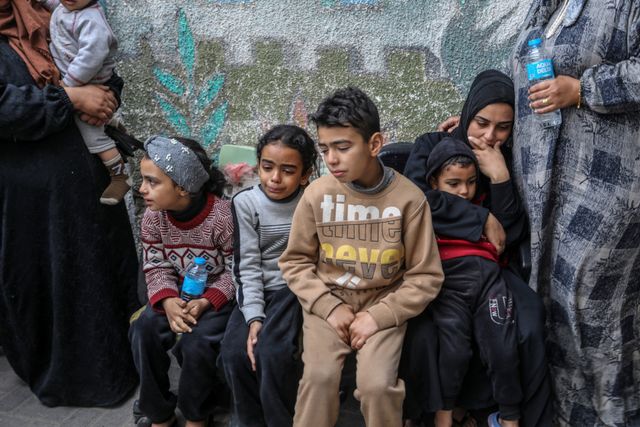
December 21, 2023, Palestinians in Rafah mourn as they wait for the bodies of their relatives killed in Israeli air strikes to be removed from al-Najjar Hospital and buried. Photo: Abed Rahim Khatib/dpa
There has always been a strange unspoken pact between Germany and the Arab world. The Arabs were less outraged by German support for Israel than by that of the US and UK. This was in part due to the widespread view that Germany could not do otherwise because of its historical guilt. Arab governments and their publics not only reluctantly let Germany off the hook but also bought into a set of historical perks. Germany could claim that it had never colonized Arab countries. Germany’s dark past skirted around the Arab world apart from the Axis invasion of North Africa in the Second World War which was short-lived and saw fewer war crimes that paled in comparison to the horrors that unfolded in Europe. And if you were later unhappy with West Germany, there was always East Germany (GDR). You could like the Germany of your choice.
Admiration remained the case in a reunified Germany too. The fact that Berlin opposed participation in the Iraq war in 2003 was well received. The sight of Syrian refugees being welcomed at German train stations in 2015 warmed the Arab public to Germany even more, as they saw the contrast to the mistreatment of Syrians by their own governments. From Rabat to Baghdad, Germany was seen through its Mercedes cars clogging the streets of Kuwait, through the Goethe Institute sticking out among the trees of Alexandria, or through friendly backpackers hiking in the Lebanese mountains. Berlin’s soft power trickled down to the Arab airport officer giving less scrutiny to the inbound German passport holder. German-Arab problems existed of course, but they were addressed on a country-by-country basis and often resolved. The rise of the far right, which frightened the Arab diaspora in Germany, was barely noticed in Arab countries. The diaspora, immersed in the difficult-lived realities of Germany, were at odds with their country of origin and its glamorization of Germany.
Then the horrific Hamas massacres and kidnappings took place on October 7, and Israel responded by bombing the Gaza Strip, starving its inhabitants, killing thousands of civilians, and displacing almost two million people. It quickly became clear that this war went far beyond self-defense. Germany lost every nuance with its one-sided support for Israel, trivializing the gruesome reality in Gaza and unwilling to demonstrate basic human empathy for the Palestinians. When the German Foreign Ministry is not praising Israel’s “humanitarian” measures, it refers to a catastrophic event with thousands of Palestinian children killed as “the situation in the Middle East.” As if it were nothing more than a Deutsche Bahn delay.
The murders and kidnappings carried out by Hamas on October 7 are reprehensible and unjustifiable. Compassion for the Israeli victims should not be conditional or dismissed because of the history of Palestinian suffering. At the same time, we must make it clear that talking about context is not tantamount to justification. Hamas is first and foremost a product of the occupation; its ideology is fueled by the displacement, dispossession, and violence that Palestinians have experienced daily since 1948. If Hamas is destroyed, something else will take its place as long as there is no just peace.
Hamas recruits many of its members from among orphans who have seen their parents murdered by Israel. The Palestinian Marxist militants from the Black September Organization, who carried out the terrorist massacre of Israeli athletes at the 1972 Olympic Games in Munich, were orphans of previous Israeli wars. Now Israel is creating a new generation of orphans. Palestinians are dying by the thousands and the scenario of the destruction of the entire Gaza Strip with a forced mass expulsion, a second “Nakba”, is very real. Renowned experts are alarmed and are speaking of a genocide taking place. Meanwhile, German politics is concerned with discursive trigger points, censoring “Free Palestine” and making the Palestinians pay the price for Europe’s bloody past to this day by letting Israel get away with everything concerning its own historical guilt.
German politicians fell over themselves in moral gymnastics to justify a death toll that has been the deranged phenomenon of our time. Berlin turned the lives of seasoned German diplomats and professional cultural workers abroad into a neurotic hell as they were forced to navigate between the German government of the day and the justified concerns of their host countries.
Last month, Germany cut funding for an anti-trafficking program at the Center for Legal Aid for Egyptian Women because its director, Azza Soliman, opposes Israel’s war in Gaza. Soliman was awarded the Franco-German Prize for Human Rights and the Rule of Law in 2020. Hossam Bahgat, head of the Egyptian human rights organization EIPR, severed cooperation on projects with the German government because “Berlin’s position on the war raises serious doubts about the space of shared values between Germany and human rights activists, feminists and independent media in Egypt.” Across the Arab world, Germany is losing allies who previously saw themselves as part of a community of values committed to human rights.
It has long been clear the liberal order and international law often apply double standards. In the early days of Vladimir Putin’s invasion of Ukraine when meeting German officials in the Bundestag saw their usual stoicism replaced with a somewhat understandable anxious behavior, it was easy to draw an analogy with occupied Palestine. But the response was nothing but silent stares, a silence that spoke volumes. The double standards were unbearable then and are more unbearable now: Berlin is in favor of sending weapons to resist an illegal occupation while providing military, economic, and moral support to an occupying power that continues to seize land illegally and murder with impunity. At best, Israel is occasionally reminded to comply with international law, but without any consequence.
Now, in the face of Western support for Israeli war crimes in Gaza, the last semblance of universality has been shattered. The autocrats have taken notes and are ready to use current events as a pretext in the future. The Western reaction to the Israeli war in Gaza is an undeserved gift for Putin, and rarely will anyone soon in the Global South listen when Western politicians insist on international law.
When it comes to the Israeli occupation, there is often an alternate reality in Germany that boggles the mind. Many Syrian refugees would correctly say that Bashar al-Assad’s bloody regime is the cause of why they left. Nothing controversial there. Yet when it is pointed out that Germany is home to Europe’s largest Palestinian refugee population, 100,000, then it should be asked: What caused them to be there if not for the direct or indirect actions of successive Israeli governments? How does that historical reality escape the conversation?
I generally felt that the Arab Spring in 2011 was a welcome change and a breath of fresh air for the German policy establishment. Cities like Tunis and Cairo were beaming with hope and gave Berlin fewer complications compared to Ramallah and Gaza City. But here is the point that many officials missed. The conflict with Israel was feeding the rise of Arab authoritarianism and securitization in the region for decades. It contributed to the destruction of fragile democratic experiments in Egypt, Syria, and Iraq in the 1950s and 1960s, and gave rise to the ruling military classes that expanded their power partly under the pretext of defending Arabs against Israeli aggression. The modern Egyptian Officer’s Republic was born in 1952 as an indirect result of the 1948 Arab-Israeli war that was in part triggered by the establishment of Israel and the new state’s expulsion of the indigenous Palestinians.
However, the protest movements of the Arab Spring in 2011 were also inspired by Palestinian popular uprisings, particularly the 2000 Intifada. The current pro-Palestinian protests in the Arab countries are sometimes mixed with other demands, such as an end to the corruption of their governments – which is why the Arab regimes tend not to like to see such protests. In a sense, Palestinian freedom is an antidote to Arab unfreedom. The Palestinian issue is central to Arab public opinion, and it will always shatter illusions that it can be ignored.
Anyone who sits down with German officials can have mostly productive conversations about any Arab country, from human rights to higher education, as they sip on their sparkling water. Yet, when it comes to Israel and Palestine, the moral sensors get suddenly jammed and the script becomes nauseatingly predictable. This reflects a hardening of the boundaries of the culture of remembrance, which has become static in its fixation on Israel, not necessarily the safety of Jews.
It is commendable that Germany is coming to terms with its dark history. The horrors and madness perpetrated by Nazi Germany must be remembered. The world would benefit from more remembrance culture, not less of it. However, there are important criticisms of the development of remembrance culture in Germany. The confrontation with anti-Semitism has become a kind of canonization of Israel that is “immune to historical and evidence-based arguments and blind to the experiences of Palestinians under occupation,” as Israeli historian Alon Confino puts it. This development has allowed the fight against anti-Semitism to be partly instrumentalized by the right wing. It is highly disturbing when high-ranking German politicians share a video by Piers Morgan with the British right-wing activist and journalist Douglas Murray, in which he claims that Hamas is worse than the Nazis. The trend of relativizing the Nazis to Hamas requires us to pause and ask how the discourse got to this sad point.
The editors of the left-leaning Jewish-American magazine Jewish Currents wrote: “The Germans tightly control the shape of Jewishness and Palestinian-ness within their borders… Germany’s stifling embrace of the Jewish community within its borders, with or without the participation of Jews, secures the German self-image as moral arbiter, while shifting the country’s blame to Arabs and Muslims.” Despite genuine Arab-Jewish solidarity efforts, let alone everyday Arab-Jewish intermingling in German cities, the state would prefer to turn Jews and Arabs into heroes and villains, caricatures in the German “theater of memory” – a term coined by the German-Jewish sociologist Y. Michal Bodemann in his critique of the German culture of remembrance. The Federal President’s call for Arabs and Muslims to officially distance themselves from anti-Semitism presupposes that anti-Semitism is a kind of standard attitude among Arabs and Muslims. This problem echoes what Palestinian-German legal scholar Nahed Samour notes in the open-access edited book Arab Berlin (in which I have a chapter) “The Arab turned German citizen is not granted the chance to act as a self-confident citizen but needs to manage the expectations of ‘the Arab’ facing German society.” This is also not to mention that 84 percent of anti-Semitic attacks in 2022 were by the German right.
But the global narrative is changing – and Germany is falling behind. Recently, Belgian transport workers refused to ship weapons destined for Israel that would most likely kill Palestinian civilians. Fortunately, some parties are learning the right lessons from history. The blockade of ports is just one of many actions directed against the West’s complicity in this war of extermination. Activists, students, trade unions, and ordinary citizens – Jews, Arabs, Muslims, Christians, atheists, and anyone who cares about the survival of our shared humanity – are mobilizing to slow down Israel’s war machine. They are all amalgamating into the world’s anti-genocidal infrastructure. Will they succeed? If I were to take a long-term view, then I would adopt the words of the 19th-century Unitarian minister Theodore Parker: “The moral arc of the universe is long, but it bends toward justice.”
Shar is the Arabic word for evil in the Islamic faith, but it actually means insufficient or incomplete. To not live up to the responsibilities of a human being is to be less than complete. Sympathy and mercy are just some of the qualities of that responsibility, the absence of which leads to the failure of humans to act as humans. The formula should be simple: Palestinian life is just as sacred as Jewish life; Jewish life is just as sacred as Palestinian life. Believing it, articulating it, and hopefully acting upon it should not be too difficult. Anything else is moral bankruptcy and will drive us all into the abyss.
Author: Amro Ali Translator: Monika Bolliger Publisher: Der Spiegel Date: 01.01.2024 Article link (Paywall) Download PDF. (Click here for the English version)
Für die arabische Welt war Deutschland ein Vorbild. Das hat sich geändert, seit die israelische Armee im Krieg gegen die Hamas Tausende Zivilisten getötet hat – und von deutschen Politikern kaum Protest zu hören ist.
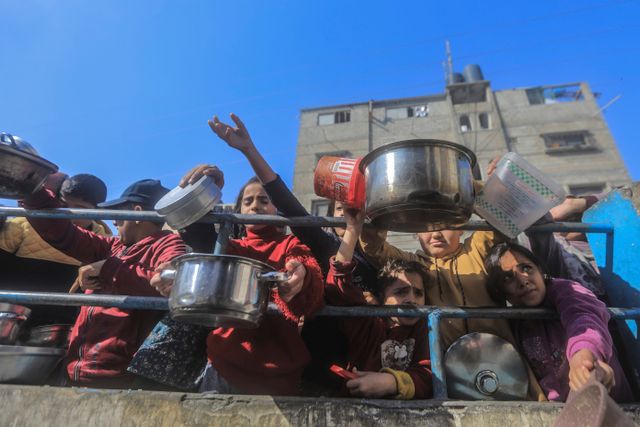
Palästinenser warten auf die Austeilung von Essen in Rafah im südlichen Gazastreifen Foto: Mohammed Talatene / dpa
Zwischen Deutschland und der arabischen Welt gab es schon immer einen seltsamen, unausgesprochenen Pakt. Die Araber empörten sich weniger über die deutsche Unterstützung für Israel als über jene der USA und Großbritanniens. Das lag auch an der verbreiteten Ansicht, dass Deutschland wegen seiner historischen Schuld gar nicht anders könne.
Arabische Regierungen und ihre Öffentlichkeiten waren Deutschland eher freundlich gesinnt. Deutschland konnte sich darauf berufen, dass es nie arabische Länder kolonisiert hatte. Deutschlands dunkle Vergangenheit ging an der arabischen Welt vorbei, mit Ausnahme der Invasion in Nordafrika im Zweiten Weltkrieg. Und wenn man mit Westdeutschland unzufrieden war, gab es immer noch die DDR. Man konnte das Deutschland seiner Wahl mögen.
Auch im wiedervereinigten Deutschland blieb das so. Man nahm wohlwollend auf, dass Berlin sich 2003 einer Beteiligung am Irakkrieg widersetzte. Der Anblick syrischer Geflüchteter, die 2015 an deutschen Bahnhöfen willkommen geheißen wurden, erwärmte die arabische Öffentlichkeit noch mehr für Deutschland, die den Kontrast zur Misshandlung von Syrern durch ihre eigenen Regierungen sah.
Mercedes, Goethe-Institut und Rucksacktouristen
Mercedes, Goethe-Institut und Rucksacktouristen Man sah Deutschland durch seine Mercedes-Autos, die die Straßen von Kuwait verstopfen, durch das Goethe-Institut, das zwischen den Bäumen von Alexandria hervorragt, oder durch freundliche Rucksacktouristen, die im Libanongebirge wandern gehen. Der Aufstieg der extremen Rechten in Deutschland wurde im arabischen Ausland kaum wahrgenommen.
Dann geschahen die entsetzlichen Massaker und Entführungen der Hamas am . Oktober, und Israel begann als Reaktion darauf, den Gazastreifen mit Flächenbombardements zu überziehen, ließ die Bewohner hungern, tötete Tausende von Zivilisten und vertrieb fast zwei Millionen Menschen aus ihren Häusern. Es wurde schnell klar, dass dieser Krieg weit über Selbstverteidigung hinausgeht. Aber Deutschland verlor jede Nuance mit seiner einseitigen Unterstützung Israels, was im krassen Widerspruch zur Realität und zur grundlegenden menschlichen Empathie steht.
Wenn das deutsche Außenministerium nicht gerade die »humanitären« Maßnahmen Israels lobt, bezeichnet es diesen katastrophalen Krieg mit Tausenden getöteten Kindern als »die Lage im Nahen Osten«. Als ob es sich um nichts Weiteres als eine Verspätung der Deutschen Bahn handelt.
Die Morde und Entführungen, die die Hamas am . Oktober verübt hat, sind widerwärtig und nicht zu rechtfertigen. Das Mitgefühl mit den israelischen Opfern sollte nicht an Bedingungen geknüpft oder aufgrund der Geschichte des palästinensischen Leidens abgetan werden.
Gleichzeitig müssen wir klarstellen, dass ein Gespräch über den Kontext nicht gleichbedeutend mit einer Rechtfertigung ist. Die Hamas ist in erster Linie ein Produkt der Besatzung, ihre Ideologie wird durch Vertreibung, Enteignung und Gewalt genährt, die die Palästinenser seit 1948 täglich erleben. Wenn man die Hamas vernichtet, wird etwas anderes an ihre Stelle treten, solange es keinen gerechten Frieden gibt.
Die Hamas rekrutiert viele Mitglieder unter Waisenkindern, die mit ansehen mussten, wie ihre Eltern von Israel getötet wurden. Die palästinensischen Terroristen der Organisation »Schwarzer September«, die ! das Massaker an israelischen Sportlern bei den Olympischen Spielen in München verübten, waren Waisen früherer israelischer Kriege. Jetzt schafft Israel eine neue Generation von Waisenkindern.
Das Szenario einer zweiten »Nakba« ist real
Die Palästinenser sterben zu Tausenden, und das Szenario der Zerstörung des gesamten Gazastreifens mit einer erzwungenen Massenvertreibung, einer zweiten »Nakba «, ist sehr real. Namhafte Experten sind alarmiert, manche sprechen von einem Völkermord. Währenddessen kümmert sich die deutsche Politik um diskursive Triggerpunkte, zensiert »Free Palestine« und lässt die Palästinenser bis heute den Preis für Europas blutige Vergangenheit zahlen, indem sie Israel mit Verweis auf die eigene historische Schuld alles durchgehen lässt.
In diesem Monat hat Deutschland die Mittel für ein Programm zur Bekämpfung des Menschenhandels beim Zentrum für Rechtshilfe für ägyptische Frauen gestrichen, weil die Leiterin Azza Soliman Israels Krieg im Gazastreifen ablehnt. Soliman war mit dem Deutsch-Französischen Preis für Menschenrechte und Rechtsstaatlichkeit ausgezeichnet worden. Hossam Bahgat, Leiter der ägyptischen Menschenrechtsorganisation EIPR, will die Zusammenarbeit bei Projekten mit der deutschen Regierung beenden, weil »Berlins Position bezüglich des Krieges große Zweifel an dem Raum gemeinsamer Werte zwischen Deutschland und Menschenrechtsaktivisten, Feministinnen und unabhängigen Medien in Ägypten aufkommen lässt«. In der ganzen arabischen Welt verliert Deutschland gerade Verbündete, die sich bisher als Teil einer Wertegemeinschaft verstanden, die den Menschenrechten verpflichtet ist.
Es war schon lange klar, dass die liberale Ordnung und das Völkerrecht oft mit zweierlei Maß messen. In den ersten Tagen von Putins Einmarsch in die Ukraine war es ein Leichtes, eine Analogie zum besetzten Palästina herzustellen. Aber man erntete darauf nur schweigende Blicke, ein Schweigen, das Bände sprach.
Eine alternative Realität in Deutschland
Die Doppelmoral ist unerträglich: In einem Fall befürwortet man die Entsendung von Waffen für den Widerstand gegen eine illegale Besatzung, während man im anderen Fall eine Besatzungsmacht, die fortlaufend illegal palästinensisches Land an sich reißt, militärisch, wirtschaftlich und moralisch unterstützt. Bestenfalls erinnert man Israel ab und zu, aber ohne jede Konsequenz, an die Einhaltung des Völkerrechts. Wenn es um die israelische Besatzung geht, gilt in Deutschland oft eine alternative Realität, die einem den Verstand raubt.
Jetzt ist angesichts der westlichen Unterstützung für offenkundige israelische Kriegsverbrechen im Gazastreifen der letzte Anschein von Universalität zerbrochen. Die Autokraten haben sich Notizen gemacht und sind bereit, die aktuellen Ereignisse künftig als Vorwand zu nutzen. Die westliche Reaktion auf den israelischen Krieg im Gazastreifen ist ein unverdientes Geschenk für den russischen Machthaber Wladimir Putin, auch im Globalen Süden wird so bald niemand mehr hinhören, wenn westliche Politiker auf das Völkerrecht pochen.
Ich hatte den Eindruck, dass der Arabische Frühling 2011 eine willkommene Abwechslung für das deutsche politische Establishment war. Städte wie Tunis und Kairo strahlten Hoffnung aus und bereiteten Berlin weniger Komplikationen als Ramallah und Gaza-Stadt. Aber hier ist ein Punkt, den viele Regierungsvertreter übersehen: Der Konflikt mit Israel förderte den Aufstieg des arabischen Autoritarismus und die wachsenden Sicherheitsapparate der Region.
Er trug in den späten 1940er- und 1950er-Jahren zur Zerstörung der zerbrechlichen demokratischen Experimente in Ägypten, Syrien oder dem Irak bei, und brachte die herrschenden Militärklassen hervor, die ihre Macht unter dem Vorwand der Verteidigung der Araber gegen die israelische Aggression ausbauten. Die ägyptische Offiziersrepublik entstand ! als indirekte Folge des arabisch-israelischen Krieges von 1948.
Umgekehrt waren die Protestbewegungen des Arabischen Frühlings auch inspiriert von palästinensischen Volksaufständen. Die aktuellen propalästinensischen Proteste in den arabischen Ländern vermischen sich manchmal auch mit anderen Forderungen, wie einem Ende der Korruption der eigenen Regime – weshalb die arabischen Regimes solche Proteste nicht gern sehen. In gewissem Sinne ist die palästinensische Freiheit ein Gegenmittel gegen arabische Unfreiheit. Die palästinensische Frage ist für die arabische Öffentlichkeit zentral, und sie wird immer wieder die Illusionen zerstören, dass man sie ignorieren könnte.
Mehr Erinnerungskultur, nicht weniger
Wer sich mit deutschen Politikern zusammensetzt, kann produktive Gespräche über jedes beliebige arabische Land führen, von Menschenrechten bis zur Hochschulbildung. Wenn es jedoch um Israel und Palästina geht, sind die moralischen Sensoren plötzlich blockiert. Das spiegelt eine Verhärtung der Grenzen der Erinnerungskultur wider, die in ihrer Fixierung auf Israel, nicht unbedingt auf die Sicherheit der Juden, statisch geworden ist.
Es ist lobenswert, dass Deutschland sich mit seiner dunklen Vergangenheit auseinandersetzt. Die Schrecken und der Wahnsinn, die von Nazideutschland verübt wurden, müssen in Erinnerung bleiben. Der Welt würde mehr Erinnerungskultur guttun, nicht weniger davon.
Es gibt jedoch wichtige Kritik an der Entwicklung der Erinnerungskultur in Deutschland. Die Auseinandersetzung mit dem Antisemitismus ist zu einer Art Heiligsprechung Israels geworden, die »immun gegen historische und evidenzbasierte Argumente und blind für die Erfahrungen der Palästinenser unter der Besatzung« ist, wie es der israelische Historiker Alon Confino formuliert. Diese Entwicklung hat es ermöglicht, dass der Kampf gegen Antisemitismus teilweise vom rechten Flügel instrumentalisiert wurde.
Es ist höchst beunruhigend, wenn deutsche Politiker ein Interview des britischen Journalisten Piers Morgan mit dem britischen Rechtsaktivisten und Journalisten Douglas Murray teilen, in dem dieser behauptet, die Hamas sei schlimmer als die Nazis. Der Trend zur Relativierung der Nazis gegenüber der Hamas erfordert ein Innehalten und die Frage, wie der Diskurs an diesen traurigen Punkt gelangt ist.
Deutschland als moralischer Schiedsrichter
Die Redaktion des linken jüdisch-amerikanischen Magazins »Jewish Currents« schrieb : »Die Deutschen kontrollieren streng die Form des Jüdischseins und des Palästinensischseins innerhalb ihrer Grenzen… Deutschlands erdrückende Umarmung der jüdischen Gemeinschaft innerhalb seiner Grenzen, mit oder ohne Beteiligung von Juden, sichert das deutsche Selbstbild als moralischer Schiedsrichter, während die Schuld des Landes auf Araber und Muslime abgewälzt wird.«
Es ist, als ob Juden und Araber zu Helden und Bösewichten gemacht werden, zu Karikaturen im deutschen »Gedächtnistheater« – ein Begriff, den der deutsch-jüdische Soziologe Y. Michal Bodemann in seiner Kritik der deutschen Erinnerungskultur geprägt hat. Das untergräbt die jüdischarabische Solidarität – etwa, wenn die Polizei in Berlin jüdische Demonstranten verhaftet, weil sie gegen den Krieg im Gazastreifen protestieren. Der Raum für solche jüdischen Stimmen ist sehr eng.
Die Aufforderung des Bundespräsidenten an Araber und Muslime, sich offiziell von Antisemitismus zu distanzieren, setzt voraus, dass Antisemitismus bei Arabern und Muslimen eine Art Standardeinstellung ist. Ungeachtet der Tatsache, dass 84 Prozent der antisemitischen Angriffe im vergangenen Jahr von der deutschen Rechten verübt wurden.
Doch das globale Narrativ verändert sich – und lässt Deutschland ins Hintertreffen geraten. Kürzlich weigerten sich belgische Transportarbeiter, für Israel bestimmte Waffen zu verfrachten, mit denen höchstwahrscheinlich palästinensische Zivilisten getötet würden. Glücklicherweise ziehen einige Parteien die richtigen Lehren aus der Geschichte. Die Blockade von Häfen ist nur eine von vielen Aktionen, die sich gegen die Komplizenschaft des Westens in diesem Krieg richten.
Protest gegen Israels Krieg
Aktivisten, Studenten, Gewerkschaften und ganz normale Bürger – Juden, Araber, Muslime, Christen, Atheisten und im Grunde jeder, dem das Überleben der Menschheit am Herzen liegt – mobilisieren für Protestaktivitäten, um Israels Kriegsmaschinerie zu bremsen. Werden sie Erfolg haben? Wenn ich eine langfristige Sichtweise einnehmen sollte, dann würde ich es mit den Worten des unitarischen Pfarrers Theodore Parker aus dem !. Jahrhundert tun: »Der moralische Bogen des Universums ist lang, aber er neigt sich zur Gerechtigkeit.«
»Shar« ist das arabische Wort für das Böse im islamischen Glauben, aber eigentlich bedeutet es »unzureichend, unvollständig«. Der vollen Verantwortung eines Menschen nicht gerecht zu werden, bedeutet, weniger als vollständig zu sein. Mitgefühl und Barmherzigkeit sind solche verantwortungsvollen Eigenschaften, deren Fehlen das Versagen der Menschen widerspiegeln, als Menschen zu handeln. Die Formel sollte einfach sein: Palästinensisches Leben ist genauso heilig wie jüdisches Leben, jüdisches Leben ist genauso heilig wie palästinensisches Leben. Daran zu glauben, es auszusprechen und danach zu handeln, sollte nicht allzu schwer sein.
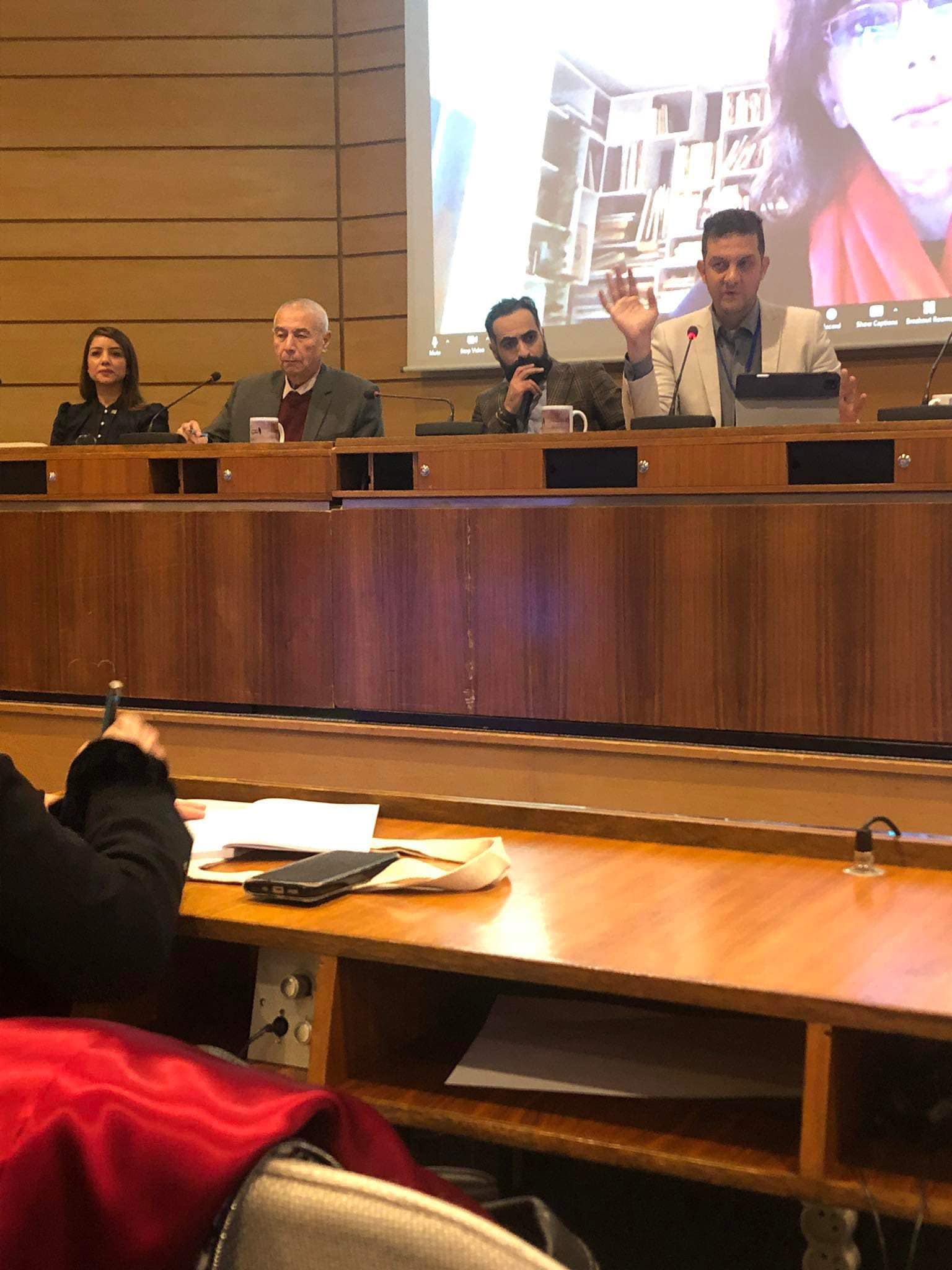
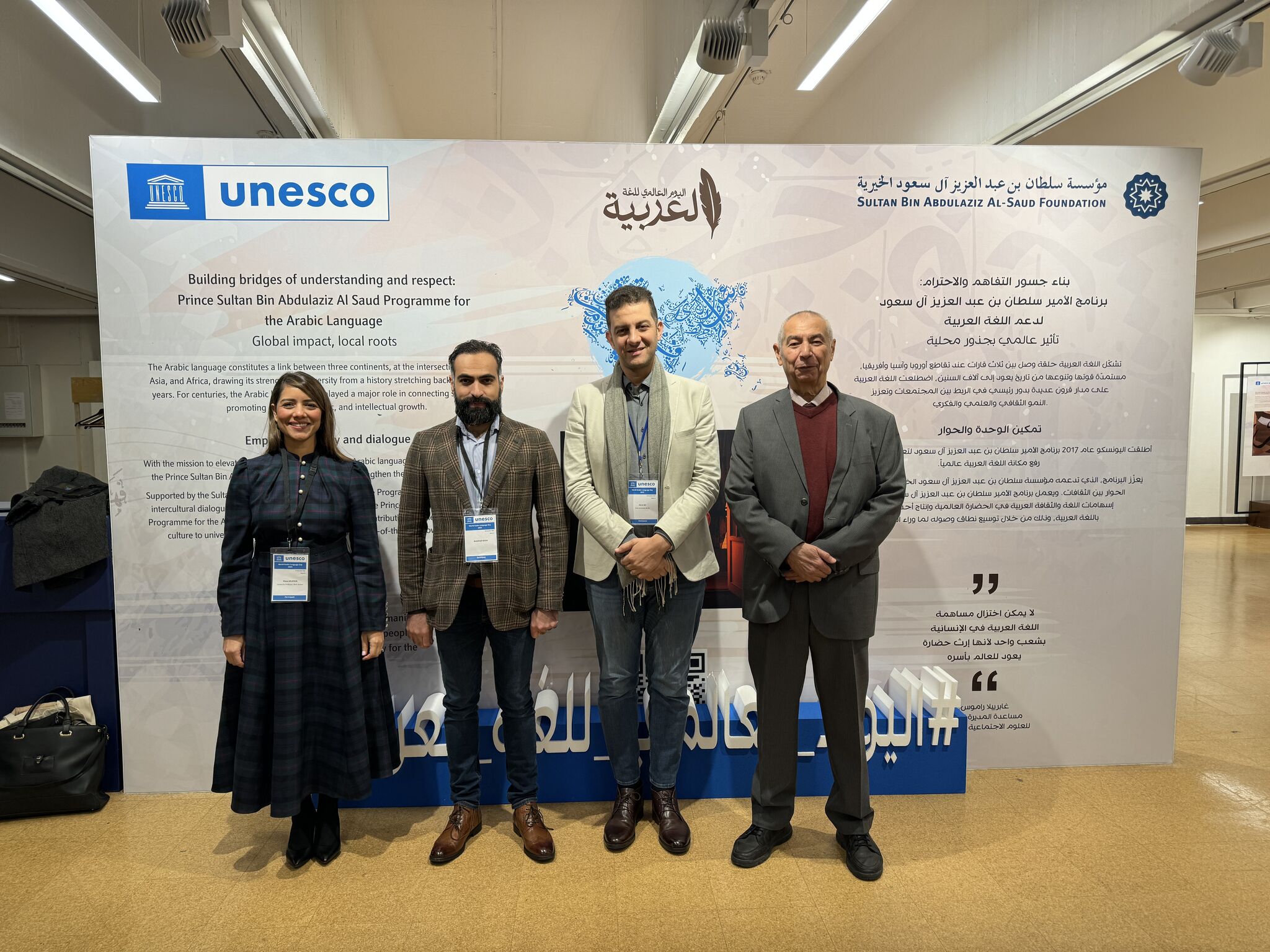
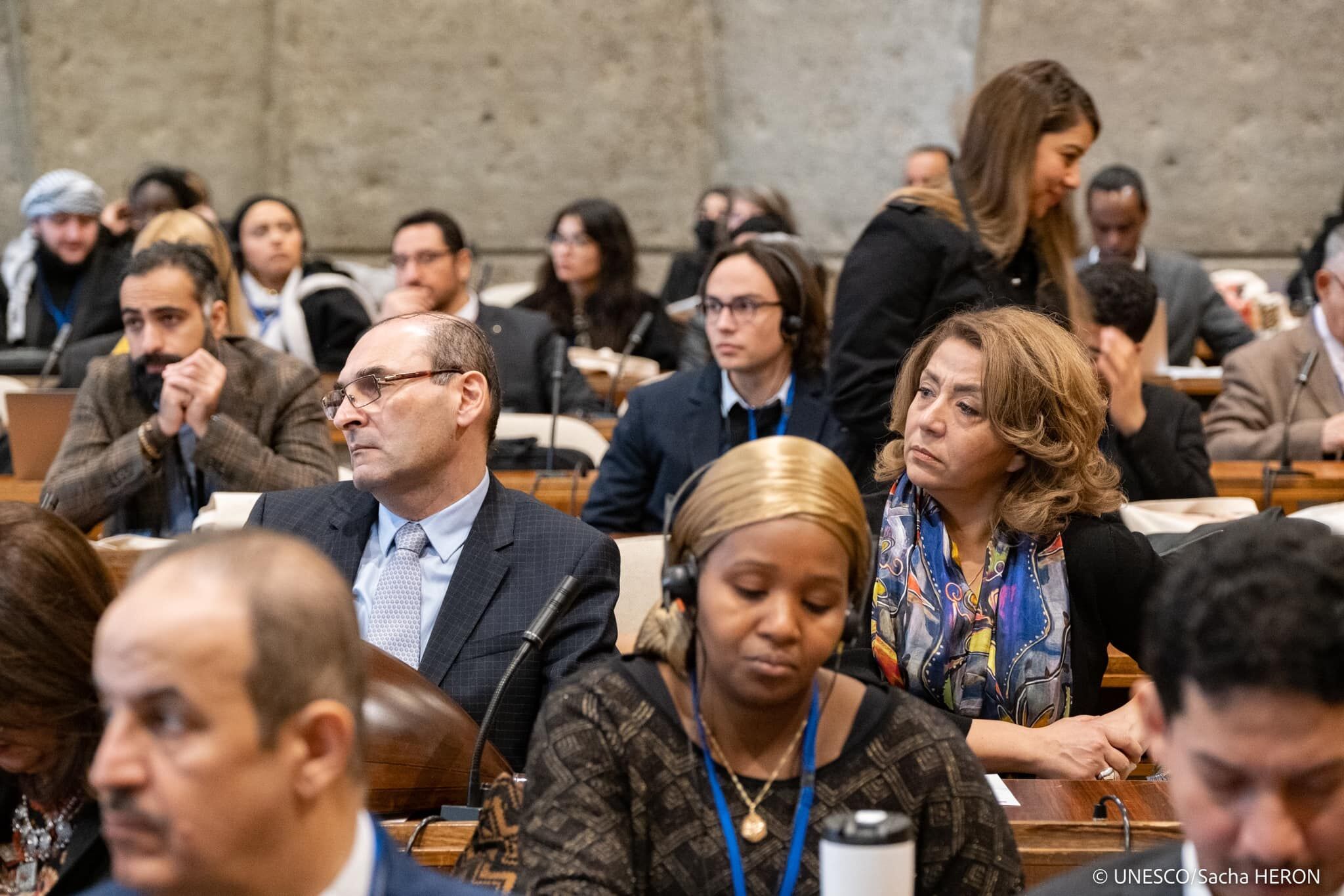
It was an honour to present my research findings at the UNESCO headquarters in Paris on Arabic language preservation initiatives among the diaspora in Germany for World Arabic Language Day on 18 December 2023. Also, my colleagues Abdalhadi Alijla presented on the diaspora in Sweden, and Nada Yafi on the diaspora in France. There will be a publication of our papers in the next two to three months.
Berlin-Cairo Express – Two Cosmopolitan Centres of the Early 20th Century in Exchange – Mittwoch, 29. November 2023, Akademiegebäude am Gendarmenmarkt, Einstein-Saal, Jägerstrasse 22/23, 101117 Berlin
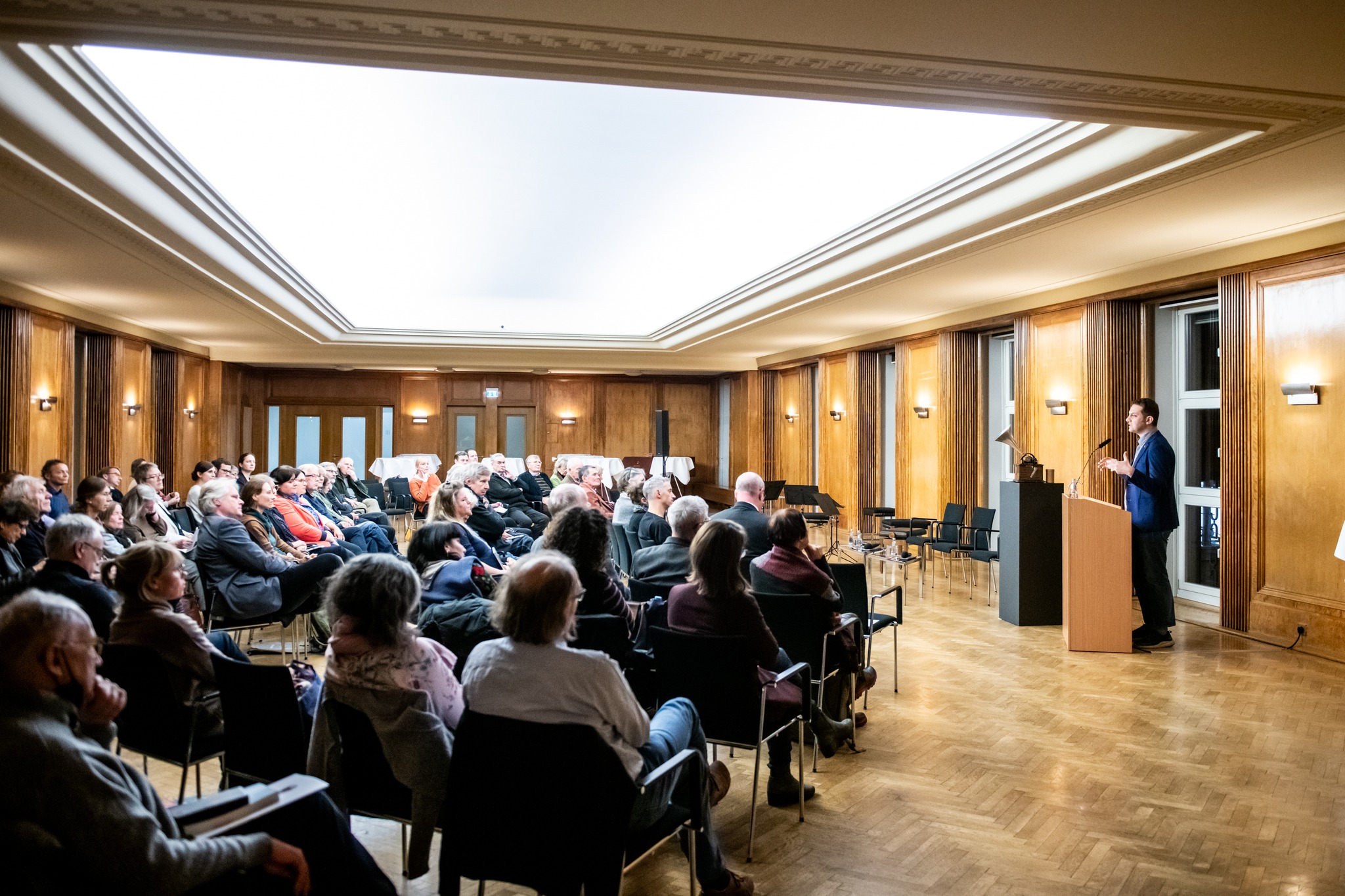
Opening the “Berlin-Cairo Express” event at the Berlin-Brandenburg Academy of Sciences that explored the vibrant musical and intellectual exchanges between the two cities in the early 20th century. Thank you to the Arab-German Young Academy of Sciences and Humanities for the invitation and honour to open and participate in the event.
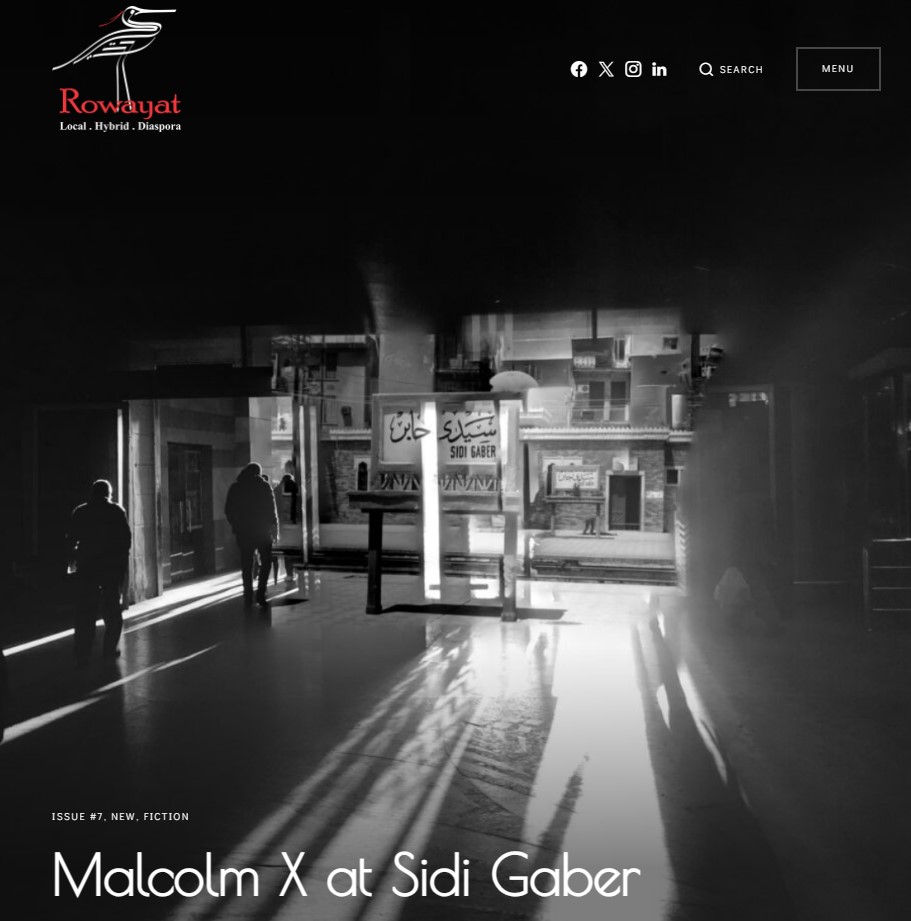
Published in the Rowayat Literary Journal, Issue #7.
My death feels imminent, but the feeling recedes when I’m distant from the American scene that daily threatens me. Being in Egypt gives me time to see myself in the mirror a little while longer, Malcolm X wrote in his diary, In America, I might be a radical black Muslim preacher, but who am I in this country? He closed the diary and rested his head against the window of the train that was well on its way from Cairo to Alexandria. The palm trees, farmers, and villages of the Nile Delta passed by in a blur. But it was the distant sky that gripped Malcolm’s attention. The horizon dissolved beneath the weight of the summer haze, its contours lost to the unknown, the future uncertain.
“Sir, can I get you anything?”
Malcolm turned to the server in a blue coat and saw a younger version of himself in the man’s bronze complexion. He recalled his time working as a train server on the Boston-New York railway line. He looked at the name tag, and though he knew a bit of Arabic, shied away from saying the name aloud for fear of mispronouncing it. The server smiled; Malcolm smiled back. “I will have a coffee with cream.”
“Your interview for al-Ahram newspaper came out,” said Amir, a young Egyptian diplomat who, along with his wife Laila, was accompanying Malcolm on his trip.
“I really didn’t want to do this interview. But anyway, it’s done. Alhamdulillah”
“You say Alhamdulillah more times in an hour than an Azhari imam in a day,” Laila said with a laugh.
“I don’t think we can put a cap on gratitude to the creator,” Malcolm said eliciting a slow nod from Laila.
“They didn’t use your new name,” Amir said.
“I think el-Hajj Malik el-Shabazz will take a while for people to get used to.”
“So, you’re not going to be as zealous as Muhammad Ali Clay about the name change? Which, by the way, they’ve reused the photo of you grinning alongside him,” Amir said.
They both laughed as Amir passed him the paper.
“Even I still slip up and say Cassius Clay. Our names never really leave us,” Malcolm said.
“What’s in a name?” Laila asked, putting down the novel she was reading.
Malcolm’s face lit up, and after a long pause, said, “The first time I came across that question was in prison when I read Shakespeare’s Romeo and Juliet: ‘What’s in a name? That which we call a rose by any other name would smell just as sweet.’ I immediately knew that to be a blatant falsehood.”
“How so?” Laila asked.
“Our names give us our scent. Malcolm X is still very much a part of me; the reason I was once X still exists within me.”
“I disagree. You can call Egypt, the United Arab Republic, or the UAR, but that doesn’t make it any less Egypt,” she said.
“A name is a frame of mind, a worldview, a philosophy even. Change the name, and you set the tone for a different journey.”
“Well, I don’t think Egyptology is going to become UAR-ology anytime soon” Amir joked.
“As for the photo, I understand that papers need to sell. My Arabic still isn’t good enough, so I’ll have to ask you what the key points of the interview are?”
“Basically, you are all praise for Cairo, Egypt, President Nasser, Africa, liberation struggles, the Third World, more Nasser.” Amir said with a smile.
“I’m sure I was more nuanced than that.”
“It was a good interview. It will go down well with the government.”
The server brought coffee, without the cream, for Malcolm and black tea for Amir and Laila. Before Malcolm could take a sip, Amir continued, “Oh Malcolm, I forgot to tell you; you are giving the keynote speech in Alexandria tonight to an audience of youth from around the Muslim world. The Abu Bakr Siddiq camp that gathers over 600 participants annually, and you…”
“Wait, wait. This is quite sudden; I was never informed of a speech. I’m not prepared.”
“You’ll be fine, Mr. Malcolm,” Laila said, “You’ve given hundreds of speeches before. It’s naseeb.”
Malcolm tried to politely argue that he was not in the right mindset to give a speech, but not wanting to offend his hosts, he eventually gave in.
He jotted down in his diary, Have to prepare a speech tonight for an audience of Muslim youth in Alexandria. Nobody informed me. I don’t know why Arabs keep abusing the word naseeb (fate). August 2, 1964.
“What are you reading if you don’t mind my asking?” Malcolm asked Laila, trying to distract himself from the upcoming event.
“It’s a novel by an Egyptian writer called Naguib Mahfouz. It came out a few years ago. It’s called Sugar Street. Funnily enough, there is a phrase here that reminds me of you where the character asks himself ‘Could you be a model teacher, an exemplary husband, and a lifelong revolutionary?’”
Malcolm laughed. “They all sound somewhat contradictory. I’m not sure I’m a model teacher. I used to think I was when I was in the Nation of Islam. As a husband, I’ve barely seen my family all year, but I’d like to think I’m a lifelong revolutionary, and maybe that’s my Achilles heel.”
“You’re being harsh on yourself. In this novel, Mahfouz tries to argue—”
“He’s a blasphemer,” Amir interrupted, “I don’t know why you bother with his ridiculous tales.”
“You are being unfair,” said Laila “How about you read just one of his books, or better still, just leave judgment to God?”
“I have better things to do than read this rubbish, habibti.”
In the silence that ensued, Malcolm turned back to his notebook and started to jot down his thoughts for the presentation.
“My assistant Omar will be waiting for you at Sidi Gaber station, Malcolm, the first station in Alexandria,” Amir said, “Laila and I will continue to Misr Station, the end of the line.”
***
The train came to a halt at Sidi Gaber and Malcolm took his bag and walked out onto the platform.
Omar recognized him, “Assalamu ‘allaikum, Mr. Malcolm X. Welcome to Alexandria.”
“Thank you, it is quite humid. It feels like Miami.”
“Well, it’s August. We also have a district here called Miami, by the way, so if you are homesick, I can take you there.”
Malcolm laughed and noted this was his third visit to Alexandria that year.
A puzzled Omar said, “I don’t understand why I was sent to pick you up from here. The Cecil Hotel where you will be staying is closer to the final station. In any case, my car is here.”
“Omar, brother, can I ask you a favour,” Malcolm said, “I don’t have time to refresh or check in, can you take me to a nice coffeehouse where I can organize my notes for a presentation I’m supposed to give in a few hours.”
“I know just the place,” Omar said, “I’ll drop you off and take your luggage to the hotel while you work.”
As they left the station, a throng of people surrounded Malcolm and asked him to autograph the day’s newspaper, the one where he was pictured with Muhammad Ali, but all the questions were about the boxer, not him.
Omar apologized, “I’m sorry that they only know you through Muhammad Ali Clay.”
Malcolm smiled, “It’s fine; I get this often.”
Omar pulled one of the loudest fans aside, “If you knew who he was, you would be asking better questions.”
They eventually got into the car and drove along the coastal road. Malcolm stared at the Mediterranean until they arrived in the downtown area of Mansheya.
As they walked to the coffeehouse, Malcolm asked, “Why do people in this country say Muhammad Ali Clay? Why merge his old and new names?”
Omar laughed and pointed Malcolm in the direction of a statue in the center of the square. “You see that over there, that man on a horse? That’s Muhammad Ali, the founder of modern Egypt. That’s probably why, to distinguish him from Clay, and also from what is a very common name in this part of the world.”
Malcolm took out his camera and took a snap of the square with the statue in the background.
“You want to see how common? Muhammad!’ Omar shouted. Five or so people within a 20-metre radius turned to look in his direction. “You, see? It’s a blessed name, but it needs a qualifier if you are to stand out in a Muslim country.”
They walked into the Aly el-Hindy coffeehouse with its gracefully decaying late 19th-century architecture. Malcolm was entranced, staring up at the glass dome which seemed to rise all the way to the heavens. “This was a hideout during the Second World War,” Omar said. “Intellectuals like to sit here, and President Nasser himself visits from time to time.”
Malcolm sat down, unable to tear his eyes from the dome.
“Do you see an angel or something, Mr. Malcolm?”
“Not at all, just admiring the view.”
Omar started to leave but suddenly stopped. He walked up to a man a few tables away and spoke a few words, shaking hands eagerly before turning back to Malcolm.
“Mr. Malcolm X, can you please come with me? I want to introduce you to one of Egypt’s most notable novelists.”
Malcolm, keen to work on his speech, was in no mood to meet anyone, but he was nevertheless intrigued.
The gentleman slowly got up as Omar and Malcolm approached his table.
“Mr. Malcolm X, I would like to introduce you to Mr. Naguib Mahfouz, Egypt’s greatest novelist. It’s truly an honour to see him here in Alexandria.”
“You are too kind, son,” said Mahfouz, “Mr. Malcolm, welcome to Egypt. As we say, nawart Masr, you have lit up Egypt. I read your interview on the train from Cairo. It was an interesting piece.”
“Thank you, sir. Whenever a man says ‘interesting,’ I take that as an ambiguous sign.”
“Not at all,” Mahfouz laughed, “Perhaps I have more questions, but I enjoyed it. Please take a seat.”
Omar excused himself and informed Malcolm that he would pick him up at 7.30pm.
“I want to apologize. I had vaguely heard of you before, but only got to know you better when I read the interview.”
“That’s perfectly fine. No apology is needed. Likewise, I hope you forgive me for not knowing one of Egypt’s greatest novelists until this morning.”
“There is no need for all these formalities,” Mahfouz said, brushing off the compliment, “The first thing that surprised me is that you speak of black oppression in your interview when you are quite light for a black man. You look like half the people in this coffeehouse.”
The relative lightness of Malcolm’s skin had always been a delicate subject for him. He replied politely, “America is a strange place, in every sense of the word.”
Mahfouz opened his mouth to say something, but just then a waitress came to take their orders.
“This is odd, I’ve been coming to this coffeehouse for many years,” Mahfouz said, “and this is the first time I see a young woman working here. What is your name?”
“Zohra,” she replied.
“Nice to meet you, Zohra. I will have another tea, and my friend will have a…?”
“Black coffee with cream.”
“Black coffee with cream?” said Mahfouz, “This is not the Nile Hilton.” He waved to Zohra to just bring plain black coffee. Malcolm saw him write “Zohra” in his notepad and circle it several times.
“She’s probably from a village in the Nile Delta,” said Mahfouz. “They leave their homes to earn a living in the city. When I look at a young fellaha like her, I see the weight of all that is wrong with Egypt on her shoulders.”
Five minutes later, Zohra returned and placed the coffee and tea on the table but left before they had a chance to ask her any more questions.
“What does her name mean?” Malcolm asked.
“It means ‘blossom,’ but like Egypt, she is anything but blossoming.”
“I see. If I understand correctly, you are from Cairo,” Malcolm said, “What brings you to this city?”
Mahfouz dropped three spoons of sugar in his tea and leaned back on the wooden chair, “I’m working on a novella set here in Alexandria. It is my first piece set primarily outside Cairo. I came here for inspiration.”
“What is it about?” Malcolm asked.
“It’s still in its early stages, but it revolves around a Greek woman running a boarding house with different Egyptian guests, each representing an element of the tragedy that is Egypt.”
Malcolm, realizing there was no point in avoiding Mahfouz’s gloom, decided to ask what he meant. “Tragedy? What tragedy? Is it because of the recent dissolution of the union with Syria? Perhaps the UAR didn’t succeed but that is not to say…”
“Do you think I care about that?” Mahfouz interrupted, “With all due respect to Syria and its wonderful people, look at the state of Egypt! If you cannot maintain the integrity of Egypt, then how can a union possibly succeed?”
Mahfouz looked around the room, lowered his voice, and pointed to the dusty black and white portrait of the president hanging on the wall. “Do you think every leader who touts anti-imperialism is automatically one of the good ones, Malcolm?”
“I don’t quite understand the question,” Malcolm replied.
“There are many writers and artists in jail here. All of them, I can assure you, are anti-imperialist and pan-African. They simply said something that was not in line with the regime.”
“Yet, you continue to write despite the odds you face. You could simply stop writing and change careers, but you don’t.”
“As someone who faces death threats, you don’t seem to be in a hurry to change careers either,” Mahfouz replied.
“Neither of us chose to live in this era. God put us here, and we are only responding to the trials of our time in the best way we can. With your free will and passion, you publish books and work on the next one…”
“Yes, yes, yes,” said Mahfouz, “even Nasser eagerly reads my work. Often favourably. He has intervened to prevent the censors from banning this book or that book. But arbitrariness is no ally of a writer. Pity the land where creativity is held hostage to the whims of the leader.”
“In some respects, it is no different from America,” said Malcolm.
“I disagree. Let me give you an example. A few weeks ago, security forces stopped me on a street in Cairo to ask what I meant by one of my novels—or I think it was a short story—that I wrote, and who was the intended target. I had to reassure them that it had nothing to do with the president or the regime. They let me go. Is James Baldwin harassed for his thoughts by your police on the streets of New York?”
“I have to stop you there!” Malcolm said, “James is a good friend, and I can speak with certainty when I say, he is harassed from many directions. There is a reason why he is in Istanbul these days.”
Slowly tracing circles on the table with the teaspoon, Mahfouz said, “Let me rephrase that. Try and find a James Baldwin in Egypt who writes the equivalent of The Fire Next Time that curses the establishment and let us see how long he remains at his typewriter.”
“Mr. Mahfouz, I’m not ignorant,” said Malcolm. “I know injustice when I come across it. I see the shoeshine boy sitting over there and wonder if he will survive to see tomorrow. But you need to understand something, I walk the streets here and have not been deprived of my rights or had my color questioned. This is radical for a black man from America.”
“Have you considered maybe you have the swagger of a foreigner, the protection of a Western passport, a colour that is not quite black? What about the charcoal suit that raises your stature, not to mention the traveller’s cheques dangling from your pocket that open doors? Your position as a prominent American Muslim that people would like to meet? Or that you brush shoulders with a rising boxing star? Or receive personal invitations from presidents? Did any of that occur to you, Mr. Malcolm, across your landscape of introspection?”
Malcolm was by now tired of Mahfouz’s cynicism. He politely stood up with the parting words, “It was a pleasure to meet you,” but Mahfouz placed his hand on Malcolm’s arm. “Please, sit down. I apologise if my words upset you. That was not my intention.” Malcolm reluctantly sat back down.
They sat in awkward silence for a few minutes before Malcolm finally said, “When Arabs visit New York, especially Manhattan, they are dazzled by the lights. They won’t set foot in Harlem, except occasionally some Sudanese visitors. I take my hat off to them. There are some Arab students enrolled at Columbia University, which is in Harlem, but the university pretends the black neighbourhood around it doesn’t exist. Arabs would barely have a clue if a race riot was happening a few blocks away, or if the prisons were filling up with Negroes. When an Arab tourist walks past a Negro, that man or at the very least someone he knows has definitely been subjected to police violence or been to jail, but I don’t expect them to know that, Mr. Mahfouz.”
Mahfouz looked like he was about to say something but just nodded his head.
“I don’t expect them to know, but I would hope that if they did get to know something of our struggle, they would show understanding at the very least. I must always assume they are well intentioned. I have taken up this attitude more so since my Hajj trip to Mecca a few months ago. I understand many things, but it does not mean I will speak of everything. Everything has its time and place.”
“The 1960s so far has been a decade of revolutions. I know in these times of upheaval, nuance will be lost. But we can’t afford to miss the train, we cannot let this global movement that breaks the shackles of the oppressor pass us by. We have no real allies in America, and we are still developing the language to describe our pain. But the burden is lighter when we share it with our brothers and sisters in Africa and Asia.” Malcolm paused and looked at Mahfouz, “Yes, my politics align with your leader, and yes, I do support him for the reasons I just said, but I never stop thinking about the shoeshine boy over there. So please try to see where I’m coming from.”
Mahfouz pulled out the newspaper with Malcolm’s interview. “Let me quote you, ‘I’m for justice, no matter who it is for or against, etc., etc. I’m for whoever and whatever benefits humanity as a whole.’ Unlike what is written here, in person, you admit you are not for justice for everyone.”
“You are putting words into my mouth,” said Malcolm.
“How about this line, ‘A man who stands for nothing will stand for anything.’”
“I’m glad you brought that one up,” said Malcolm, “let me reword that for this occasion. ‘A man who stands for everything will achieve nothing! We pick our battles. The pen, pulpit, and pistol are different paths towards justice. Not every cause has to be theatrical.” He paused again, “It’s like you’re making a concerted effort to misunderstand me, Mr. Mahfouz. From what I gathered this morning from a heated exchange between my colleagues, you are a man who is misunderstood across Egypt.”
Mahfouz leaned back on his chair and paused for a moment. “Yes, yes. It is true. I know the feeling of being misunderstood very well. I’m tarnished with the false claim that I am somehow against God and religion. Nothing could be further from the truth.”
“Certain minds cannot distinguish between fiction and reality. Allegories are a struggle for the man who treats life literally. One unacceptable book is enough to condemn all your works, let alone condemn you in perpetuity.” Mahfouz paused, “I sometimes wish justice could be clearer, just a little bit closer to perfect. But if that were so, then the world would not need artists, novelists, and preachers.”
“Leave the perfection to the afterlife and let’s sort out the mess on this earth while we are still breathing,” said Malcolm.
“I have to admire you converts,” said Mahfouz, “You see something deeper in the faith that we have long taken for granted or chosen to ignore.”
“What can I say but alhamdulillah,” Malcolm said simply.
***
It was 4pm and the coffeehouse was stuffy, but neither man wanted to end the conversation.
“How about a stroll on the boardwalk?”
“What is a ‘boardwalk’?” asked Mahfouz.
“Umm, the sidewalk, the cemented or paved sidewalk along the sea.”
“Ah, the corniche!” Mahfouz laughed, “My American English is lacking, but I’m glad to see you have taken up the Alexandrian tradition of walking along the corniche.”
“I’ve taken long walks on previous visits. It helps clear my thoughts.” Malcolm said as he stood up to stretch.
“Won’t you finish your coffee first?”
“I’ll finish it when we return.”
The six foot two Malcolm and the five foot four Mahfouz made an odd sight as they crossed the gardens and the road and stepped onto the corniche. They walked side by side, their gaze on the water, a strong wind – unusual for August – pushing against their faces. It was a full fifteen minutes before either of them broke the meditative silence.
Mahfouz was the first to speak, “Let me ask you, did you get off the train at Sidi Gaber or Misr Station?”
“Sidi Gaber.”
“You know, I started thinking about death when I turned 40. I recently turned 50, and now I’m obsessed with the idea. Egypt can do that to you.”
“I turn 40 next year, and I’ve been dancing with death since my childhood,” said Malcolm.
“I always say there are two stations in life, Sidi Gaber and Misr Station. When you pass by Sidi Gaber, it reminds you to get your bags ready to disembark at Misr Station. The end of life.”
“You can say I’m perpetually at Sidi Gaber, but my Misr Station might just be in Harlem.”
“We are all at Sidi Gaber station, Malcolm. The angel of death awaits at the final station.”
“Only Allah knows when we will see our last summer.”
“It surprises me that you do not write. You should consider it. Even your nemesis Martin Luther King has penned a few books.”
“He is not my nemesis. It’s a story that just won’t die out. We met a few months ago in Washington, shook hands in front of the cameras. I don’t know what more needs to be done to kill that false image.”
“Well, you get my point.”
“I’m not a writer of books, but I do write essays from time to time, although technically, I’m close to finishing a book. I’m in the final stages of transcribing my autobiography. It should be ready for publication by next year. I will send you a copy. That’s if I live long enough to see it.”
“Malcolm, if you feel your life may be under threat, why don’t you stay in Egypt. I think President Nasser would be happy to host you.”
“A few other African heads of state have also made that offer. It was kind of them, but I declined.”
“You should bring your family and move to Cairo. After all, you are all praise for Cairo and Nasser in your interview.”
“Mr. Mahfouz, with all due respect,” Malcolm took a moment to gather his thoughts then resumed, “could you live in Alexandria?”
“Alexandria is a refuge for my soul. But no, Cairo is home.”
Malcolm smirked. “You cannot consider an enchanting city like Alexandria your abode? A city which is only a four-hour train ride away from Cairo, and yet, and yet, sir, you expect me to leap over the Atlantic and make a home here?”
“But when the price of your home is death?”
“To stop or flee from my calling, my life’s work would be a greater death. Right now, I have to balance the cause with staying alive long enough to see my daughters grow up.”
“Inshallah you will. What are their names?” asked Mahfouz.
“Attallah, Qubilah, Ilyasah, and last month, Gamilah Lumumba was born.”
“Alf mabrouk, a thousand congratulations. You named her after the late Congolese rebel leader?”
“Everything in my life comes as a surprise to you.”
“It is not that. Have you lived through a real revolution, Malcolm?”
“Let me guess, you will say because I wasn’t part of something like Egypt’s 1952 revolution, I don’t have credibility?”
“Don’t assume too much. 1952 was not a real revolution; that was a coup.”
“What are your children called?” asked Malcolm.
“Fatima and Um Kalthoum.”
“Um Kalthoum? You named her after the singer I hear everywhere in coffeehouses in the Arab world?”
“How would you know that?”
“Either way, it doesn’t matter. You named her as such because it meant something to you.”
They eventually stopped in the Camp Shizar area of the corniche to purchase termes, lupini beans, from a cart to snack on. Malcolm then saw an ice-cream cart and requested the biggest scoop possible.
“You don’t strike me as an ice-cream person at all” said Mahfouz who was baffled by the sight of the solemn and austere Malcolm attacking his ice-cream cone with childlike delight.
“In America, my friends find it ironic that I prefer vanilla over chocolate ice-cream,” Malcolm said.
Mahfouz chuckled which led Malcolm to burst into laughter almost making a mess of what was left of the ice-cream. After their laughs subsided, Malcolm realized he needed to return to the coffeehouse for Omar to pick him up. They headed back but underestimated how far they had walked. A few metres from the coffeehouse, Malcolm saw an anxious Omar pacing up and down.
“Mr. Malcolm, we only have 20 minutes!” said Omar.
Malcolm turned to Mahfouz, “I apologise Mr. Mahfouz, I have to go; can we meet tomorrow?”
“I have some errands to run in the morning and will catch the 2:15 train back to Cairo. Perhaps we can meet just before then?”
“In that case, I will board the same train. I must return to Cairo as well to catch my evening flight. It might be my last visit to Egypt for some time.” Malcolm said, his tone certain.
“Although Misr Station is closer, it is far too crowded. Let us meet at Sidi Gaber. Platform 4 at 2pm?”
“Inshallah,” Malcolm said, “I will also introduce you to my friends, one of whom is an admirer.”
As they walked away, Mahfouz shouted, “Ya Mr. Malcolm X! None of my novels have been translated into English yet, but I will bring you an Arabic one. When you master Arabic, you can read it someday. I will bring it tomorrow.”
Malcolm smiled and said, “Thank you, it will be first on my reading list after the Quran.”
A thought struck Malcolm as he walked away. He turned back. “Mr. Mahfouz. I have a final question. Can one be a model teacher, an exemplary husband, and a lifelong revolutionary?”
Mahfouz looked taken aback for a few seconds before laughing.
“But how did you know about that? Mesh momken. You do not cease to amaze me. With regards to the question, I know it doesn’t apply to me. Having said that…”
“Mr. Malcolm, we are late!!” interrupted Omar.
And with that, they ran to the car and sped off.
***
Malcolm arrived at the venue and saw Amir and Laila waiting for him together with some other delegates who crowded around him. Youth from Muslim nations spanning from Morocco to Indonesia greeted him enthusiastically, many conveying the regards of their countries’ leaders. One Algerian said, “President Ben Bella looks forward to meeting you.”
After the introduction by the moderator, Malcolm walked up to the podium with the few notes he had written on the train.
“Assalamu Allaikum, peace be upon you… I want to say…” Malcolm paused and looked out over the throng of expectant faces. “I’m honoured to be the key speaker to open…I’m, umm, it is a pleasure to be here…I’m happy…umm…your anthem song shook me. I…” He looked up at the ceiling, the hours of conversation with Mahfouz still replaying in his head.
The puzzled crowd moved restlessly. Malcolm took a deep breath and continued.
“Many years I spoke in the name of a man who lied and swindled the masses.” He soon found his voice again. “The Nation of Islam movement offered me hope and reform, but it was in some sense a cult of personality, a distorted Islam; it eases my heart to know that I left it and came to practice the same faith practiced by many of you here. Brothers and sisters, I’m here to tell you…” Malcolm saw a list of kings and presidents that he wanted to praise on his notepad. He took out his pen, crossed out their names, and rested the pen on the lectern. The tempo changed.
“In my spiritual journey, I learned that Allah has 99 names. I will be honest and tell you now that I cannot recall all of them, but it suffices that truth and justice are two of them. I speak in the name of no leader who walks this planet. Truth and justice know no era or leader.”
Amir turned to Laila, “I hope they don’t broadcast this. How does one start a speech without invoking the president of the republic?”
“They won’t broadcast it if it will ruffle feathers,” Laila said.
“Arbitrariness is no ally of the writer, nor is arbitrariness an ally of the thinker and doer, may we all have a safe and secure life with healed hearts answerable to no one but the Divine,” said Malcolm, his voice rising.
The speech went on for 30 or so intense minutes, and when it came to an end, the crowd erupted in a mix of applause and Islamic chants, liberation slogans, and shouts of solidarity for the Afro-American struggle in an intoxicating atmosphere of Third World solidarity that went on for a few minutes. As Malcolm stepped down, many delegates surrounded him, taking photographs and asking for autographs. The youthful energy drawn from countries breaking out of colonialism gave Malcolm a peculiar elation that he had not felt in a long time.
Omar approached Malcolm “I didn’t know where you were going with this, but I can’t fault any of it.”
“This was more uplifting than all the Organization of African Unity summits and diplomatic meetings,” Malcolm said, “A far cry from having to deal with a room full of carefully worded communiques from African leaders. The voices of the youth were unchecked, raw, zealous, revolutionary. It was the closest I have come to pure love.”
“You know, there is an old Arab proverb that says, ‘The word of the tongue roams in the ears, but the word of the heart remains in the heart.’ Insincere words will be forgotten, yet your words driven by genuine emotion have built castles in their hearts,” said Omar.
“Alhamdulillah” said Malcolm, “in Mecca, I was spiritually reborn. In Cairo, I was internationally reborn, and tonight in Alexandria, something special in me was reborn and I have yet to give it a name or a shape.”
After dinner was served and conversation exhausted, they discussed the arrangements for the following day. Malcolm requested to leave Alexandria on the 2.15pm train from Sidi Gaber. Omar said, “We will pick you up from the hotel at 12.30pm. We can have a quick seafood lunch before we leave.”
***
Malcolm paced up and down the hotel lobby. It was 1.20pm. “Arab time!!” he mumbled to himself in exasperation.
The car showed up at 1.50pm. Omar apologised. It had taken him a while to buy the train tickets. They agreed to skip the seafood restaurant and just order lunch on the train.
Meanwhile, Mahfouz arrived at Sidi Gaber at 2pm and waited for Malcolm on the platform. The train arrived on time, and Mahfouz boarded, checking his seat number: carriage 4, seat 37.
Malcolm finally arrived five minutes late and hopped onto the train just as it was about to move.
Amir passed Malcolm his ticket. Carriage 4, seat 32. Malcolm and Mahfouz were a mere four rows apart.
“Omar tells me you spoke at length with Mahfouz. How did it go?”
“I never got to finish my coffee with him. He is a complex man.”
Laila was curious but stayed quiet. She didn’t want another argument with Amir.
The journey was a bizarre series of misses. At one point, Mahfouz turned to look down the carriage aisle but only saw Amir in his line of sight. When Malcolm went to the bathroom, Mahfouz was asleep with a newspaper covering his face. Malcolm walked the length of the train and at one point imagined the blurry reflection of Mahfouz’s face in the window, but it was just another government bureaucrat in first class.
The journey continued without either realizing the other was on board, let alone a few seats away.
“Maybe he boarded an earlier or later train,” Laila said, who had been hoping to meet Mahfouz.
“Maybe,” Malcolm replied. He was upset; he hated to break promises.
The train came to a halt at Cairo’s Ramses Station. Mahfouz got up from his seat and briskly left the train. Amir woke up Malcolm, who stood up and grabbed his bag and suitcase from the overhead shelf. On his way to the exit, he noticed a book stuffed in a copy of the day’s newspaper abandoned on one of the seats. He took it and went to the conductor.
“Someone forgot this book?”
The conductor looked at it. “Oh, a book by Mahfouz, actually he was just…”
Malcolm realized what had happened. He snatched the book from the conductor’s hand and bolted onto the platform scanning the faces of the passengers. He pushed through the crowd straining to find Mahfouz. When he finally came to a stop, an agitated Amir asked him, “Why are you running? What is wrong?”
“He was on the train.”
“Who?”
“He was in the same carriage.”
“Who are you talking about?”
“Him!” Malcolm waved the book in his hand. Amir finally understood and shrugged as if to say, so what?
Malcolm opened the book. Inside, on the first page, there was a note in neat English handwriting.
Dear Malcolm,
I was hoping to catch you on the train but naseeb would not allow. I guess you made other arrangements. That is ok. I hope that life will be kinder upon your return home.
I will hold onto this book and give it to you when you return. I hope you make it back next summer Inshallah, or even earlier. Alexandria is a magical place in winter. If you cannot for whatever reason return to Egypt, then I hope and pray that your work shines and outlasts you.
I had meant to tell you, that you are the model teacher, an exemplary husband, and a lifelong revolutionary. You are all three and more. Had I known you a decade ago, you would have been the inspiration for a worthy character in that novel.
Masalaama,
N. Mahfouz, August 3, 1964
Laila looked at the book title. “He gave you The Thief and the Dogs. It might make you lose faith in revolutions. It’s a good thing you can’t read Arabic for now.”
***
Mahfouz got into a taxi, “Khan el Khalili,” he said.
“Mr. Naguib Mahfouz! What beautiful naseeb! I will take you to the moon and back” said the excited driver with typical Egyptian flattery.
The driver dialled through several radio stations, before settling on the national news. The announcer stated, “Last night in Alexandria, the black American Muslim Malcolm X delivered a speech to a large audience of…”
“Turn up the volume, son!” Mahfouz said.
The announcer played three minutes of the key moments in Malcolm’s speech, followed by a summary in Arabic.
“Impressive it was not censored,” Mahfouz said.
“Do you know the speaker?”
“Yes, we met yesterday in Alexandria. He is a political activist and a friend of Muhammad Ali Clay.”
The driver went wide eyed “Tell me more!”
“I will just say that he is a man I learned a lot from, and maybe he learned something from me.”
“His voice sounds familiar,” the driver said. “I think he might be the man I met yesterday on my train shift. I work the snack trolley there two days a week. He looked worn down, austere He wasn’t like the other black American visitors who are usually jovial. I imagined myself like him one day, in a nice suit, worldly, a traveller, cosmopolitan. I really wanted to talk to him, but I was too embarrassed. I smiled, and he smiled back, but he didn’t even finish the coffee I brought him.”
“Many coffees go unfinished,” Mahfouz said.
“I know, it’s just that I really went out of my way to make him a good coffee, minus his strange request for cream in it.”
A warm grin spread across Mahfouz’s face.
“What’s your name son?”
“Sarhan”
“A nice name.”
Sarhan smiled.
“I have something for you, Sarhan.” Mahfouz reached into his bag for the copy of the book he had brought for Malcolm and realised it wasn’t there. “I apologise, the novel I would have given you … I must have left it on the train.”
“It’s ok, Mr. Mahfouz. It was naseeb for someone else to pick it up, just like it was naseeb for me to pick you up. I can always buy the book, but I can’t always drive the distinguished author behind the book.”
Mahfouz smiled and said, “Shukran.” He leaned his face against the window, his gaze falling on a group of shoeshine boys exchanging jokes and sharing a laugh before parting ways to tout for customers with their boxes slung over their shoulders.
***
In the taxi on the way to the airport, Malcolm looked out at the dusty sky but his thoughts kept shifting back to Mahfouz. He smiled to himself and added a line at the end of Mahfouz’s note, “Shukran. And above all else, Alhamdulillah.”
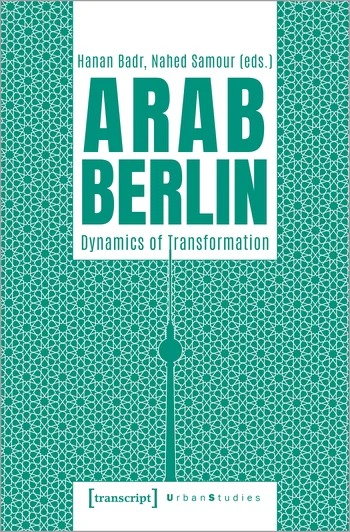
Amro Ali, “On the Need to Shape the Arab Exile Body in Berlin” in Arab Berlin: Dynamics of Transformation, Eds. Hanan Badr and Nahed Samour (Berlin: Transcript Urban Studies, 2023)
Abstract: Berlin is increasingly emerging as a hub of Arab intellectual life in Europe. In this first study of Arab culture to zoom in on the thriving metropolis, the contributors shed light on the dynamics of transformation with Arabs as agents, subjects, and objects of change in the spheres of politics, society and history, gender, demographics and migration, media and culture, and education and research. The kaleidoscopic character of the collection, embracing academic articles, essays, interviews and photos, reflects critical encounters in Berlin. It brings together authors from inter- and multidisciplinary fields and backgrounds and invites the readers into a much-needed conversation on contemporary transformations.